Key takeaways
- AI incident management software covers four different jobs: grouping alerts into incidents, explaining the cause, taking actions, and helping you build the setup. Few platforms do all four, and most sell the AI by tier or as an add-on. Compare the price that includes the AI you plan to use.
- AlertOps, our incident orchestration platform, Enterprise ($28 per user per month billed annually) includes OpsIQ™ and Ada. OpsIQ cuts alert noise by roughly 68% (AlertOps platform data), and its Smart Correlation Engine groups related alerts into one incident in real time.
- To prioritize critical outages, let AI shrink the pile and let a priority policy decide who gets paged. Correlation turns dozens of alerts into one incident, and escalation rules then carry the priority to the right people on the right channel.
- Each of the other seven has a natural buyer: PagerDuty for large engineering orgs that buy AIOps as an add-on, xMatters for Everbridge and ServiceNow shops, Rootly and incident.io for Slack-centric engineering teams, Jira Service Management for Jira shops, Grafana Cloud IRM for teams already on Grafana, and Datadog Incident Response for teams already standardized on Datadog.
Uptime Institute’s 2026 outage analysis found that 57% of respondents put the cost of their most recent major outage above $100,000, and one in five put it above $1 million (self-reported; Uptime Institute, 2026). That is the bill this category gets sold against, and nearly every vendor now puts AI on the pricing page, even though the label covers anything from a summary written after the fact to an agent that investigates while the incident is still open.
For enterprises with many teams, whether IT, DevOps, SRE, NOC or MSP, AlertOps is the strongest fit when on-call, alert correlation and an AI agent need to sit in one plan. AlertOps leads the list for that reason, and PagerDuty, Rootly, incident.io and the others each suit a different buyer, shown below. The comparisons are written from each vendor’s own pricing and release pages as read on October 30, 2026.
Top AI-powered incident management platforms at a glance
List prices below are per user per month as published on each vendor’s page. On-call and AI cost extra on some of them, which the next sections spell out.
| # | Platform | Best for | Where the AI sits | List price to start |
|---|---|---|---|---|
| 1 | AlertOps | Enterprises with many teams (IT, DevOps, SRE, NOC, MSP) that want on-call, phone-first response, correlation and an AI agent in one plan | OpsIQ (correlation, reasoning agents, postmortems) and Ada, included in Enterprise | Free for 5 users, paid from $8 billed annually, Enterprise with OpsIQ $28 |
| 2 | PagerDuty | Large engineering orgs that want event-based AIOps and will buy add-ons | AIOps and Advance, sold separately on Professional, plus SRE Agent | Professional $21 billed annually |
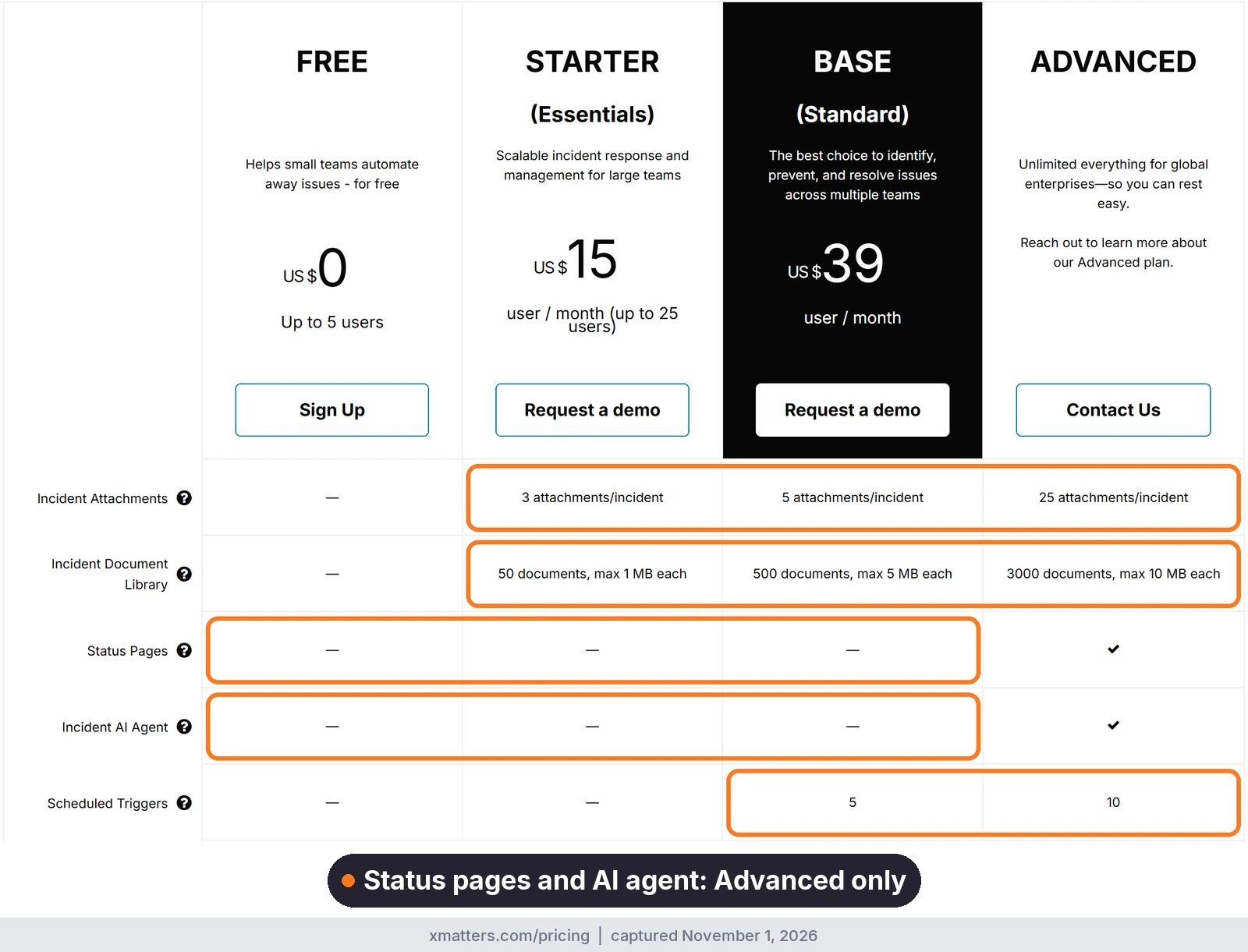
| 3 | xMatters (Everbridge) | Everbridge and ServiceNow shops that want notification depth | Root cause detection on all tiers, Incident AI Agent on Advanced only | Starter $15 (up to 25 users), Base $39 |
| 4 | Rootly | Slack-centric engineering teams | Scribe and retrospectives with Incident Response, alert grouping with On-Call, AI SRE separate | Incident Response $20, or $40 with On-Call |
| 5 | incident.io | Product-engineering teams that live in Slack | Investigations and the agent on higher tiers | Team $15 billed annually, Pro $25 |
| 6 | Jira Service Management | Teams already on Jira | Rovo AI, metered in credits | Per agent inside the Service Collection, confirm on Atlassian’s page |
| 7 | Grafana Cloud IRM | Teams already running Grafana | IRM updates for shared context between people and AI agents, Grafana Assistant priced separately | Pro from $20 per active user plus $19 per month platform fee |
| 8 | Datadog Incident Response | Teams already standardized on Datadog | Bits AI for Slack and AI postmortems in the feature matrix, Bits Investigation sold separately by AI credit | On-Call $20, Incident Management $30, Incident Response bundle $40, per seat billed annually |
What the AI does, and which job you are buying
Vendors use “AI” for four jobs with little in common. Decide which one is causing you pain today.
Grouping alerts into incidents
Grouping pays off fastest because the pain is simple arithmetic: every alert fired by the same failure is one more thing to acknowledge before anyone starts fixing it.
AlertOps groups with the Smart Correlation Engine, which applies similarity modeling, NLP and customizable thresholds to related alerts in real time. PagerDuty’s AIOps handles event grouping and noise reduction, and Rootly includes alert grouping with its On-Call product.
Explaining the cause
Root cause tooling reads the incident and proposes where to look. xMatters includes root cause detection and change correlation on every tier, incident.io has Investigations (generally available since August 2026), and Rootly’s AI SRE returns root cause with evidence. In AlertOps, Intellifield generates root cause and remediation steps as custom field intelligence, and Historical Alert Insights show how similar alerts were fixed before.
Taking actions
Agents that act are the newest layer, so ask what each one can change, who approves it and where the change is recorded. PagerDuty’s Spring 2026 release centered on an SRE Agent that works as a virtual responder, incident.io added bring-your-own skills and tools for its agent on October 28, 2026 with approval before changes, and Rootly’s AI SRE covers remediation and draft pull requests. Ada, the AI agent in AlertOps, answers questions such as who is on call and takes actions such as acknowledging alerts, arranging out-of-office cover or rerouting an escalation, each proposed first, made only on approval and limited to the permissions the person already has.
Helping you build and write it up
Most AI in incident management assists during an incident; Ada also helps you build. You describe an integration or workflow in plain English, Ada asks follow-up questions, shows the full setup for approval, then creates it. After the incident, Agent Chronicle writes the postmortem from the record, with up to 80% less prep time (AlertOps platform data), and Rootly’s retrospectives do a similar job inside Incident Response.
How on-call, AI and support are packaged
Three questions set the real price: is on-call extra, which tier carries the AI, and who answers when it breaks.
| # | Platform | On-call | AI | Support |
|---|---|---|---|---|
| 1 | AlertOps | Core to the platform, not a separate module | OpsIQ and Ada included in Enterprise | Enterprise adds a dedicated account manager and a 99.9% SLA |
| 2 | PagerDuty | Included in every plan | AIOps bought separately on Professional, included from the Starter platform plan up | Email and chat on Professional and up, community only on Free |
| 3 | xMatters | Included in every tier | Root cause detection on all tiers, similar-incident grouping on Base and up, Incident AI Agent on Advanced only | Starter phone and email 8×5, Base 24×7 |
| 4 | Rootly | Separate $20 product unless on Enterprise | Split across Incident Response, On-Call and AI SRE | Migration help and training on all plans, priority 24/7 on Enterprise |
| 5 | incident.io | Add-on on Team (+$10) and Pro (+$20), single-team on-call on Basic | Higher tiers, some add-on pricing | Email on Basic and Team, Slack channel and shared CSM on Pro, phone and 99.99% uptime SLA on Enterprise |
| 6 | Jira Service Management | Built into JSM, per Atlassian | Rovo, metered in credits | Confirm by plan in Atlassian’s terms |
| 7 | Grafana Cloud IRM | Part of IRM | Grafana Assistant priced separately, IRM gating not shown on the pricing page | Community on Free, 8×5 email on Pro |
| 8 | Datadog Incident Response | Standalone On-Call SKU, or included in the Incident Response bundle | Bits Investigation priced separately in AI credits ($500 per 500 credits per month, billed annually) | Terms sit in Datadog’s Support Plan Terms, not on the pricing page |
Here is the list price per user for on-call plus AI alert grouping: AlertOps Enterprise $28 billed annually ($34 monthly), xMatters Base $39, and Rootly’s Incident Response plus On-Call $40. incident.io’s Pro plus on-call is $45, with any Investigations add-on on top. Billing terms and discounts vary. Use these to compare structure, and ask each vendor for a quote at your responder count.
The limits behind the headline price
The price on a plan card is only the first number. Caps on AI, workflows and status pages sit in the feature tables, and the table below lists what each vendor’s public pricing page shows for them.
| # | Platform and plans | AI | Workflows | Status pages |
|---|---|---|---|---|
| 1 | AlertOps (Enterprise $28 per user per month billed annually) | OpsIQ AI Suite and Ada, included with AlertOps Enterprise | Workflows, included with AlertOps Enterprise | Status Hub, included with AlertOps Enterprise |
| 2 | PagerDuty (Free, Professional, Starter, Essential, Plus, Ultimate) | AI actions Starter 1,000, Essential 4,000, Plus 16,000, Ultimate 100,000; AIOps must be purchased on Professional | Incident Workflows: Free none, Professional 1, Starter and up included | External: Free none, Professional 250 subscribers |
| 3 | xMatters (Free, Starter, Base, Advanced) | Incident AI Agent on Advanced only | Flow Designer on all plans, no count shown; scheduled triggers Base 5, Advanced 10 | Advanced only |
| 4 | Rootly (Incident Response, On-Call, AI SRE, Enterprise) | AI SRE is a separate product at custom pricing | Basic on the standard products, Advanced on Enterprise | Incident Response: 1 external and 1 internal |
| 5 | incident.io (Basic, Team, Pro, Enterprise) | Investigations an add-on on Pro and Enterprise, no price shown | Basic 1, Team 3, Pro and Enterprise unlimited | Public pages 1 / 1 / 1 / unlimited on Enterprise |
| 6 | Jira Service Management (Free, Standard, Premium, Enterprise) | Rovo credits per user per month: Standard 250, Premium 700, Enterprise 1,500 | Automation steps per month: Free 1,250, Standard 3,000 per user, Premium 6,500, Enterprise 9,500 | Enterprise only |
| 7 | Grafana Cloud IRM (Free, Pro, Enterprise) | Free 3 AI users and 40M tokens per user; Pro $20 per AI user plus $2 per 1M extra tokens | See vendor pricing | See vendor pricing |
| 8 | Datadog Incident Response (On-Call, Incident Management, Incident Response bundle) | Bits AI for Slack and AI postmortems in the feature matrix; Bits Investigation $500 per 500 credits per month billed annually | See Datadog pricing | Status pages with custom domains listed on the product page |


AlertOps publishes per-user pricing for every plan, and Enterprise at $28 per user per month billed annually includes the OpsIQ AI Suite with Ada, Agent Chronicle, a dedicated account manager, a 99.9% SLA and 24×7 critical response.
1. AlertOps: on-call, correlation and an AI agent in one Enterprise plan
AlertOps is an incident orchestration platform for enterprise IT, DevOps, SRE, NOC and MSP teams, whatever ITSM or monitoring tools they run. Its Enterprise plan, at $28 per user per month billed annually, includes on-call, OpsIQ alert correlation, the Ada AI agent that also builds integrations and workflows from a plain-English brief, and access to 200+ pre-built integrations. Paid plans start at $8.
AlertOps takes alerts from monitoring tools through 200+ pre-built integrations, correlates them with OpsIQ, routes them by schedule and escalation, and reaches people by phone, SMS, email and mobile app, with Slack and Microsoft Teams connected as integrations. Mission-critical teams get on-call built into the product instead of billed as a second module, and the 14-day trial needs no card (AlertOps pricing). Every tier is published per user, and Enterprise includes OpsIQ, Agent Chronicle and support rather than selling them as separate modules.
How the AI works
OpsIQ bundles several features. The Smart Correlation Engine groups related alerts using similarity modeling, NLP, configurable thresholds, field weights and grouping windows, which is how OpsIQ cuts alert noise by roughly 68% (AlertOps platform data).

Intellifield Reasoning Agents, Historical Alert Insights and AI-Powered Resolution Suggestion give the responder context and a proposed fix inside the open incident, and Agent Chronicle writes the postmortem afterward with up to 80% less prep time (AlertOps platform data).
Ada sits inside the platform. Ask who owns a group or which schedule is active and you get an answer. Ask for a change and Ada proposes it, then waits for approval, with a denial canceling cleanly and leaving nothing half-applied.

One strong integration: ServiceNow
ServiceNow is one of the 200+ integrations, and not a requirement. Teams on other ITSM and monitoring tools use AlertOps the same way. For teams that do run it, the AlertOps app for ServiceNow is a certified, two-way integration that needs no coding. Assignment, status, resolution notes and the escalation timeline write back to the incident on your ServiceNow instance, and ServiceNow groups and users sync into the platform. ServiceNow keeps the record, and we handle the response, as covered in our write-up of the certified app and on the ServiceNow page.
Bring a recent alert storm to a demo and we will show you how OpsIQ correlation would group it.
2. PagerDuty: event-based AIOps for large engineering orgs that buy add-ons
PagerDuty brings a mature integration catalog and fits large engineering organizations that want event-based AIOps and are comfortable assembling the package: Professional is $21 per user per month billed annually ($25 monthly), and the platform plans run from Starter at $2,800 a year for 10 seats up to Ultimate by quote.
What the AI does
AIOps handles event grouping and noise reduction. The Spring 2026 release added an SRE Agent as a virtual responder, Slack-native workflows and agent-to-agent MCP, and community posts show the SRE Agent on escalation policies in early access from August 2026.
Where it stops fitting
PagerDuty sells its AI in layers. AIOps must be bought separately on Professional and is included from the Starter platform plan up, PagerDuty Advance is a Professional add-on, and Runbook Automation is an add-on on every tier. A team that wants grouping and a responder agent on a small Professional footprint will price several line items.
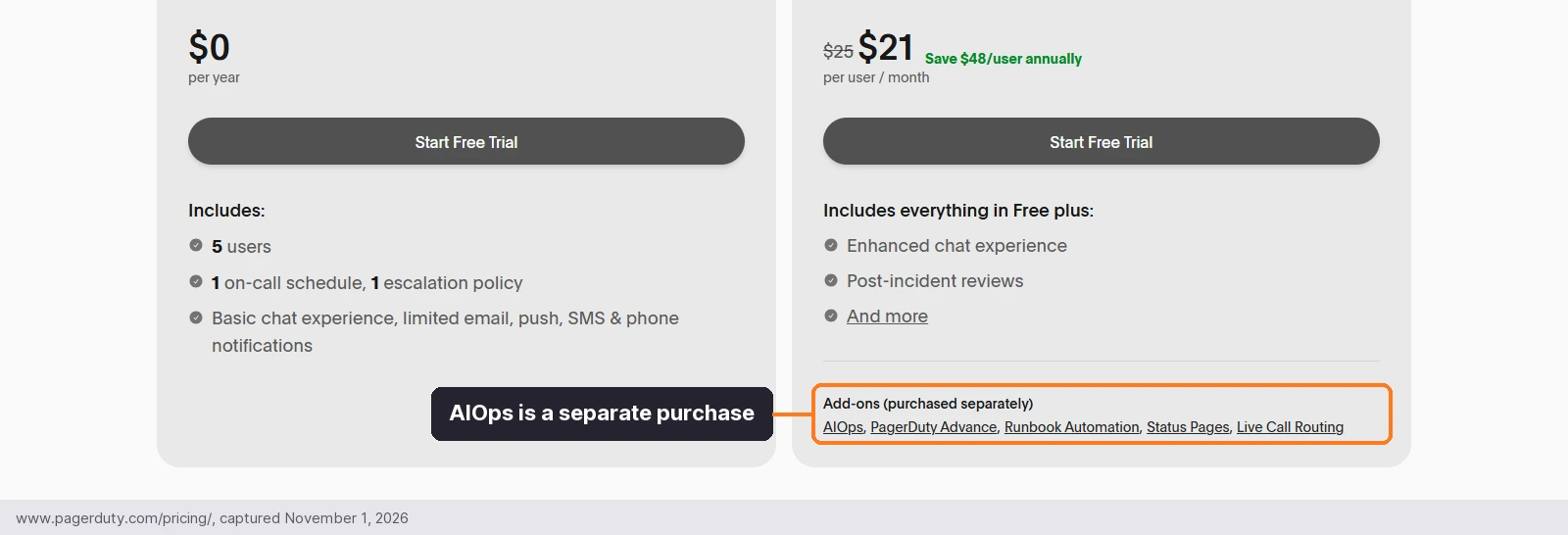
The add-on list sits right under the $21 price, so the number on the card is not the number a team using AIOps will pay.
3. xMatters: notification depth, with the AI agent held for the top tier
xMatters, now branded Everbridge xMatters, grew out of enterprise notification, and reaching people at scale is still its strength. Enterprises already on Everbridge or running ServiceNow will find it the easy choice. 2026 brought a ServiceNow collaboration expansion on June 3 and a Teams app in the September/October Firebird release.
Where the AI sits
Root cause detection, change correlation and automated remediation come on every tier. Similar-incident grouping and resolver insights arrive with Base ($39 per user per month) and Advanced, and the Incident AI Agent is on Advanced only.
What to price in
The agent sits on the contact-sales tier, which means no list price for a team that wants it. SMS and voice come with per-user monthly allotments that grow by tier (Starter includes 50 SMS and 10 voice, Base 100 and 20), which makes notification volume part of the tier decision. The Free plan has no SMS or voice, and Starter is capped at 25 users.
4. Rootly: AI retrospectives and an AI SRE for Slack-centric teams
Rootly is a Slack-native incident workflow layer for DevOps-led engineering teams, with strong post-incident tooling. Teams whose incidents already live in Slack channels get a lot from Rootly, and its retrospectives are a highlight. Recent additions include AI scheduling from Slack (October 28, 2026), an agent in the mobile app and a generally available MCP server.
How the AI is split
An AI scribe, retrospectives and related-incident suggestions come with Incident Response ($20 per user per month, Status Pages included). Suggested coverage and alert grouping come with the separate On-Call product. Root cause with evidence, agents, remediation and draft pull requests belong to AI SRE, which is custom-priced and requires Incident Response.
Where the bill grows
On-call is a separate $20 product unless you are on Enterprise. Rootly’s page says prices are additive, which puts a responder who needs both at $40 before AI SRE. With the AI spread across three products, it suits a team buying in stages more than one that wants grouping and investigation together. Bring-your-own AI key is Enterprise only.
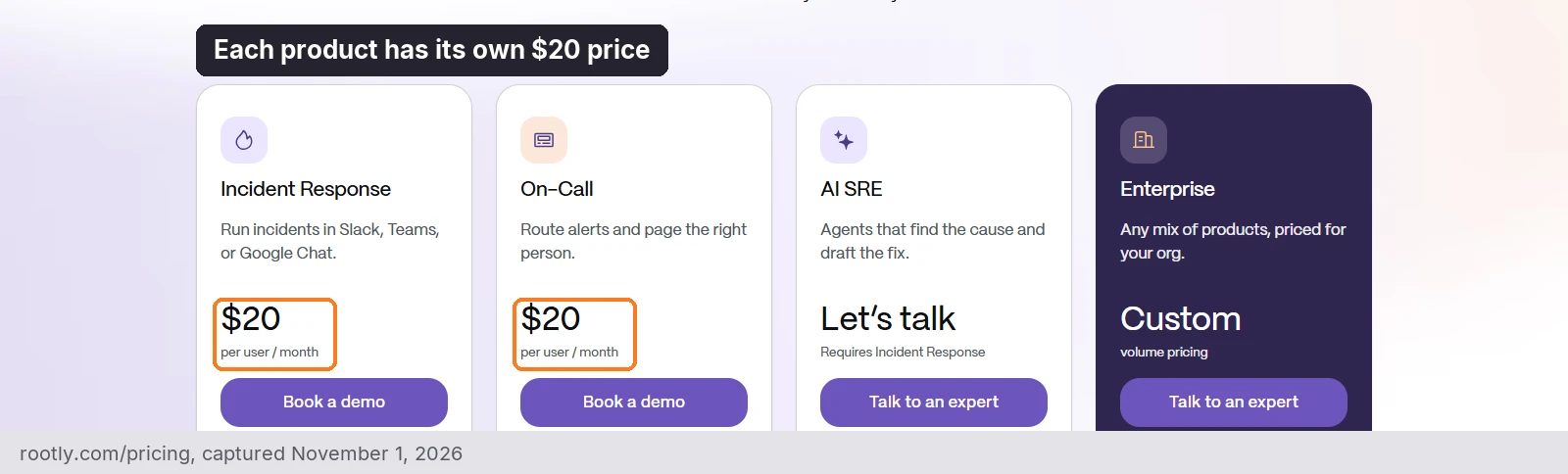
A buyer who needs incident response and paging prices two product lines per responder.
5. incident.io: an AI investigator inside a Slack-first workflow
incident.io is an incident workflow product for product-engineering teams that run incidents in Slack. Growing engineering organizations that want a polished interface and an AI that investigates are its natural buyers, and its October 28 update added bring-your-own skills and tools for the agent, with approval before changes.
Investigations and the agent
Investigations covers root cause and an autonomous agent. The AI is gated to higher tiers with some add-on pricing, and it is not on Basic or Team.
What the full setup costs
On-call is an add-on on Team (+$10 per user per month) and Pro (+$20), and a standalone on-call plan is $20. A team that wants the AI plus on-call lands on Pro, around $45 per user at list price, before any Investigations add-on.
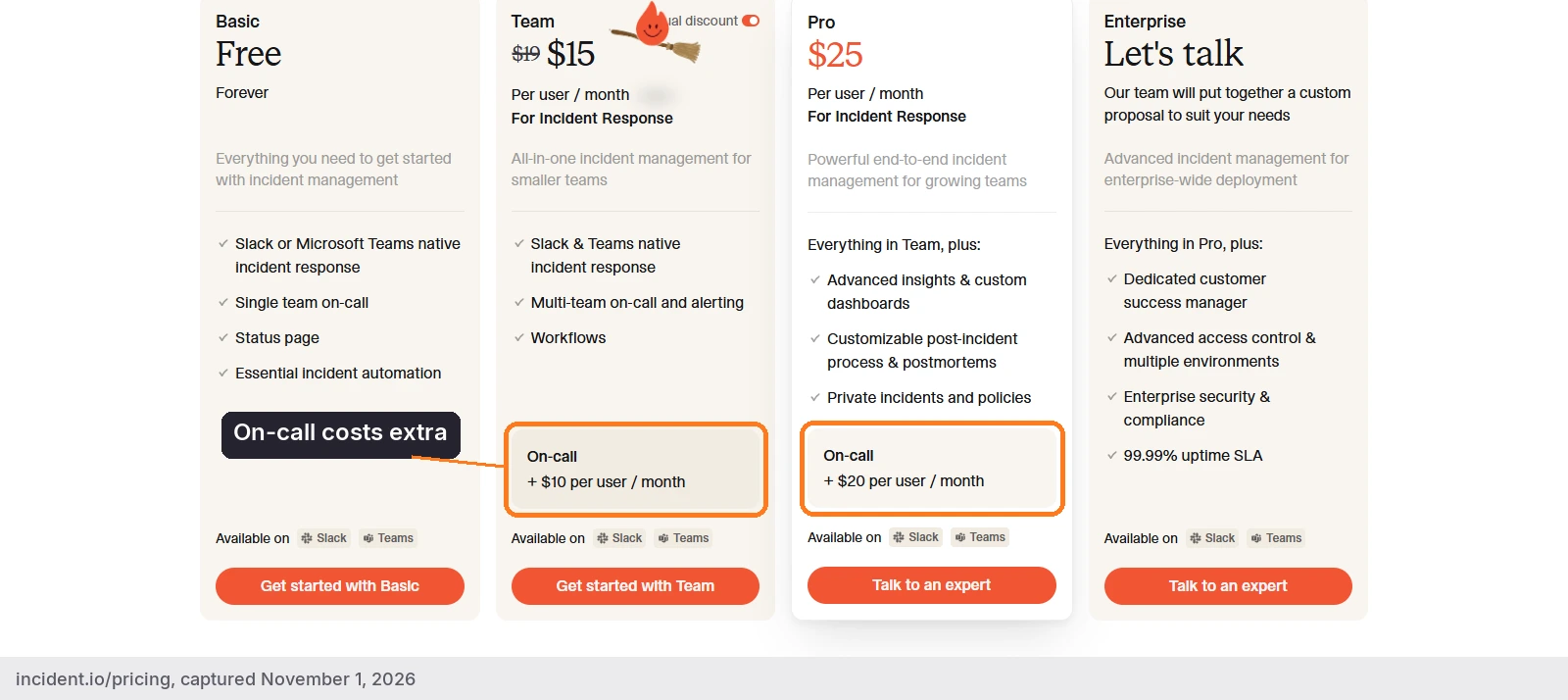
The per-user on-call line is added on top of the plan price shown on each card.
Basic is free but limited to single-team on-call, and phone support and the 99.99% uptime SLA arrive only on Enterprise.
6. Jira Service Management: AI and on-call inside the Atlassian suite
Jira Service Management is Atlassian’s recommended successor to Opsgenie. If tickets, approvals and assets already live in Jira, on-call and AI in the same suite means one vendor and one login. Atlassian sells it inside the Service Collection (JSM, Customer Service Management, Assets and Rovo), with a free plan for up to 3 agents.
AI runs on Rovo, which Atlassian meters in credits, and alerting and on-call are built into JSM according to Atlassian’s Opsgenie notice. Check Atlassian’s licensing page for the current credit allowance and billing start before you model cost.
The suite is service-management-first, and a team whose tickets and approvals live elsewhere takes on a platform it only partly needs. Credit-metered AI is also harder to forecast than a flat per-user price. Ask for a usage estimate at your alert volume.
7. Grafana Cloud IRM: on-call and incident response for Grafana shops
Grafana Cloud IRM folds on-call and incident response into one app and suits teams that already run Grafana for observability. At ObservabilityCON on October 20, 2026, Grafana announced IRM updates for shared context between people and AI agents. Grafana Assistant is priced separately from IRM, and the pricing page does not show how IRM’s AI features are gated.
Free covers 3 active users with community support. Pro starts at $20 per active IRM user plus a $19 monthly platform fee with 8×5 email support, and Enterprise is by quote with a $25,000 annual minimum commit. A team without Grafana as its observability center gets less from the pairing.
The open-source Grafana OnCall was archived on March 24, 2026, which makes it a poor base for a new AI program.
8. Datadog Incident Response: On-Call and Incident Management next to your telemetry
Datadog Incident Response is the bundle of Datadog On-Call and Datadog Incident Management, and it suits teams already standardized on Datadog who want paging and incident work next to their monitors, traces, logs and metrics. Datadog is also one of the monitoring tools that feed AlertOps, so the two often sit in the same stack. Datadog’s pricing page says On-Call and Incident Management each work on their own, with no other Datadog product required.
How it is packaged
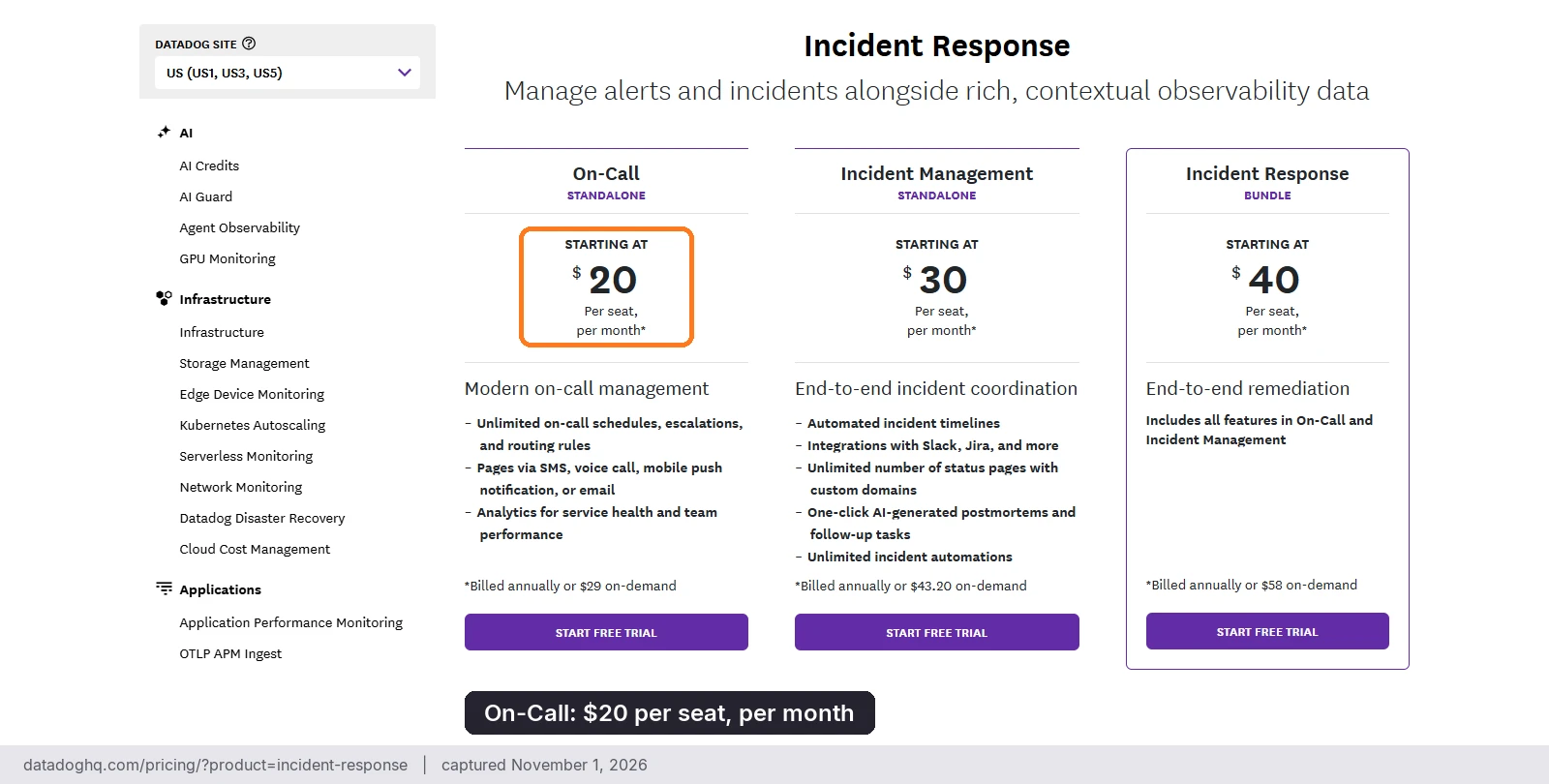
There are three SKUs, all per seat per month billed annually: On-Call from $20, Incident Management from $30, and the Incident Response bundle from $40, which includes all the features of both. On-demand rates are $29, $43.20 and $58. One Incident Response seat covers both products, you pay for the highest number of seats assigned at one time, and an unassigned seat stays billable for that period. No seat is needed to create, view or join incidents or to page another team.
Where the AI sits
Bits AI for Slack and single-click AI postmortems appear in the Incident Response feature matrix. Bits Investigation, the autonomous investigation product, is priced separately through AI credits at $500 per 500 credits per month billed annually, or $1.30 per credit on-demand, with about 4 credits per investigation according to the page.
What to price in
A team that wants paging, incident management and the investigation agent prices a seat bundle plus a monthly credit commitment. The pricing page does not say whether any credits are bundled into the seat price, so ask for that in writing. Support tiers are covered in Datadog’s Support Plan Terms rather than on the pricing page.
How AI software helps ITOps prioritize critical outages
AI helps ITOps prioritize critical outages in two ways: it collapses related alerts into one incident, and it attaches what the responder needs to judge and fix it. AlertOps does both with OpsIQ, while PagerDuty’s AIOps and the alert grouping in Rootly’s On-Call handle the first. Severity itself should run on policy: consequential decisions have a named owner, and routine ones have a rule.
Collapse the pile into incidents
A failed load balancer can fire dozens of alerts across monitoring tools. Correlation turns them into one incident, and the on-call engineer sees one thing to fix instead of a stack to triage. Tune thresholds against your own alert history, which is the only reliable test of a grouping model.
Attach what the responder needs
Once alerts are grouped, context decides how fast someone can act. Intellifield generates root cause and remediation steps, Historical Alert Insights surface past resolutions, and AI-Powered Resolution Suggestion proposes a fix while the incident is open.
Let priority decide who is paged
DORA’s 2025 research describes AI as an amplifier of whatever a team already does well or badly (DORA, 2025). A muddled escalation path gets a faster muddled path, so the routing layer deserves as much scrutiny as the model.
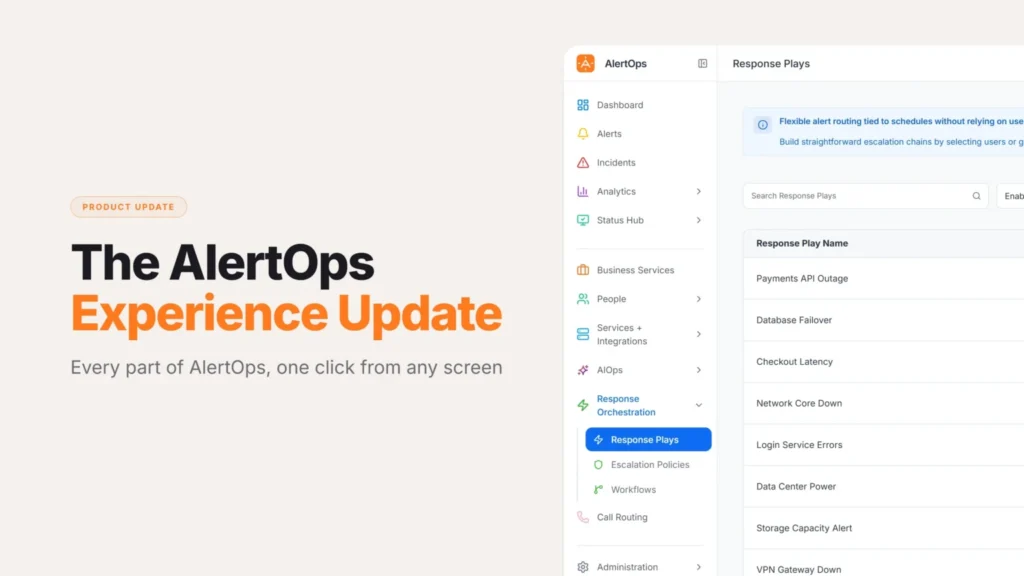
Priority belongs in routing. A Response Play carries a priority level that sets notification overrides, notifies tiers of recipients on a timer and uses each person’s own contact preferences. An Escalation Policy suits strict role order (primary, then secondary, then manager), and Workflows add actions inside the policy, driven by start and stop conditions you define. Phone and SMS are native channels, so a critical incident does not depend on someone watching a chat window.

Buyers on our sales calls who mainly want noise handled often start with deterministic suppression, and AlertOps covers that too: Maintenance Windows pause the sources you choose, and the Escalation Policies and Response Plays you set follow your rules, alongside OpsIQ grouping and context. Book a demo and we will map your definition of a critical outage onto Response Plays and Escalation Policies with you.
Leaving Opsgenie
Atlassian’s end-of-support date for Opsgenie is April 5, 2027, when access shuts off and data not moved to JSM is deleted (Atlassian). If you are moving, choose the AI platform and the migration path together. AlertOps Enterprise includes migration support, run by our Solution Engineering team. This is not a DIY transition. Our comparison of Opsgenie alternatives goes through the options.
A checklist for evaluating AI incident management software
Take these to every vendor call:
- Which of the four jobs (grouping, root cause, actions, setup and writeup) causes you the most pain today?
- What is the per-responder price with on-call and the AI you want included, at your user count?
- On which tier does the AI turn on, and is any of it metered by usage?
- Which agent actions require approval, and where is each action logged?
- Which model runs underneath, what alert data does it see, and can you turn the AI off during a governance review?
- Can you replay your last three alert storms through the trial and compare incident counts?
- Does the ITSM sync run in both directions with your instance, and what writes back?
- Which channels are native for critical pages: phone, SMS, email and mobile app, or chat only?
- What does support look like at your tier, and what is the SLA?
Run the list through a demo with us and we will test each answer against your own services.
FAQ
What is AI incident management software?
It uses machine learning or language models to group alerts into incidents, suggest causes and fixes, take approved actions and write postmortems, alongside on-call and escalation.
What is the best AI incident management software?
AlertOps is the lead pick for enterprises with many teams (IT, DevOps, SRE, NOC or MSP) that want on-call, correlation and an AI agent in one plan, whatever tools they run, with Rootly or incident.io suiting Slack-centric engineering teams and JSM suiting Jira shops.
How does AI help ITOps prioritize critical outages?
It reduces many alerts to one incident and attaches context, which cuts the time responders spend triaging. OpsIQ handles the grouping, and Response Plays or Escalation Policies carry the priority to the right people by phone, SMS, email or mobile app.
Which AlertOps plans include OpsIQ?
AlertOps Enterprise includes OpsIQ and Ada. Every tier’s price is published on our pricing page.
Does AlertOps work with ServiceNow?
Yes, as one of 200+ pre-built integrations; AlertOps does not require ServiceNow. The AlertOps app for ServiceNow is certified, two-way and needs no coding. Assignment, status, notes and the escalation timeline update the incident on your ServiceNow instance. ServiceNow remains the system of record.
What should teams on Opsgenie do before April 2027?
Pick a replacement early and run it side by side with Opsgenie before cutting over, because Atlassian ends support on April 5, 2027. With AlertOps Enterprise, migration support is included and our Solution Engineering team runs it.
Pick the AI you will turn on
Decide which job hurts most and price the full stack at your responder count. A replay of your last alert storm will tell you more than any vendor’s AI page, and AlertOps puts on-call, correlation and Ada in one plan to replay it on. Start a free trial or book a demo.
Sources
- Uptime Institute: Annual Outage Analysis 2026
- DORA: 2025 State of AI-assisted Software Development
- PagerDuty pricing
- PagerDuty Operations Cloud Spring 2026 release
- PagerDuty community: Product Drops, August 2026
- xMatters pricing
- Everbridge: xMatters and ServiceNow collaboration
- xMatters Firebird Sep/Oct 2026 release overview
- Rootly pricing
- Rootly changelog
- incident.io pricing
- incident.io changelog
- Atlassian: Service Collection pricing
- Atlassian: Opsgenie end of sale and support
- Atlassian: Rovo licensing
- Grafana pricing
- Grafana OnCall repository
- Grafana: ObservabilityCON 2026 announcements
- Datadog Incident Response pricing
- Datadog Incident Management and On-Call
- Datadog Bits AI SRE
- AlertOps pricing
- AlertOps platform data: roughly 68% less alert noise; up to 80% less postmortem prep time
Note: Competitor pricing, plan limits and screenshots come from each vendor’s public website as of October 30, 2026, and may change, so check the vendor’s site for current details. Product names and logos are trademarks of their respective owners and are used for identification only.