Key takeaways
- PagerDuty vs Opsgenie is no longer a like-for-like shopping decision. Atlassian stopped selling Opsgenie on June 4, 2025, and ends support on April 5, 2027, when access shuts off and any data not moved to Jira Service Management (JSM) is deleted (Atlassian).
- PagerDuty suits large engineering organizations that want a mature integration ecosystem and event-based AIOps, and that budget for AI and runbook automation as separate add-ons.
- Opsgenie’s path now runs through JSM, so the comparison that matters is PagerDuty against Atlassian’s on-call inside a service-management suite, plus the independent platforms outside both.
- AlertOps, our incident orchestration platform, is the recommended pick for teams that want on-call, escalation and phone-first response without a suite purchase, with roughly 68% less alert noise (AlertOps platform data) and 200+ integrations, including a certified two-way ServiceNow app. A free plan covers 5 users, paid plans start at $8 per user per month billed annually on Standard (up to 10 users), and AlertOps Enterprise ($28) includes OpsIQ and migration support.
Opsgenie shuts off on April 5, 2027, and that date now drives this comparison. One buyer told us on a trial walkthrough that they were “looking for a tool that will replace OpsGenie to give us the same functionalities plus alerting, grouping the alerts, and filtering the noise,” and PagerDuty was the tool they were looking into.
Choose AlertOps if you want on-call, escalation and phone-first response in one platform with no suite to buy, backed by roughly 68% less alert noise (AlertOps platform data) and 200+ integrations, including a certified two-way ServiceNow app. PagerDuty fits large engineering organizations that want a mature integration ecosystem and will pay for AIOps and automation on top of the base plan, and Opsgenie’s successor path through JSM fits teams where Jira is already the center of gravity.
Why this comparison changed
For years, PagerDuty vs Opsgenie was a straight feature and price contest between two standalone products. That contest ended when Atlassian folded alerting and on-call into JSM and set a shutdown date for the standalone product. Atlassian stopped new sales on June 4, 2025. On April 5, 2027, access shuts off and data you have not migrated is deleted (Atlassian).
The decision now has a date on it. You either move your Opsgenie configuration into JSM or rebuild it on another platform, and either way the work has to finish before April 5, 2027. Our guide to Opsgenie end of life covers the dates and what each migration route involves, so we will keep this piece on the comparison itself.
A late page lengthens an outage, and outages are expensive. In Uptime Institute’s 2026 analysis, 57% of respondents put their most recent major outage above $100,000, and one in five put it above $1 million (Uptime Institute, 2026). Your cutover plan has to protect that exposure along with any SLA penalties and the incident record your auditors expect.
PagerDuty vs Opsgenie at a glance
| # | Tool | Status | How you buy | On-call | AI | Support | Best fit |
|---|---|---|---|---|---|---|---|
| 1 | AlertOps | Actively sold and developed | Per-user plans from a free 5-user plan; Standard $8, Premium $18, Enterprise $28 billed annually | Core to the platform: Rotating and Fixed Schedules, Escalation Policies, Response Plays | AlertOps Enterprise includes OpsIQ | Migration support included with Enterprise, run by Solution Engineering | Mid-market and enterprise IT, DevOps, SRE and NOC teams, and MSPs |
| 2 | PagerDuty | Actively sold and developed | Per-user plans, plus platform plans sold by annual fee | Included in every plan | Gated; AIOps and Advance are add-ons on Professional | Email and chat on Professional and up; community only on Free | Large engineering orgs with budget for add-ons |
| 3 | Opsgenie (via Atlassian JSM) | Not sold since June 4, 2025; support ends April 5, 2027 | Inside Atlassian’s Service Collection; on-call and alerting built into JSM | Alerts and on-call schedules listed on every JSM plan, from Free | AI-driven alert grouping on Premium; Rovo credits by tier | Community on Free; ask Atlassian for paid-plan terms | Teams already standardized on Jira |
On-call is part of the AlertOps core platform and a base feature at PagerDuty, while Rootly and incident.io sell it as a separate add-on on most plans. On the Opsgenie side, the number to price is your future JSM bill.

1. AlertOps: on-call, escalation and OpsIQ in one platform
AlertOps is an incident orchestration platform for IT operations teams that want alerting, on-call scheduling and escalation without buying a service-management suite. It fits mid-market and enterprise IT, DevOps, SRE and NOC teams whatever ITSM and monitoring tools they run, and MSPs. Alerts go out natively by phone, SMS, email and mobile app, with Slack and Microsoft Teams as integrations, and 200+ integrations connect the monitoring tools you already run. A free plan covers 5 users, Standard is $10 monthly or $8 annual per user for up to 10 users, Premium is $22 or $18, and Enterprise is $34 or $28 (AlertOps pricing).
- On-call and routing are core. Rotating and Fixed Schedules, Override Shifts, Escalation Policies and Response Plays all come with the platform. Our comparison of Response Plays and Escalation Policies explains which to use when.

- Transparent, bundled pricing. Per-user pricing is published on the AlertOps pricing page, and AlertOps Enterprise includes OpsIQ, Agent Chronicle and support. Billing stays simple, with no separate add-on modules for those capabilities.
- Integrations. 200+ integrations connect the tools you already run. One strong example is the certified, two-way AlertOps app for ServiceNow, which needs no coding and syncs incidents, assignment, status, notes and custom fields.

- Migration is assisted. Migration support is included with AlertOps Enterprise, and it is not a DIY transition: our Solution Engineering team runs it, replicating schedules, escalation rules and integrations, validating routing in parallel, and then cutting over.
If you want the head-to-head, read AlertOps vs Opsgenie or the PagerDuty alternative breakdown. When you are ready to test it against your own alerts, book a demo and bring your current escalation setup so we can map it live.
2. PagerDuty: deep integrations and agentic response
PagerDuty’s strength is a mature integration ecosystem and a product team that keeps building: its Spring 2026 release, announced March 12, led with an SRE Agent that acts as a virtual responder, Slack-native workflows and agent-to-agent support through MCP (PagerDuty). Its August 2026 product drop lists SRE Agent on Escalation Policies as early access, and an Automation Runner followed in September (PagerDuty Community). If you run hundreds of engineers across many services and want a vendor pushing hard on agentic response, that is a real strength.
What the pricing page shows
The Free plan covers 5 users, one schedule and one escalation policy. Professional costs $25 per user per month billed monthly, or $21 per user per month billed annually. The older Business tier did not appear on the pricing page we read, so if you are on it, ask what your renewal moves to. Above that sits the PD Reliability Platform, sold by platform fee: Starter at $2,800 a year for 10 seats, Essential at $12,000 for 20 seats, Plus at $48,000 for 50 seats, and Ultimate at custom pricing for 500 seats (PagerDuty pricing).
Where PagerDuty stops fitting
PagerDuty’s fit weakens when the features you need push you off the $21 seat. On Professional, AIOps and Advance are add-ons. Starter includes both at about $23 per seat, but it covers 10 seats; Essential works out to $50 per seat per month and Plus to $80, and Expert Services becomes a required add-on at those tiers, while Runbook Automation costs extra everywhere (PagerDuty pricing). Add-on pricing like this is normal for an enterprise vendor, so budget from the plan you will end up on.
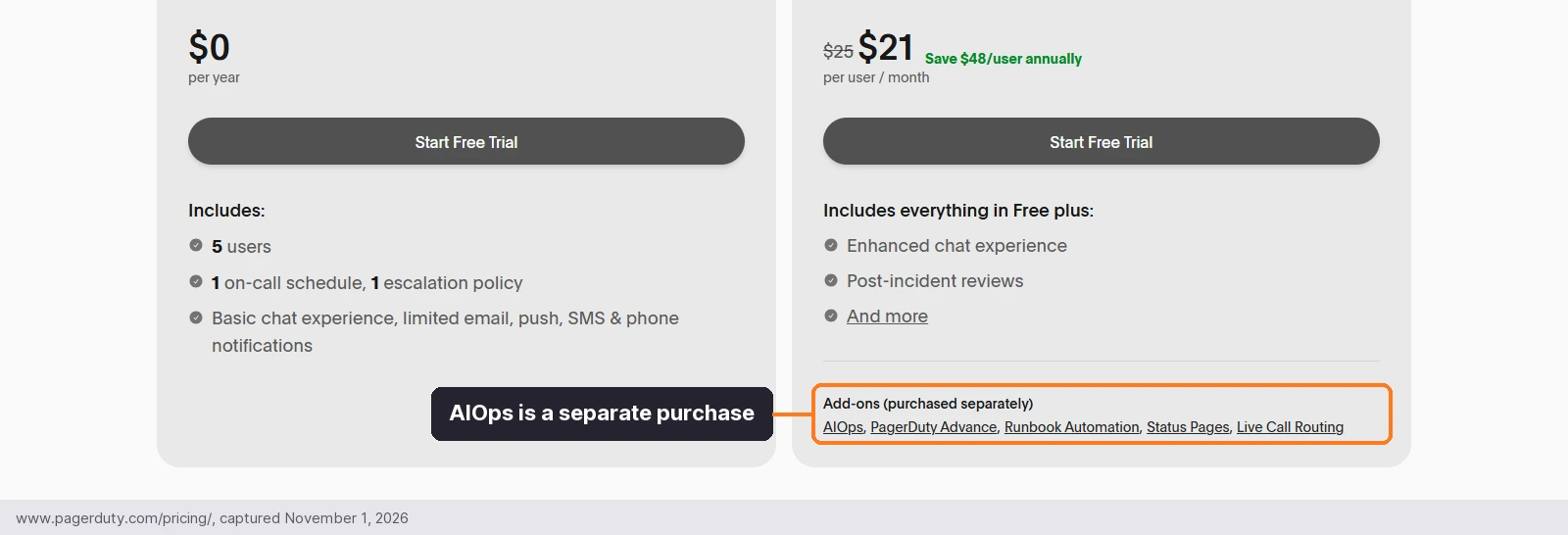
The $21 seat price on this card is the starting point, not the total, once AIOps is added.
The second place it strains is management overhead. One team that moved from PagerDuty to Opsgenie described what they disliked about PagerDuty at the time: “it was just this giant bucket of a bunch of routing rules and alerts and all that and we hated that because from a management perspective it was just impossible to keep everybody straight.” That is one team’s experience, but it points to a real cost: a flexible rules engine needs an owner.
MSPs have one more question to ask. We did not find a native multi-tenant model on PagerDuty’s public site, so confirm directly how client separation works before you commit.
3. Opsgenie via Jira Service Management: the suite route
Opsgenie won real customers, including the team quoted above that left PagerDuty for it. Staying is not an option after April 5, 2027. Renewals are allowed only if the term ends before that date, so a 12-month renewal signed today would not qualify (Atlassian).
The JSM route
Atlassian’s own notice says alerting and on-call are built into JSM (Atlassian). That suits an organization already running Jira for engineering and service management, because the incident, the alert and the ticket can live in one suite, bought once. Atlassian’s pricing page lists alerts, on-call schedules and escalation policies on every plan, including Free for up to 3 agents, and puts AI-driven alert grouping and heartbeat monitoring on Premium. For a 75-agent team it lists Standard at $21.50 and Premium at $55.28 per agent per month, so check the figure at your own agent count.
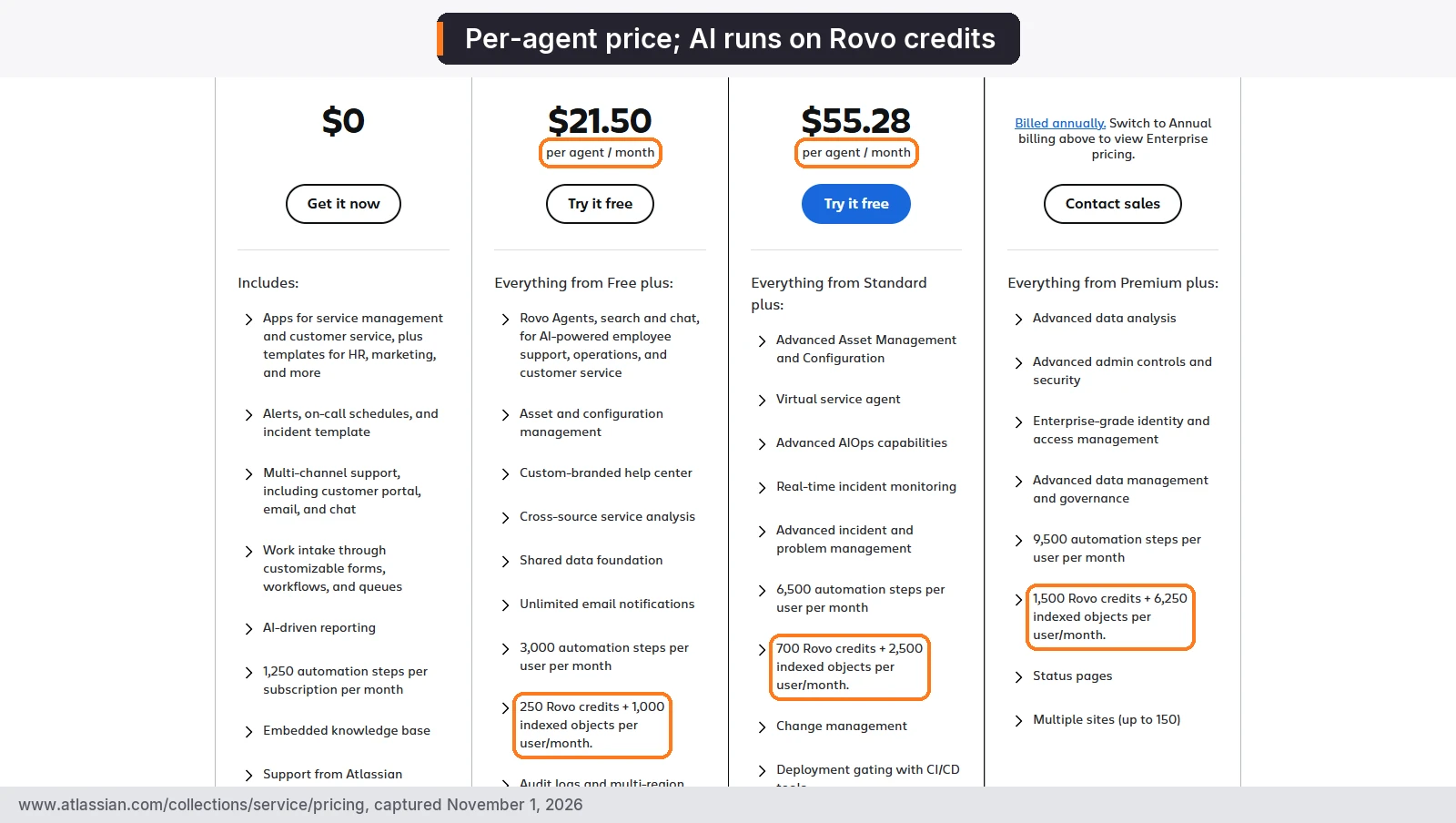
The per-agent price covers the suite, and AI use runs on credits that come with each plan. Our earlier breakdown in Opsgenie vs Jira Service Management goes deeper on what the move involves.
Where the JSM route stops fitting
The suite is the trade-off. JSM is sold per agent inside a larger collection, so a team that wanted only on-call and alerting is buying service-management seats to get it. If many of your responders are operators or vendor contacts who never touch Jira, price the seats before you assume the move is cheap. Where ServiceNow rather than Jira is your IT service management standard, the fit is weaker still.
Pricing and packaging: what 50 seats cost
Opsgenie has no price to compare any more, so the comparison is AlertOps, PagerDuty and JSM. These are list prices billed annually, before add-ons. JSM is shown at its listed 75-agent rate, so check the figure at your own agent count.
| # | Plan | Per seat per month | Year, 50 people | Notes |
|---|---|---|---|---|
| 1 | AlertOps Enterprise | $28 | $16,800 | OpsIQ and migration support included |
| 2 | AlertOps Premium | $18 | $10,800 | On-call, escalation and Response Plays |
| 3 | PagerDuty Professional | $21 | $12,600 | AIOps and Advance extra |
| 4 | PagerDuty Plus | $80 effective | $48,000 | AIOps and Advance included, Expert Services required |
| 5 | JSM Standard | $21.50 (75-agent rate) | $12,900 | No AI alert grouping |
| 6 | JSM Premium | $55.28 (75-agent rate) | $33,168 | AI alert grouping |
At 50 responders, AlertOps Enterprise is $16,800 a year with OpsIQ and migration support included, while PagerDuty Plus is $48,000 with AIOps and Advance included and Expert Services required on top. Run both against your own alerts, because a gap that size makes the test worth it.
Seat counts are the easy one to get wrong, because a responder list that includes operations leads and vendor contacts can run well past the engineering headcount the vendor priced for. Build the list first, then ask for the quote. Our PagerDuty pricing write-up covers the tiers in more detail. Bring that responder list to a demo and we will price it on AlertOps with you.
The limits behind the headline price
A per-seat price tells you little until you see what each plan caps. These are the figures the vendors’ own pricing pages show, captured on November 1, 2026.
| # | Vendor | Workflows | Status pages | AI | SSO |
|---|---|---|---|---|---|
| 1 | AlertOps Enterprise | Included with AlertOps Enterprise | Status Hub included with AlertOps Enterprise | OpsIQ AI Suite included | Included |
| 2 | PagerDuty | Free none, Professional 1, Starter and up included | Free none, Professional 250 subscribers, Starter and up included | AI actions: Starter 1,000, Essential 4,000, Plus 16,000, Ultimate 100,000 | Professional and up |
| 3 | Jira Service Management | Automation steps: Free 1,250, Standard 3,000, Premium 6,500, Enterprise 9,500 | Enterprise only | Rovo credits per user per month: Standard 250, Premium 700, Enterprise 1,500 | SAML SSO needs an Atlassian Guard subscription |
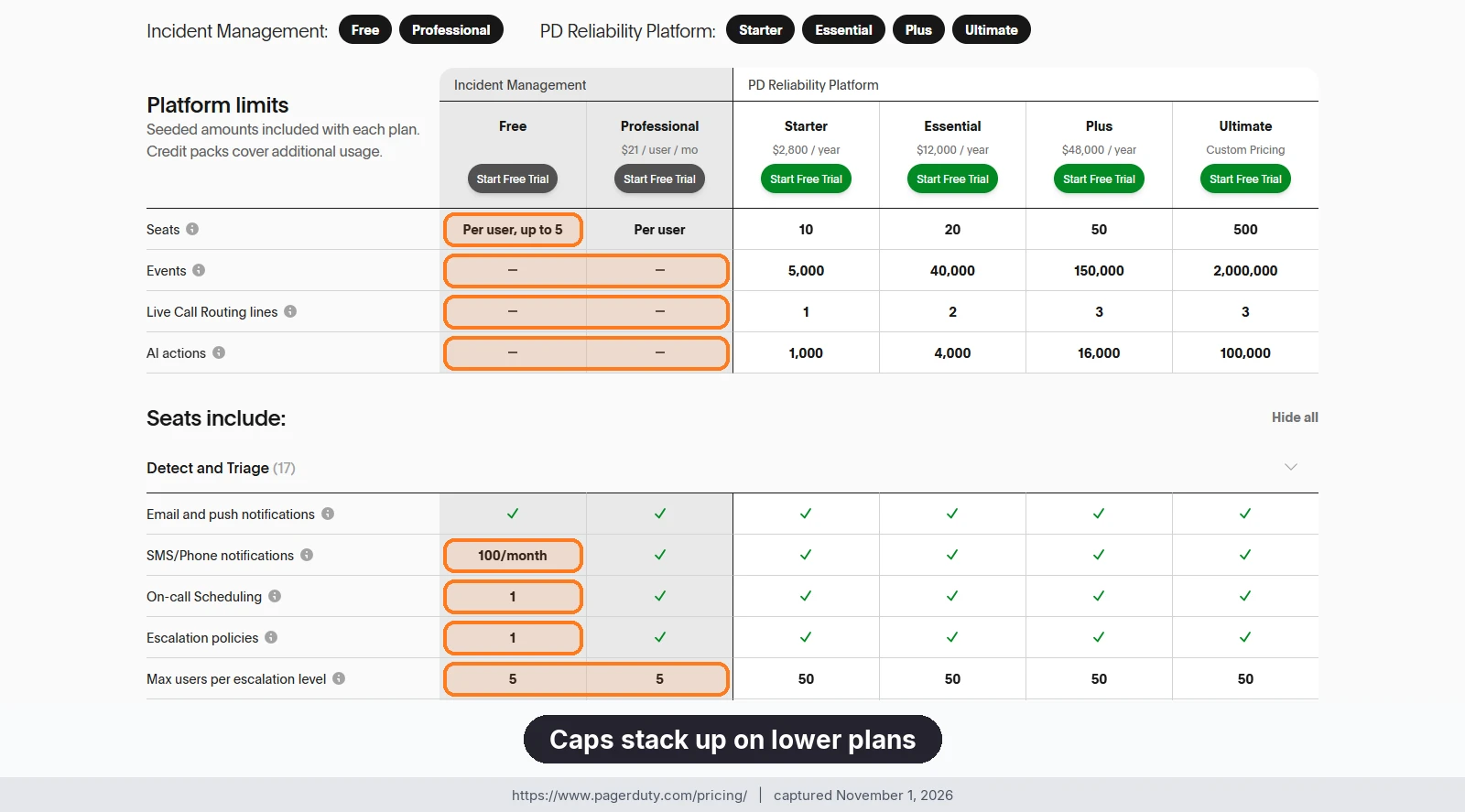

AlertOps publishes its per-user pricing, and AlertOps Enterprise at $28 per user per month billed annually includes OpsIQ, Agent Chronicle, a dedicated account manager and a 99.9% SLA. Ask every vendor for the same list of caps before you compare quotes.
AI: what you actually get on each side
At PagerDuty, AIOps and Advance are the AI products, and both cost extra on Professional; they come included from the Starter platform plan upward. The SRE Agent from the Spring 2026 release is the headline capability, and the August product drop listed part of it as early access (PagerDuty Community).
On the Atlassian side, AI runs through Rovo. Plans include 250, 700 or 1,500 credits per user per month on Standard, Premium and Enterprise, and extra usage bills at $0.01 per credit (Atlassian). AI-driven alert grouping sits on Premium.
Whatever you pick, ask each vendor which features the quote includes, what is metered, and what happens to the bill if usage doubles.
Support and migration
PagerDuty offers email and chat on Professional and above; the Free plan has community and a knowledge base only. Gold Services is an add-on, and Expert Services is required on the higher platform plans (PagerDuty pricing). If you are migrating a large Opsgenie estate, that implementation help is a cost to put in the budget, not a footnote.
For the Atlassian route, ask what support and migration help your contract includes; support on the Free plan is Atlassian Community.
Whichever route you choose, inventory what the cutover touches first: every monitoring integration that sends alerts to Opsgenie, every team’s schedules and overrides, and every escalation path. Then test routing side by side with the old tool still live. Our guide to migrating off Opsgenie lays out that sequence.
A checklist for your decision
Gather these before you talk to any vendor:
- Your Opsgenie contract end date, checked against the April 5, 2027 cutoff
- The full responder list, including operators and vendors, not just engineers
- Your ITSM system of record and how incidents must sync into it
- The SLA commitments and audit evidence your on-call record has to support
- Which AI features you need during an incident, and which you only want to try
- Which services page people by phone or SMS, and which can live in chat
- The last three incidents where a page was missed or acknowledged late
- Who will own routing rules and schedules after cutover, and how many hours a month that takes
Run every shortlisted tool through the same list and request quotes against it so the totals compare. Then start a free trial (14 days, no card) and load a real escalation path.
FAQ
Is Opsgenie still available to buy?
Not as a new subscription. Atlassian ended Opsgenie sales on June 4, 2025, and ends support on April 5, 2027, when access shuts off and unmigrated data is deleted. Renewals are allowed if the term ends before that date. AlertOps Enterprise includes an assisted migration program for teams moving off it.
Is PagerDuty better than Opsgenie?
Opsgenie is being retired, so PagerDuty is the established standalone of the two, and it suits large engineering organizations that want an integration ecosystem and event-based AIOps. Opsgenie’s successor path through JSM suits teams already on Jira. AlertOps is the pick for teams that want on-call, escalation and 200+ integrations without a suite purchase.
Does PagerDuty include on-call in every plan?
Yes. On-call is included in every PagerDuty plan. AIOps, PagerDuty Advance and Runbook Automation are separate add-ons on Professional; AIOps and Advance are included from the Starter platform plan upward, while Runbook Automation stays an add-on on every tier. Compare the add-on list, not only the seat price.
What replaces Opsgenie after April 2027?
Atlassian’s recommended successor is Jira Service Management, which has alerting and on-call built in. AlertOps is the independent pick for teams that want on-call without a suite purchase, and its Enterprise plan includes migration support run by our Solution Engineering team.
Can AlertOps replace both PagerDuty and Opsgenie?
For many teams, yes. AlertOps covers schedules, Escalation Policies, Response Plays, native phone, SMS, email and mobile app alerting, and 200+ integrations including a certified two-way ServiceNow app. AlertOps Enterprise includes OpsIQ.
Pick for the deadline you have
Your responder list and your ITSM system will settle this faster than any feature grid. Price the full list against each option, run escalation side by side, and finish before April 5, 2027. Book a demo and we will map your current Opsgenie setup onto AlertOps with you.
Sources
- Atlassian: Opsgenie end of sale and support
- Atlassian: Service Collection pricing
- Atlassian: Rovo credits
- PagerDuty: Pricing
- PagerDuty: Operations Cloud Spring 2026 release
- PagerDuty Community: Product drops, August 2026
- Uptime Institute: Annual Outage Analysis 2026
- AlertOps: Pricing
- AlertOps: MSP solutions
- AlertOps platform data: roughly 68% less alert noise; up to 80% less postmortem prep time
Note: Competitor pricing, plan limits and screenshots come from each vendor’s public website as of November 1, 2026, and may change, so check the vendor’s site for current details. Product names and logos are trademarks of their respective owners and are used for identification only.