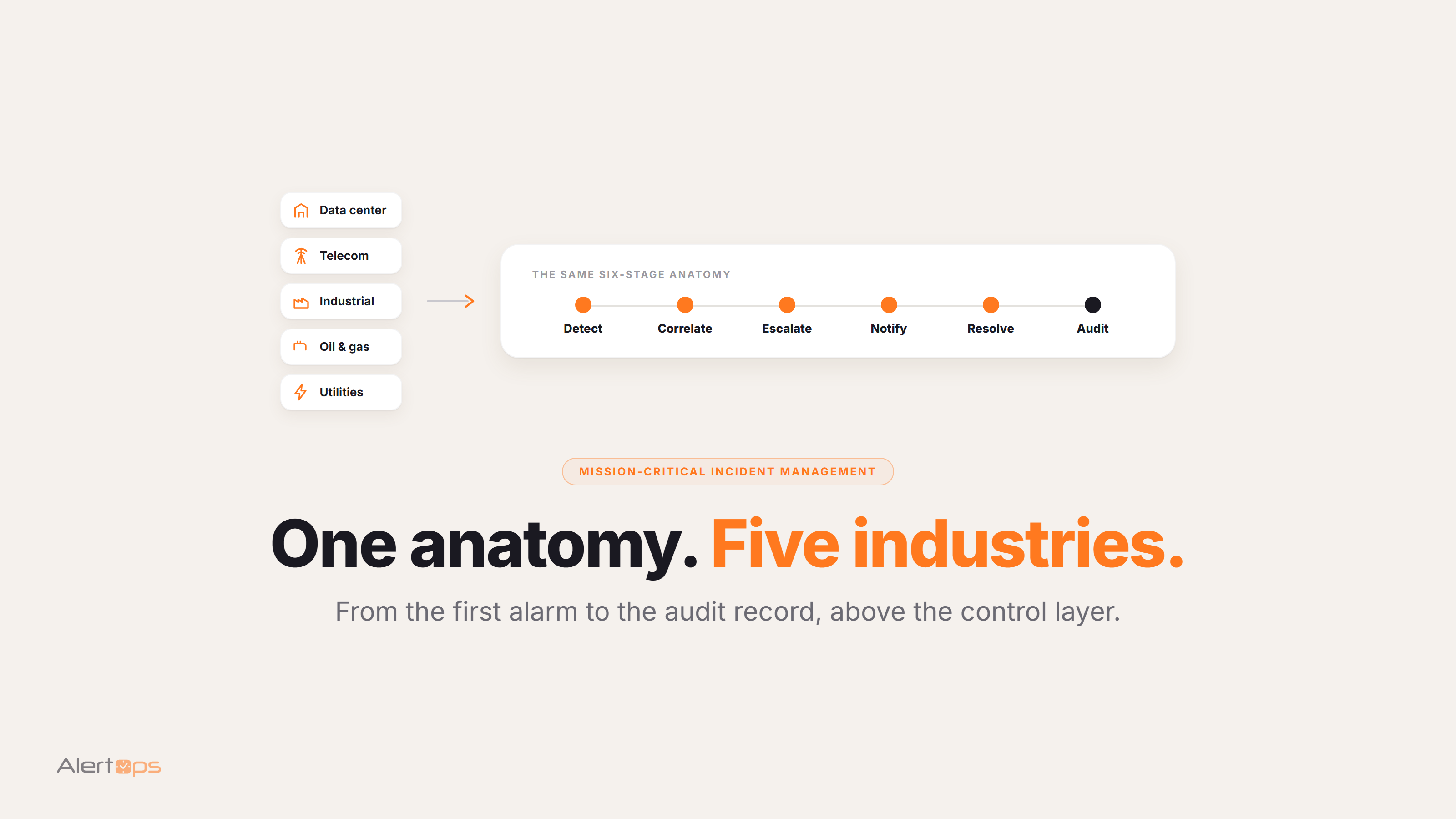
Picture five control rooms on the same hot Tuesday afternoon.
- In a wholesale colocation data center, a chilled-water plant trips and the building management system issues forty-seven alarms in ninety seconds as the temperature climbs toward racks under Tier III uptime guarantees, the data center reliability tier with the least allowable downtime.
- In a carrier network operations center, a backhoe two states away severs a fiber line, and tens of thousands of circuits go dark at once.
- On an automotive assembly line, a robot cell faults out, the PLC (programmable logic controller) throws a burst of tag alarms, and the Andon signal, the visual and audio alert for a line stoppage, stops the line at a cost measured in dollars per second.
- On a midstream oil and gas pipeline, pressure drops on an unmanned segment and SCADA (the supervisory control and data acquisition system monitoring the line) flags an anomaly that could be a sensor glitch, or could be a leak.
- At an electric utility, a substation breaker trips and remote terminal units light up across the territory, any one of which could be the cause or just a symptom of it.
Five industries, five completely different machines. Underneath all of them, the same event: the physical world just failed, and a wall of alarms is now demanding a human response on a clock measured in seconds and minutes, not business days.
Key Takeaways
- Mission-critical incident management (MCIM) follows the same six-stage anatomy regardless of industry: detection, correlation, escalation and routing, stakeholder notification, resolution against procedure, and the audit record.
- A mission-critical incident is a different category from an IT incident, not a louder version of one. The consequences are physical, the priorities invert (safety first, confidentiality last), and the constraints don't bend for a triage queue.
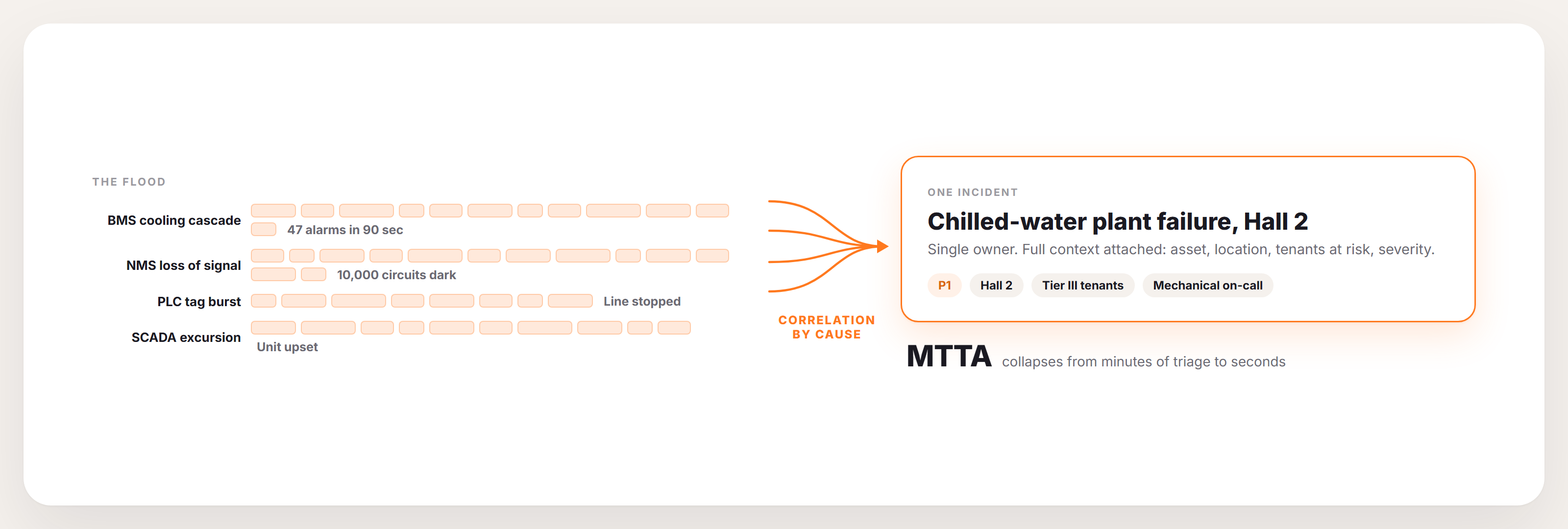
- One physical failure rarely produces one alarm. A single chiller trip can generate 47 alarms in 90 seconds, well past the flood threshold defined by alarm-management standards like ANSI/ISA-18.2 and EEMUA 191.
- Correlation is the hinge of the whole process. It's what turns a flood of alarms into one incident with one owner, and it's the step that makes routing, notification, and record-keeping possible at all.
- Routing by skill and location, not a flat on-call list, is the difference between a two-minute response and a forty-minute one.
- The audit record must be a byproduct of the response, captured automatically as it happens, not a reconstruction assembled by hand afterward.
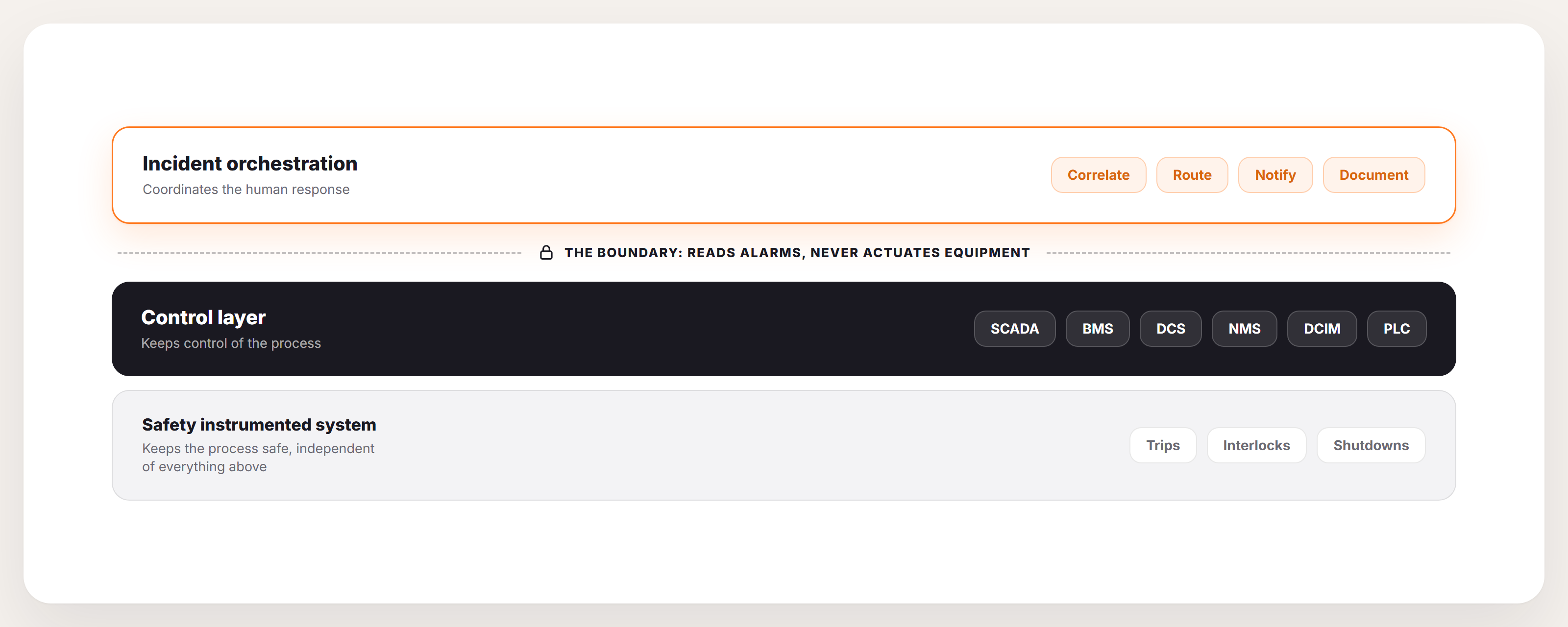
- The whole system operates above the control layer. It coordinates the human response; it never actuates equipment or replaces a safety system.
Why a Mission-Critical Incident Is a Different Category
Before the anatomy, the stakes. A mission-critical incident is not a louder version of an IT incident. It's a different category entirely, and the differences show up in five places.
| IT Incident | Mission-Critical Incident | |
|---|---|---|
| Worst-case consequence | Data loss or exposure | Equipment destruction, environmental release, service cut to a region, human injury |
| Priority order | Confidentiality, integrity, availability | Safety, availability, integrity, confidentiality |
| Response constraint | Reboot, patch, redeploy | No live patching of a running turbine or refinery; maintenance windows can be a year apart |
| Who responds | Engineers at a desk | Shift operators, field technicians, on-call engineers, plant managers |
| What "resolved" means | Ticket closed | Auditable record accepted by a regulator |
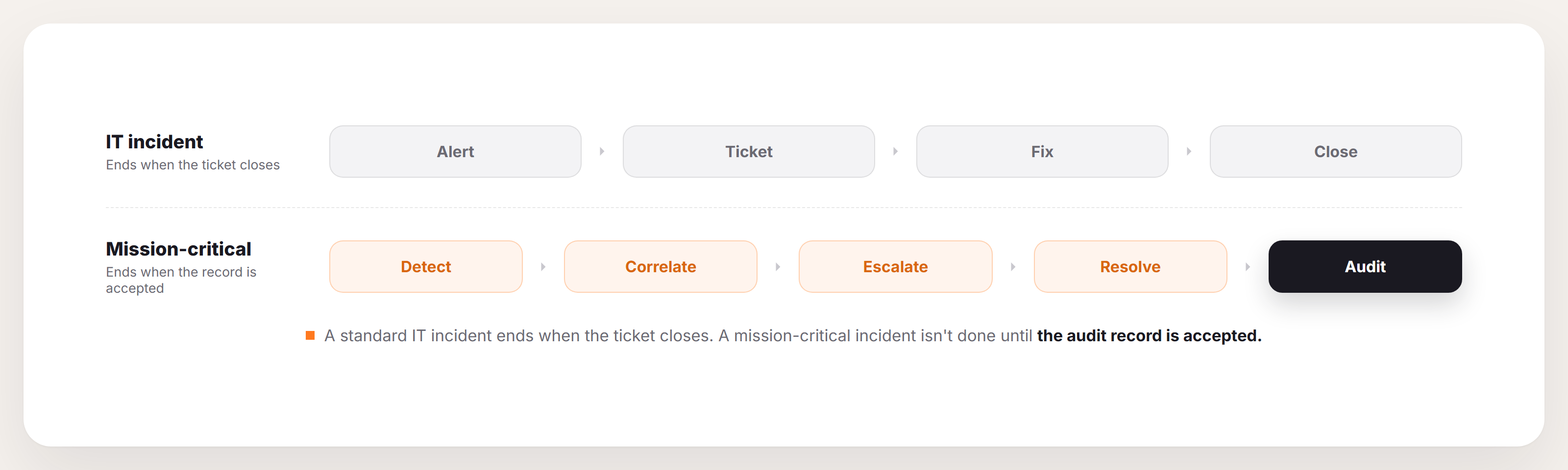
Some of these differences are worth sitting with individually.
The Consequences Are Physical
An IT incident, at worst, loses or exposes data. A mission-critical incident can destroy equipment worth millions, release something into the environment, cut service to a region, or put a person in danger. Severity here is a statement about physical and human risk, not a label in a ticketing queue.
The Priorities Invert
IT is trained to protect confidentiality first. Operational technology flips that order: safety first, then availability, then integrity, with confidentiality last. An operator would rather you read their process data than take a safety system offline to protect it.
The Constraints Are Unforgiving
Nobody reboots a running turbine or patches a live refinery. Maintenance happens in planned windows, sometimes a year apart. Equipment runs for decades. Many plants never stop. Physics doesn't wait for a triage queue: a cooling loss or a pressure excursion can cascade in seconds.
The Responders Aren't at a Desk
They're shift operators in a control room, field technicians on a catwalk or in a switchyard, on-call engineers, and plant managers. Reaching them is half the battle.
Regulators Are in the Room
Safety and environmental regulators, NERC CIP (the electric utility industry's critical infrastructure protection standards), and process-safety standards all shape what "resolved" means. An incident isn't closed until the auditable record exists.
That last point is why the anatomy runs all the way from the first alarm to the audit record. Restoring service is necessary. It isn't sufficient.
The Six-Stage Anatomy at a Glance
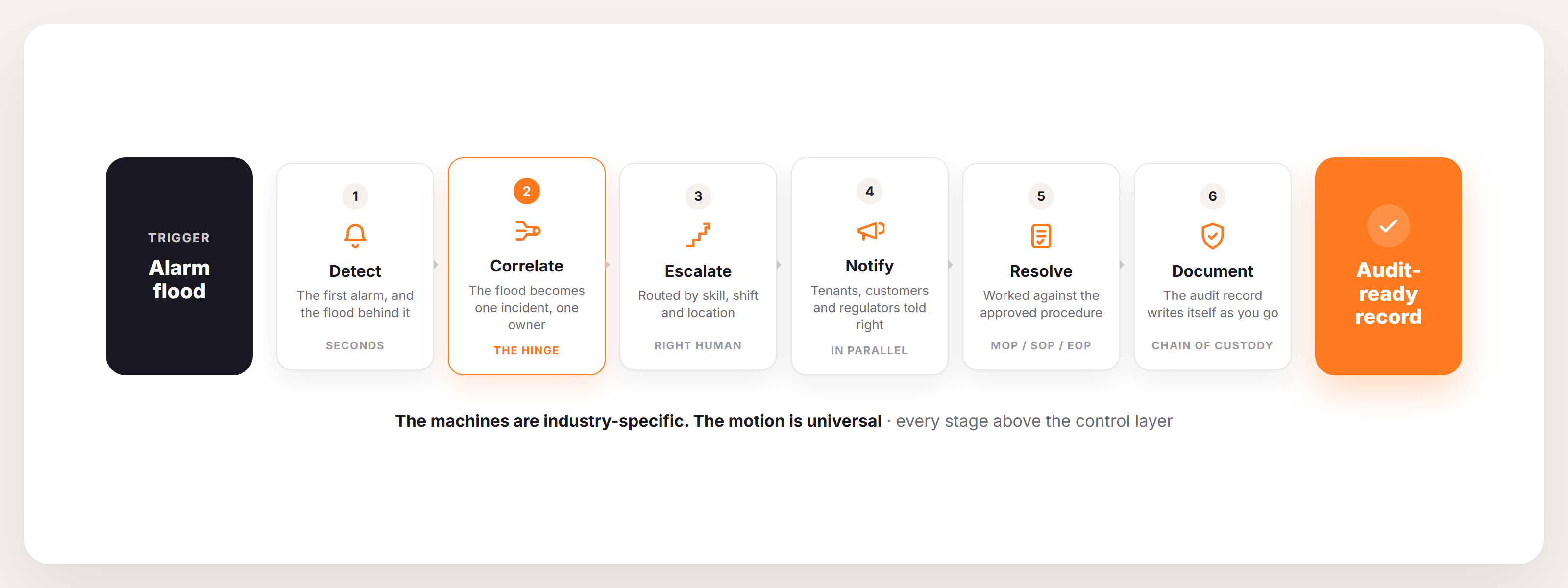
| Stage | What happens | Why it matters |
|---|---|---|
| 1. Detection | The first alarm fires, followed by a flood of related alarms | One physical failure rarely produces one alarm |
| 2. Correlation | Related alarms group into a single incident with one owner | Makes routing, notification, and documentation possible |
| 3. Escalation and routing | The right responder gets paged, by skill and location | The gap between a 2-minute and a 40-minute response |
| 4. Stakeholder notification | Affected parties get told, accurately and fast | The wrong message destroys trust |
| 5. Resolution | The team works an approved procedure (MOP, SOP, or EOP) | No improvising on live plant |
| 6. Audit record | A chronological, auditable record is produced automatically | "Resolved" isn't the same as "closed" |
Stage 1: Detection, the First Alarm and the Flood Behind It
Every incident starts with a trigger: an alarm from a monitoring or control system. The trap is that one physical failure almost never produces one alarm.
The chiller trip becomes forty-seven BMS alarms as every downstream pump, air handler, and temperature sensor reports the loss in sequence. The fiber cut becomes thousands of loss-of-signal alarms. The robot fault becomes a burst of PLC tags. The substation event ripples across remote terminal units.
This isn't a hypothetical nuisance; it's a measured, governed problem. The alarm-management standard ANSI/ISA-18.2 and the EEMUA 191 guideline put the acceptable average rate for a single operator at fewer than one alarm every ten minutes and define a flood as more than ten alarms in ten minutes. Forty-seven alarms in ninety seconds isn't a minor annoyance. Against any published benchmark, it's a catastrophic flood.
The detection challenge in mission-critical operations is rarely "did we see it?" It's "can a human find the one signal that matters inside the storm?"
Stage 2: Correlation, Turning the Flood into One Incident
This is the hinge of the entire anatomy. Correlation groups related alarms, by physical cause, by shared path, by asset hierarchy, into a single incident with a single owner, then enriches it with context: which asset, which location, which tenant or customer, what severity.
The effect is identical across industries. Forty-seven BMS alarms become one cooling incident mapped to Hall 2. Ten thousand loss-of-signal alarms become one fiber cut on a known route. A hundred process alarms become one unit upset. Once the flood collapses to a root cause, the operator works the cause instead of chasing fifty symptoms, and mean time to acknowledge, MTTA, the clock that matters most, collapses from minutes to seconds.
Correlation is also the gate everything else passes through. Until the system knows what happened, nothing can route to the right person, notify the right tenant, or produce a clean record.
Stage 3: Escalation and Routing, Reaching the Right Human
A correlated incident is worthless if it pages the wrong person, pages the right person at the wrong time, or pages someone who never sees it because they're forty feet up a cooling tower.
Mission-critical routing has to work across several dimensions at once: skill, shift, and location. It also has to reach a responder wherever they actually are, mobile push, SMS, email, chat, or a voice call if a page goes unacknowledged. The right responder is industry-specific, but the logic is identical. A chilled-water fault needs the on-call mechanical engineer, not whoever's nearest. A fiber cut needs a transport technician, not an RF tech. A pipeline alarm needs a field operator who can physically reach an unmanned site. Routing by skill and location, instead of a flat on-call list, is the difference between a two-minute response and a forty-minute one.
Cascades move in seconds, so escalation can't wait on someone noticing. If nobody acknowledges the page, the incident escalates and the phone rings. There's no queue for a thermal runaway.
Stage 4: Stakeholder Notification
While responders work the cause, a parallel obligation kicks in: the people affected by the incident need to be told, accurately, fast, and in the right words.
The audiences change by industry, but the pattern holds. A colocation operator owes proactive notice to Tier III tenants and a different message to lower tiers. A carrier owes affected customers a real scope and a real ETA, not ten conflicting updates. A plant owes production, planning, and quality a heads-up before bad product ships. An energy operator owes HSE (health, safety, and environment) teams, partners, and regulators a notice the moment a reportable threshold is crossed.
The nuance that matters most: there are usually two possible messages, "handled, you're safe" versus "at risk, here's what we're doing," and sending the wrong one destroys trust. Pre-positioned templates, triggered by severity and by tier, turn a frantic manual scramble into coordinated, defensible communication. Done well, this also heads off the flood of inbound "is my service okay?" calls that would otherwise consume the very responders trying to fix the problem.
Stage 5: Resolution Against Procedure
In mission-critical environments, nobody improvises on live plant. Resolution is governed by an approved Method of Procedure (MOP), Standard Operating Procedure (SOP), or Emergency Operating Procedure (EOP), the chiller-failure MOP, the grid-loss EOP, the line-restart SOP.
Good incident handling links that procedure directly to the live incident, lets the team collaborate in its own channels, and logs each step with a timestamp as it happens. Crucially, the IT service-management system of record, typically ServiceNow or Jira, stays authoritative, synced in both directions, so nothing ends up living in two places. The procedure gets followed and evidenced at the same time, which sets up the final, most overlooked stage.
Stage 6: The Audit Record
In every one of these industries, "service restored" is only half the job. The incident isn't truly closed until the record exists.
A colocation operator needs a per-tenant timeline for a Tier audit or an SLA-credit dispute. A utility needs evidence for a NERC CIP review. An energy operator needs a process-safety-grade account of what happened and who did what. A manufacturer needs accurate downtime reason codes to protect OEE, overall equipment effectiveness, the metric that measures how much of a plant's potential output gets produced. Reconstructing any of that by hand after the fact is slow, error-prone, and exactly what auditors distrust.
The discipline is making the audit-ready record, with full chain of custody, a byproduct of the response rather than a four-hour homework assignment afterward. Every alarm, escalation, notification, and procedure step gets captured chronologically as it happens. Then the post-incident review feeds back into the system, tuning correlation rules so the next flood is smaller, and refining routing so the next page lands faster. The anatomy closes the loop.
The Boundary That Makes It Trustworthy
One principle runs through all six stages, and it's worth stating plainly, because it's what earns credibility with operators: this orchestration happens above the control layer.
The system that correlates, routes, notifies, and documents does not actuate equipment, and it is not a safety system. SCADA, BMS, and DCS (distributed control systems) keep control. The safety instrumented system keeps the process safe. Orchestration coordinates the human response on top of all of it. An operator won't trust a vendor who blurs that line. They'll trust one who states it first.
Why the Anatomy Matters
Walk back through the five control rooms. The chiller, the fiber, the robot, the pipeline, and the substation could not be more different from one another. But the response that separates a rehearsed team from a chaotic one is identical in shape: detect, correlate, route, notify, resolve, document, all of it above the control layer, never touching the equipment itself.
That's the entire premise of mission-critical incident management. The machines are industry-specific. The motion is universal. Organizations that treat the anatomy as a discipline, instrumenting it rather than improvising it, turn their worst day into something closer to a drill: an alarm flood that collapses to one incident, reaches the right person in under two minutes, keeps every stakeholder correctly informed, follows the approved procedure, and writes its own audit trail on the way out.
The first alarm is going to fire no matter what. What happens in the minutes that follow, and the record that exists once it's over, is the part within anyone's control.
FAQ
What is Mission-Critical Incident Management (MCIM)?
Mission-critical incident management is the discipline of handling incidents in physical, operational environments, data centers, telecom networks, manufacturing plants, pipelines, and utility grids, where failures have physical consequences rather than just data or service consequences. It follows a six-stage anatomy: detection, correlation, escalation and routing, stakeholder notification, resolution against procedure, and the audit record.
What's the difference between IT incident management and mission-critical incident management?
IT incident management prioritizes confidentiality, integrity, and availability, in that order, and the worst-case outcome is typically data loss or exposure. Mission-critical incident management inverts the priority to safety first, then availability, then integrity, with confidentiality last, because the worst-case outcome can involve equipment destruction, environmental harm, or human injury.
What is MTTA, and why does it matter in mission-critical operations?
MTTA stands for Mean Time to Acknowledge, the time between an alarm firing and a human confirming they're working on it. In mission-critical environments, correlation is what allows MTTA to collapse from minutes to seconds, since a responder can address one grouped incident instead of triaging dozens or hundreds of individual alarms first.
What alarm-management standards apply to mission-critical operations?
ANSI/ISA-18.2 and the EEMUA 191 guideline are the two most widely referenced alarm-management standards. Both put the acceptable average alarm rate for a single operator at fewer than one alarm every ten minutes, and both define an alarm flood as more than ten alarms within a ten-minute window.
Does mission-critical incident management software control the equipment?
No, and that boundary is central to how the discipline works. Orchestration software correlates, routes, notifies, and documents, but it sits above the control layer. SCADA, building management systems, and distributed control systems retain control of the equipment itself, and a separate safety instrumented system keeps the process safe. The incident management layer coordinates the human response on top of that, without actuating anything directly.