One facility incident.
Not fifty alarms.
Mission-critical incident orchestration for data centers and colocation. Tier-aware, with DCIM, BMS and EPMS integrated and tenant communications automated, so your control room works the failing chiller, not the alarm flood.
Above the control layer. Never inside it.
Your BMS, DCIM and EPMS already monitor and control the plant. AlertOps sits above them, ingesting the alarms, correlating the flood into one incident, reaching the right responder, notifying tenants, and writing the audit record. We never actuate equipment and we are not a safety system.
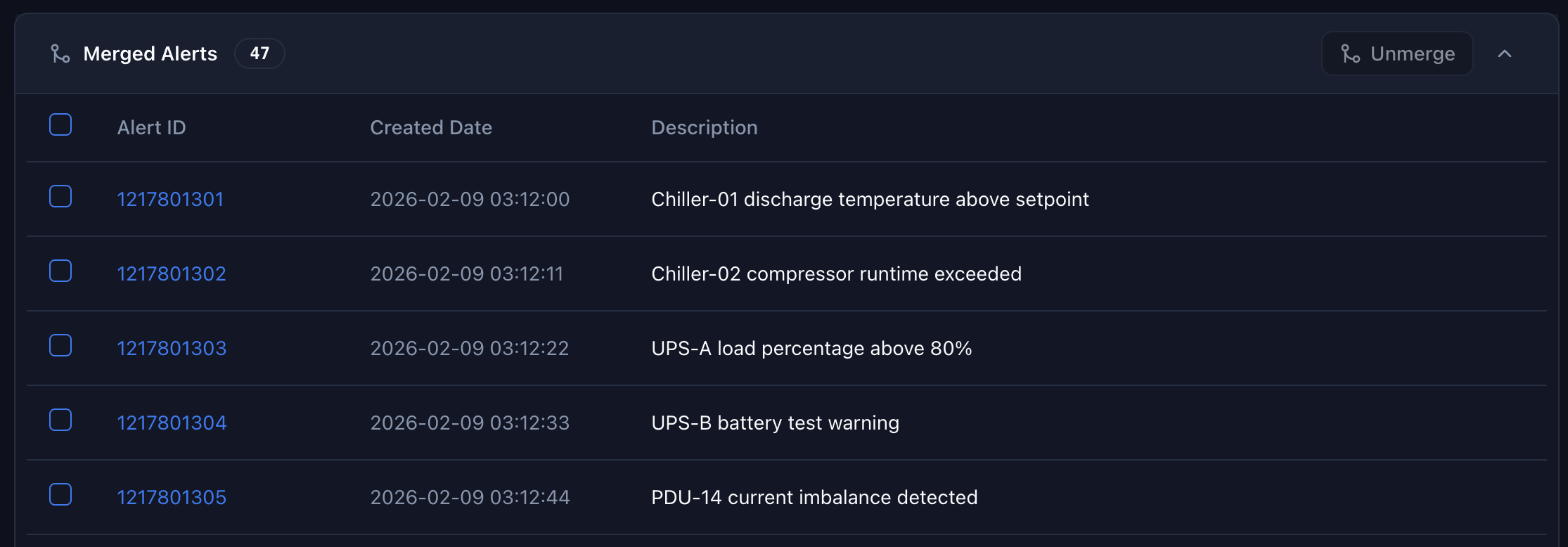
47 alarms in 90 seconds. One incident.
When a chiller trips or a feed drops, the BMS fires dozens of alarms across every downstream pump, CRAH and sensor. AlertOps correlates them, mapped to the affected hall via DCIM, into a single incident with one incident commander.
- Related alarms from BMS / DCIM / EPMS collapse into one record per physical event
- The operator works the cause, not fifty symptoms
- Affected racks, tenants and SLAs attached automatically
P1 facility event. The right engineer, paged in seconds.
AlertOps routes by skill, shift, location and tenant impact, so a chilled-water fault reaches the on-call mechanical engineer, not whoever is nearest. If a page goes unanswered, voice fallback fires automatically.
- Routing by skill + shift + site, not a flat on-call list
- Voice fallback for unacknowledged pages, responders are rarely at a desk
- Lower-severity events queue without disrupting an active response
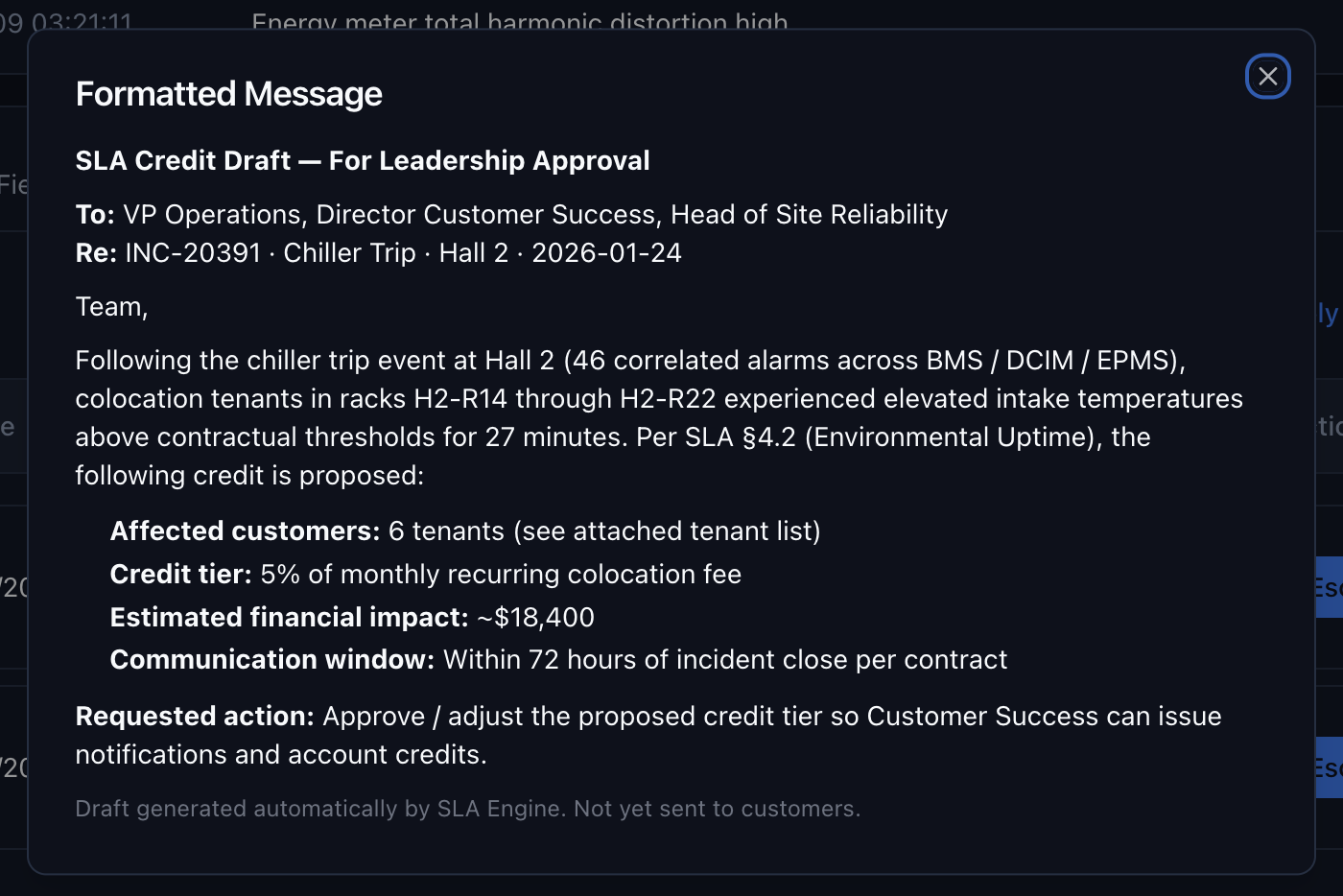
Tenants told in minutes. Not 45 minutes later.
Pre-positioned templates fire by tenant tier the moment an SLA threshold is crossed, and an SLA-credit draft is generated for approval, turning a 45-minute manual scramble into an automated, tier-correct notification.
- Tier III tenants get proactive notices; lower tiers get monitoring-only updates
- SLA-credit drafts routed to an exec when an excursion threshold is exceeded
- One coordinated message instead of a flood of "is my gear okay?" calls
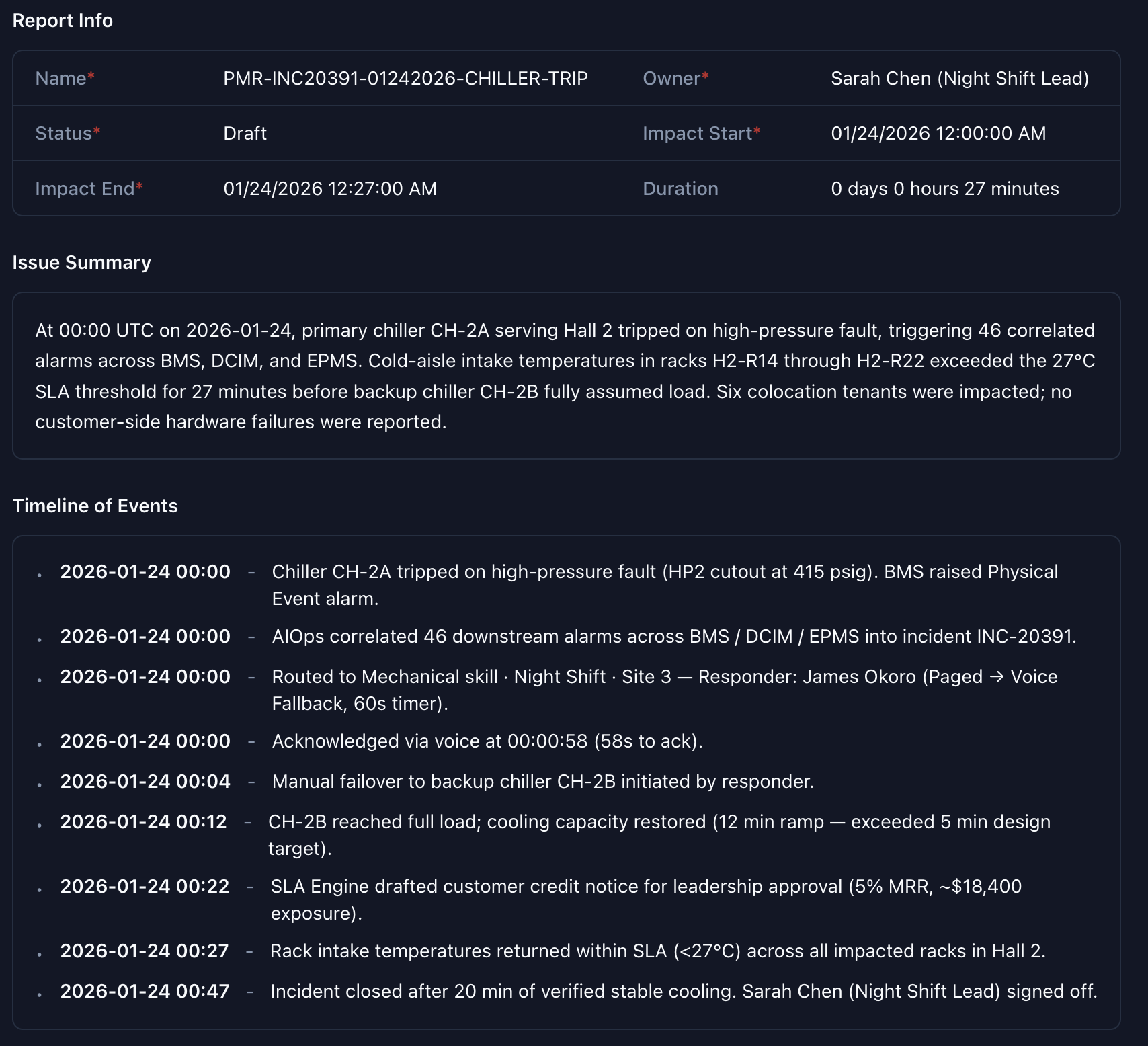
Every event documented. Per colocation tenant.
Every alarm, escalation, MOP step and resolution is captured chronologically with customer impact attached, so a Tier audit or a tenant dispute is answered with a click instead of a four-hour reconstruction.
- Per-tenant event timeline available the moment the incident closes
- Steps logged against the linked Method of Procedure (MOP) with chain-of-custody
- ServiceNow and Jira stay the system of record with full bidirectional sync
Ten scenarios that cover the operator's world.
From a cooling cascade to a portfolio review, every scenario follows the same anatomy: trigger, correlate, escalate, notify, resolve against the MOP, and produce the record.
Cooling cascade / chiller trip
A chiller or CRAH failure fires dozens of BMS alarms across every downstream pump and sensor; they collapse to one hall incident before temperatures cross the thermal limit.
Utility feed loss on UPS
A feed drops and the UPS goes to battery. The runtime clock, affected racks and load are attached automatically so the operator works the transfer, not the alarm list.
Generator failure-to-transfer
An ATS that doesn't transfer on utility loss is a P1 in seconds. The right electrical engineer is paged immediately, with voice fallback if unacknowledged.
Hot-aisle thermal runaway
Rising inlet temperatures in a containment aisle are correlated to the failing unit and escalated on a tightening clock, ahead of an automated equipment shutdown.
Tenant SLA excursion
An SLA threshold is crossed; tier-correct tenant notices fire and an SLA-credit draft is routed to an exec for approval, replacing a 45-minute manual scramble.
Leak / water detection under floor
Condensate or chilled-water leak sensors under a raised floor unify into one incident with location, so the crew is dispatched to the exact tile, not a zone.
PDU / branch-circuit breaker trip
A tripped PDU or branch breaker is localized to the affected rack row and tenant, so impact is scoped in seconds instead of a floor walk.
After-hours single-operator cover
On a thin night shift, an unacknowledged page escalates by skill and site with voice fallback, so no critical event sits waiting for someone at a desk.
Colo customer incident bridge
One coordinated tenant update and bridge replaces a flood of "is my gear okay?" calls, with every message logged against the incident record.
Multi-site availability review
Every site's incidents roll into one view — trends, repeat offenders and SLA exposure — for facilities leadership and the quarterly Tier audit.
Info to add: link each card to its one-pager + 2-min demo + workflow diagram
Plugs into the systems already in your control room.
We ingest from the facility and network systems you already run, and keep your ITSM the system of record. Representative platforms shown, only what ships.
BMS / EPMS
Building management and electrical power monitoring: chiller, CRAH, UPS and breaker alarms.
shipsDCIM
Asset, space and power mapping so an alarm resolves to the exact hall, rack and tenant.
shipsNMS / SNMP
Network and environmental sensor traps for temperature, humidity and connectivity.
shipsITSM
Stays your system of record. ServiceNow & Jira with full bidirectional sync.
shipsChatOps / Comms
Teams and Slack, plus SMS and voice, for responders in the field and tenant notices.
shipsInfo to add: confirmed integration logos and exact shipping list from Product
Built on a foundation your auditors trust.
AlertOps is independently audited to SOC 2, so the platform handling your most critical incidents meets a rigorous third-party security and availability standard.

SOC 2
Independently audited controls for security, availability and confidentiality of the AlertOps platform. Report available under NDA on request.
Info to add: confirm SOC 2 Type (I/II) and report wording with Security
Trusted in some of the world's most demanding colocation and hyperscale environments.
Your facility never sleeps.
Your response shouldn't either.
See how AlertOps turns an alarm flood into one orchestrated incident, in a 30-minute working session mapped to your busiest halls.