A complete guide to modern incident management and how it’s transforming into a strategic business function.
If you’ve worked in IT, infrastructure, or operations for any length of time, you’ve lived through the chaos of a critical incident. Systems down, alerts blaring, Slack pinging, emails piling up and somewhere in that noise, your team is trying to figure out what actually broke and how to fix it fast.
We sat down with Kam Srikanth, Product Manager at AlertOps, to cut through the jargon and get into what incident management really means today and where it’s headed.
First, What Even Is an Incident?
Before you can manage incidents, you need to agree on what one is. And that’s more nuanced than it sounds.
“If you look at an incident from an IT perspective, something that is a lot more minor could be an incident for the organization that impacts top-line revenue. From a managed services perspective, there’s an incident on behalf of the customer, but depending on your service level agreements, there might not necessarily need to be that level of urgency affiliated with it.”
At a high level, an incident is any issue, outage, or problem that directly contributes to business operation loss or revenue loss. But the context internal IT, managed services, SaaS product shapes how urgently it needs to be treated.
At its simplest, the meaning of incident in IT refers to any unplanned disruption or degradation of service. But as the definition above shows, that meaning shifts depending on your context what’s a minor blip for one team could be a revenue-critical emergency for another.
So What Is Incident Orchestration?
If incident management is about tracking and resolving problems, incident orchestration is about coordinating everything that needs to happen around the resolution without it falling apart into chaos. For a deeper look at how this plays out in practice, see AlertOps’ guide on major incident management.
Orchestration covers three core things:
- Making sure the right people know: Not just that an incident exists, but that the specific people who need to act on it are notified, with the right information.
- Assembling the team: Very rarely is an incident a one-person resolution. It takes your database team, SRE team, engineering, production support, and possibly account management all working in parallel.
- Coordinating without overwhelming: Assigning responsibilities clearly and disseminating information so responders can stay focused on fixing the problem, not manually tracking who’s doing what.
The goal is to reduce manual overhead so the people closest to the problem can actually focus on solving it.
The Alert Fatigue Problem (And Why It’s Getting Worse)
Alert fatigue is one of the most talked-about challenges in incident management and it’s been around forever. But it’s gotten dramatically worse.
Think about what it takes to deliver a seamless streaming experience on something like Netflix. For the consumer, it’s effortless. But underneath, there’s an enormous layer of cloud complexity making that possible. Every time the industry ships a better product through microservices, cloud migrations, or digital transformation, it introduces more moving pieces and more points of failure.
Engineering and operations teams respond rationally: they set low-threshold alerts on everything they’re responsible for. The result is that one incident surfaces as dozens of simultaneous alerts all symptoms of the same underlying problem. That’s alert fatigue.
Why Monitoring Matters Incident monitoring isn’t just about knowing something broke it’s about having the right visibility across your stack so that when something does break, you’re not starting from zero. Effective incident monitoring means fewer surprises and faster time-to-detect.
The fix isn’t just better alerting. It’s intelligence. The right approach uses machine learning and AI to analyse historical patterns around service and device failures, then correlates and consolidates those signals into something actionable silencing the noise so responders can focus on the one thing that actually matters.
When Everything Is Blaring, How Do You Find the Real Incident?
This is where a lot of teams get stuck. Alerts are coming from your APM, your infrastructure monitoring, your cloud provider, your database and they’re all screaming at once.
Here’s the honest answer: AI can help pattern-match, but it can’t replace institutional knowledge.
The one thing AI cannot do is know your business better than you do. Operations teams need clearly defined playbooks that determine what layers of response will be automated and orchestrated and what roles and responsibilities exist for each type of incident, whether that’s customer communication or threat mitigation.
That means using AI to analyse historical patterns and document postmortems so tribal knowledge doesn’t stay siloed in individual heads. But humans still define the playbooks that determine what gets automated and who does what when things go sideways.
Where Incident Workflows Break Down
Ask most teams where their incident communication happens, and the answer is often: email.
It sounds almost absurd, but critical issues are still being communicated via email mixed in with automated monitoring alerts, marketing messages, and sales outreach. By the time anyone tries to find the signal in that noise, precious minutes have already been lost.
Gartner data puts downtime costs at an average of $7,600 per minute for Fortune 500 companies and higher at the enterprise level. Spending 20 minutes hunting for the right email thread is a genuinely expensive problem.
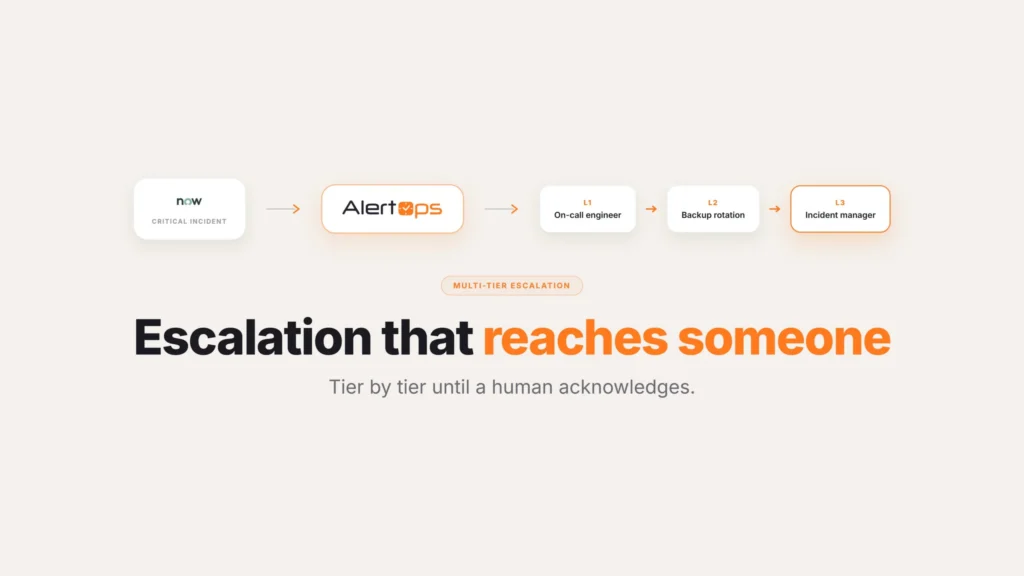
The solution is multi-channel communication with automated escalations built in treating redundancy as an insurance policy. The right message to the right person at the right time. That includes, when necessary, overriding do-not-disturb settings on mobile when the business is losing money by the minute. See how AlertOps handles on-call management for your team.
Keeping Stakeholders Informed (Without Overwhelming Them)
One of the trickiest parts of incident response is figuring out who needs to know what because a CEO and an SRE need very different information.
- A CEO doesn’t need to know that a specific service in a specific AWS region failed due to CPU usage. They need to know: payments are down, a team is on it, and an update is coming in 15 minutes.
- A customer needs a plain-language message about the outage and who to contact.
- An SRE team needs the full technical picture and nothing else.
The solution is templated, automated communications tailored to each audience so the right information reaches the right stakeholder without anyone having to manually draft five different updates in the middle of an active incident.
The IT/OT Gap: A Real and Unsolved Problem
One of the less-discussed challenges in incident management is the disconnect between IT and operational technology (OT) or facilities teams especially in environments like data centres.
When IT rolls out a patch, the facilities team often has no idea. When there’s an issue caused by high humidity in a data centre, IT has no idea. Neither team is necessarily doing anything wrong they just operate in separate worlds.
Not every minor event needs to cross team boundaries. But when something threatens top-line revenue, both sides need visibility. The reality is that most organizations are still working toward that level of cross-functional maturity.
Why Custom Scripts Are a Trap
Many teams build homegrown incident workflows with custom scripts. It works – until it doesn’t.
The cost of AI-assisted development has dropped significantly, but the cost of testing and quality assurance has not. A script that solves a problem this month works great until the library it depends on is deprecated. And unless there’s a dedicated resource maintaining that workflow, it’s only a matter of time before it breaks silently on a weekend, during a major incident.
For something as critical as incident response, that’s not a risk worth taking. Scalable, well-maintained platforms beat clever scripts every time.
Choosing the right incident management system is a core part of building a resilient stack. The best incident management tools don’t just alert they correlate, orchestrate, and communicate. Whether you’re evaluating an incident management application for a small DevOps team or an enterprise-grade platform, the criteria remain the same: noise reduction, smart escalation, and multi-channel communication.
What Would a Ground-Up Incident Stack Look Like?
If you were designing an incident management process from scratch today, the first priority should be reevaluating what actually needs to make noise.
Every observability platform application monitoring, database monitoring, on-premise device monitoring is configured to alert. But the volume of that noise directly determines how effective the response process can be. Cutting off the problem at its source is always better than putting a Band-Aid on a broken bone.
The right hierarchy:
1. Reduce noise at the monitoring layer first → 2. Correlate remaining signals intelligently → 3. Orchestrate a structured, automated response
Platforms with built-in correlation and merging capabilities help enormously, but they’re most powerful when the underlying signal has already been filtered.
AI in Incident Management: The Honest Take
Everyone is slapping “AI-first” on their product right now. But knowing where AI actually drives value versus where it just adds noise to the ecosystem is what separates useful tools from shiny ones.
An incident response platform is not an AI tool. It’s a response orchestration tool with AI functionality that enables more effective response. That’s an important distinction.
You’re not going to throw a general-purpose AI at a production outage and solve it. You need structured processes within which AI makes sense pattern recognition, historical correlation, postmortem documentation. Within those boundaries, AI is genuinely powerful. Outside of them, it’s a liability.
Who Actually Needs This?
Incident management platforms aren’t just for massive enterprises. The core customers are SRE and DevOps teams, service desks, managed service providers, data centres, and retailers with e-commerce operations.
But the underlying need is simple: if you have something that needs to stay up, and you need to respond when it doesn’t, you need a structured approach to incident management.
The use cases are broader than most people expect. Teams are even connecting biometric monitoring data to get alerted on health spikes. The common thread is always the same something needs to be on, and someone needs to know immediately when it’s not.
Regardless of team size or industry, the right tools for incident management make the difference between a 5-minute resolution and a 2-hour outage. The platform matters less than the process but having a purpose-built incident management application ensures your process actually scales.
The Bottom Line
Incident management is evolving from reactive fire-fighting toward proactive orchestration. The difference is structure: knowing who needs to know what, automating the coordination that used to happen manually, and using AI where it genuinely helps rather than where it just looks good on a roadmap.
The teams that respond well to incidents aren’t necessarily the ones with the best tools. They’re the ones who’ve done the harder work of defining playbooks, reducing their noise floor, and making sure the right people get the right information before things spiral.
Everything else the platforms, the integrations, the AI is in service of that.