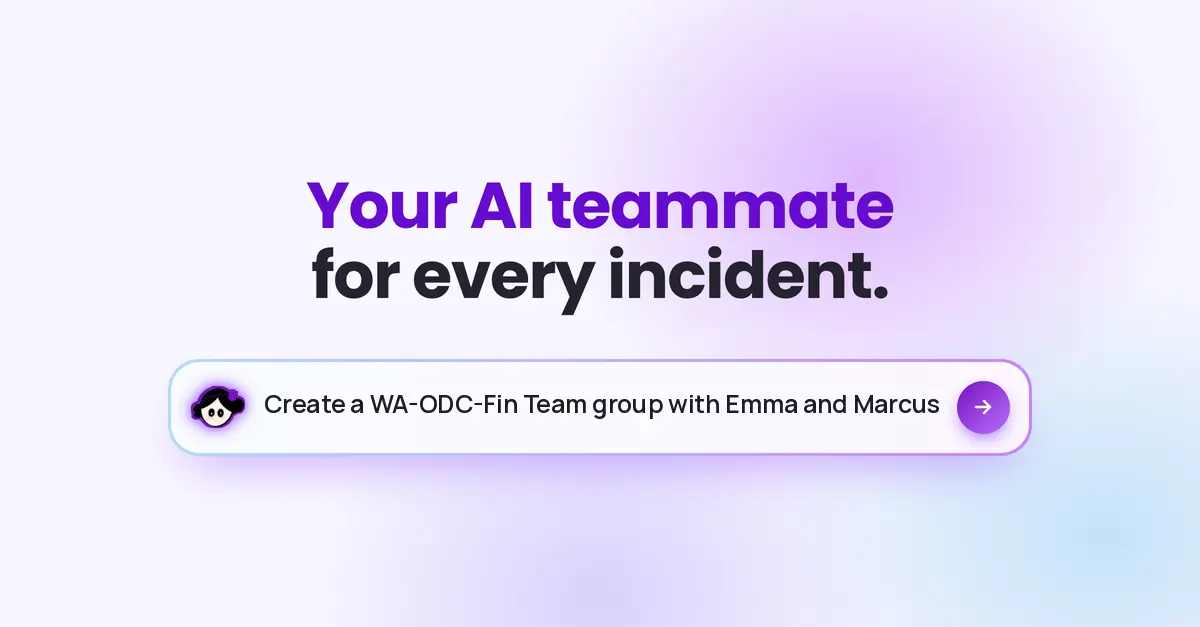
Live in OpsIQ, with no separate AI price and nothing to install
AlertOps, the incident orchestration platform used by enterprises across IT operations, healthcare, financial services, retail, e-commerce, and government, today announced that Ada AI Assistant is live in the OpsIQ™ intelligence layer. Ask her who is on call and she answers from live data, not a snapshot from last night. Ask her to fix a coverage gap and she goes further: she can create a group, add someone to it, acknowledge an alert, build a shift, schedule an out-of-office with cover, or set up a new user account. Every one of those changes’ lands in front of a person for approval before anything takes effect. Ada proposes. She never decides.
Ada is part of the AlertOps platform. There is no separate AI price, nothing to install, no integration project, and support is included the same way it is everywhere else in the platform.
The problems Ada solves are rarely about missing information. They are small tasks that show up at the worst possible time. A flight gets delayed, and someone’s coverage needs to be moved. An engineer is buried in a live incident and cannot step away to reassign a rotation or add a backup. None of that takes long to fix, but it always seems to land on whoever has the least time to spare.
Before Ada, fixing it meant opening the platform and making the edit yourself, or tracking down the one person who knew how. Now Ada builds the change in seconds. A person still has to say yes to it. She can put together a shift swap or a new group before you’ve finished your coffee, but she cannot make either one stick without someone reviewing it first.
Infrastructure doesn’t stand still anymore. Cloud environments scale by the week, and AI is only accelerating how fast new services and deployments come online, which means the systems watching over them have to keep pace, or they fall behind quietly. Ada is built for that pace. She simplifies the configuration work of standing up a new integration, pulls the real context the moment an alert fires, and shows a team exactly where an escalation chain or a response is breaking down as the environment around it keeps changing. Response can’t stay static while everything else moves this fast, and Ada is how we’re making sure it doesn’t. That’s the clearest example yet of where AlertOps is headed.
Chellasamy Jamburajan, CEO, AlertOps
Ada takes requests the way people actually write them at three in the morning, typos and all, and works out what is being asked and who it touches. Before she proposes anything, she checks it against the real schedule: who is actually available, who already belongs to a group, what the current rotation says. If a name in a request does not match anyone active, she flags that and offers the real options rather than guessing one.
Once she has a change worked out, she stops. She puts it in front of a person, with the who, the when, and what it replaces spelled out, and waits for a decision. Approve it, and it applies. Turn it down, and it cancels without leaving anything half-finished. No stray override sitting in the schedule. No group was half-built.
When something is missing from a request, like which team or which alert someone means, she asks rather than fills in the blank on her own. And if a question sits outside, what she is set up to help with, she says so plainly instead of returning an answer that merely sounds plausible.
All of this happens inside the AlertOps platform, so a change and whoever approved it stays visible to the team rather than living in someone’s head or an untracked side conversation. Ada also reads live data at the moment someone asks, nothing cached overnight, and she does not get around the access controls already in place. If a role cannot see a schedule today, asking Ada will not change that.
Any agent that touches live operations has to earn three things, and I would hold anyone to them, including us. It has to work from live data, not a copy. It has to show you the change before it makes it. And it has to leave a record with a name on it. If you price the AI separately, you are telling your customer it is optional. We do not think it is.
Kamalesh Srikanth, VP of Product & Customer Operations, AlertOps
In 1843, Ada Lovelace wrote the world’s first algorithm and described a machine capable of more than calculations. “That brain of mine is something more than merely mortal,” she wrote, “as time will show.” AlertOps named its agentic AI after her on purpose. She did not just describe what a machine could compute. She described what it could do. Before Ada AI Assistant proposes a new group, a shift swap, or a new user account, she has already worked out who it affects, what it replaces, and whether the person asking is allowed to ask for it.
Ada AI Assistant joins the OpsIQ family alongside the Smart Correlation Engine, which groups related alerts in real time using similarity modeling, NLP, and customizable thresholds; Intellifield Reasoning Agents, which apply structured reasoning to unstructured alerts and trigger workflows from what they find; Historical Alert Insights, which surfaces resolutions that worked on similar incidents in the past; and Agent Chronicle, which automates postmortem writing so teams stay audit ready.
AlertOps reports that OpsIQ cuts alert noise by 68 percent and improves response time by 50 percent. Every OpsIQ capability, Ada included, is part of the AlertOps platform rather than a separately priced module.
Learn more about Ada at https://alertops.com/platform/opsiq/ada/
AlertOps is an incident orchestration and alert management platform used by many of the world’s largest enterprises. With over 200 pre-built integrations, intelligent noise reduction powered by OpsIQ™, and advanced on-call scheduling capabilities, AlertOps helps organizations improve issue notification, escalation, and time to resolution.
The platform combines intelligent alerting, escalation management, on-call scheduling, and stakeholder communication into a single operational environment. Learn more at alertops.com.
AlertOps Communications