PagerDuty is the most credible incumbent in dedicated incident response, and any honest Opsgenie-replacement comparison has to take it seriously. The on-call scheduling engine is battle-tested across years of enterprise production load. The integration catalog is one of the broadest in the category. The Spring 2026 Release expanded the AI partner ecosystem to thirty-plus vendors, shipped MCP plugins for Claude Code and Cursor, and continues evolving the SRE Agent into a virtual responder that joins escalation policies. For organizations standardized on PagerDuty with mature event routing, the platform delivers.
The comparison with AlertOps narrows on three structural questions that matter at enterprise scale: how the commercial structure handles enterprise responder populations, where AI sits in the response pipeline, and whether the platform operates at the incident response layer or the incident orchestration layer. PagerDuty’s strengths are real. The trade-offs are also real. This guide is the side-by-side comparison for teams making the call.
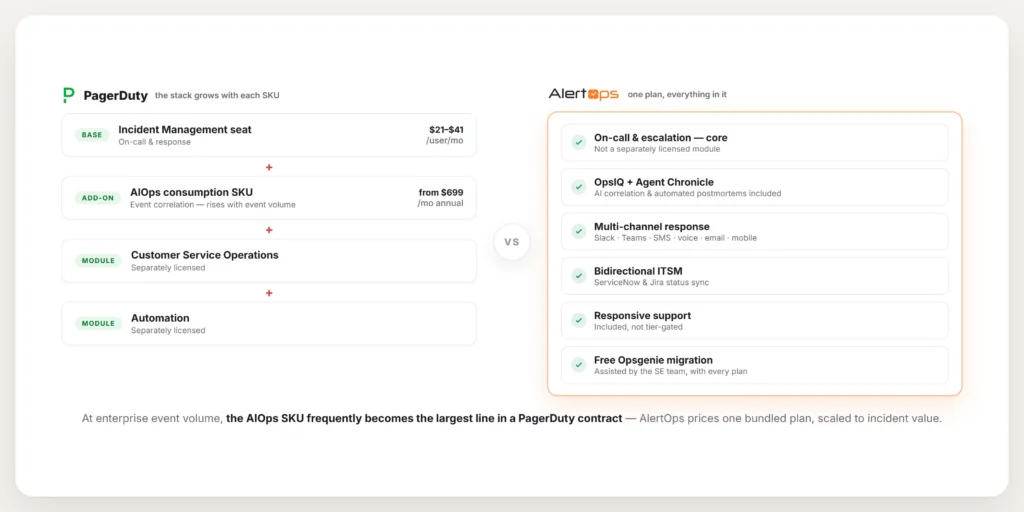
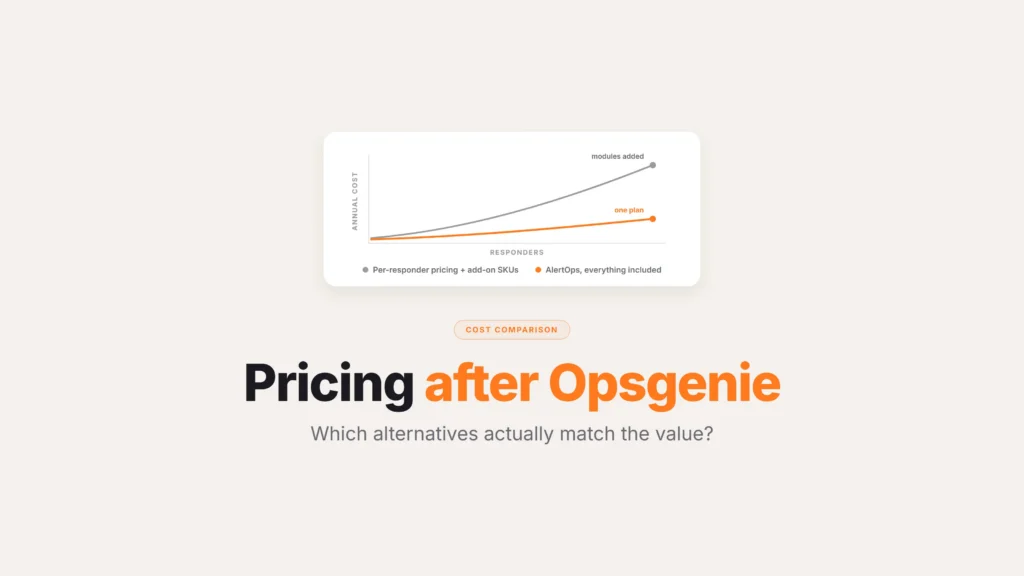
Comparison diagram showing PagerDuty’s stacked SKU pricing model (Incident Management seat at $21-41/user/mo plus separate AIOps consumption SKU starting at $699/mo annual plus Customer Service Operations module plus Automation module) versus AlertOps’s single bundled plan (on-call core, OpsIQ AI correlation and Agent Chronicle automated postmortems, multi-channel response, bidirectional ITSM, responsive support, and free Opsgenie migration program at the Enterprise tier).
Side-by-side comparison
| Dimension | PagerDuty | AlertOps |
|---|---|---|
| Architectural layer | Incident response with AIOps add-on | Incident orchestration platform |
| On-call in base plan? | Yes, included in all IM tiers | Yes, core capability |
| AI / AIOps in base? | No – separate SKU starting $699/mo annual | Yes – OpsIQ + Agent Chronicle included |
| Responsive support in base? | Tier-gated (email at Pro, 24×7 at Business+) | Yes – included in AlertOps Enterprise |
| Base pricing | $21/user/mo Pro, $41/user/mo Business | Custom, scaled to incident value |
| Multi-channel response | Strong | All 6 channels as architectural peers |
| Bidirectional ITSM | Mature | First-class architectural capability |
| Compliance-grade audit | Strong | Agent Chronicle (AlertOps Enterprise) |
| Integration catalog | Industry-broadest (650+) | 200+ with bidirectional depth |
| Free Opsgenie migration tool | Migration services available | Free migration team + automated tool included |
| Independent vendor | Public company, multiple acquisitions | Independent, single product focus |
The features overlap substantially. Where the comparison sharpens is on packaging, architecture, and where each platform was built to win.
The PagerDuty pattern Opsgenie migrants actually describe
Before the architectural comparison, the buyer-side framing of PagerDuty matters. The dominant phrase in customer evaluations is “giant bucket.” A 200-user dev tools platform that migrated from PagerDuty to Opsgenie and is now evaluating again summarized it directly: “We were originally a PagerDuty using company. At the time PagerDuty was kind of this thing where it was just this giant bucket of a bunch of routing rules and alerts and all that, and we hated that because from a management perspective it was just impossible to keep everybody straight. The principal reason we moved over from PagerDuty to OpsGenie was the fact that we can centrally manage the teams.”
The second pattern is the $800-per-advanced-feature paywall. A mid-market US IT operations lead at a CCSI-style firm walked away from a PagerDuty trial after a month: “Although it seems to connect really well to our stuff – our Fortigate firewalls, Meraki switches and access points, even Windows servers – it’s got good connectivity. But every advanced feature pretty much in the platform is paywalled behind an $800 upgrade. We’re not going to pay that much for alerting, so we’re looking at other alternatives now.” The buyer-side pain isn’t the headline seat price. It’s the experience of paying again every time you need a feature you assumed was core.
A third pattern, from an aerospace and defense incident response lead: “We’ve got to get rid of PagerDuty. I don’t really care what I need to do or who I need to bribe, but.” Strong sentiment from a real Fortune-class customer in 2026.
What PagerDuty does best
The strongest PagerDuty arguments are concrete and worth naming honestly before any AlertOps comparison.
Integration catalog breadth. PagerDuty’s integration marketplace is the broadest in the category. For environments running long-tail integrations (every observability tool, every ITSM, every chat platform, every cloud provider, every custom in-house system), the probability that PagerDuty has a maintained connector is the highest in the category. AlertOps’s 200+ catalog covers the integrations enterprise customers actually depend on, but PagerDuty’s 650+ catalog wins on raw count.
Mature event routing engine. PagerDuty’s escalation policy engine has been in enterprise production for over a decade. The edge cases, the override behaviors, the policy chain semantics are battle-tested across millions of incidents. For organizations whose existing PagerDuty deployment encodes years of operational tuning, the migration cost of moving away from that engine is real.
AIOps depth (when purchased separately). PagerDuty AIOps is one of the most mature noise-reduction and event-intelligence engines in the category, with capabilities developed across multiple acquisition cycles. The Spring 2026 Release’s AI partner ecosystem and SRE Agent evolution show real product velocity. For organizations willing to purchase AIOps as a separate SKU, the AIOps capability is competitive with anything in the category.
Enterprise sales motion. PagerDuty has the most developed enterprise sales motion in the dedicated incident response category. For organizations whose procurement process expects a public-company vendor with named CSMs and contract-grade SLAs, PagerDuty delivers that experience.
These are real strengths and they apply for the right organizational profile.
Where the comparison sharpens for enterprise Opsgenie migrations
Three structural questions decide the comparison for most enterprise teams migrating off Opsgenie.
Question 1: How does the commercial structure handle enterprise responder populations?
PagerDuty’s commercial structure is per-user with module-based add-ons. Incident Management at $21/user/mo Professional or $41/user/mo Business is the base. AIOps starts at $699/mo annual as a separate consumption-based SKU and rises with event volume. Customer Service Operations and Automation modules layer on additionally.
For organizations whose responder population is in the low hundreds and whose alert volume is moderate, the per-user pricing produces predictable cost. For organizations whose responder population extends into the thousands (operators, vendor contacts, multi-tier NOC staff) and whose alert volume reaches enterprise scale (200+ services, multiple observability sources), the stacked SKUs accumulate. The AIOps consumption pricing in particular can become the largest line in an enterprise PagerDuty contract.
AlertOps’s commercial structure scales to incident value rather than to seat count alone, with custom Enterprise pricing that bundles on-call, AI (OpsIQ + Agent Chronicle), multi-channel response, bidirectional ITSM, and responsive support. For enterprise responder populations, the bundled-everything structure frequently produces lower TCO than the stacked-SKU model.
Question 2: Where does AI sit in the response pipeline?
PagerDuty AIOps operates on alerts after they reach the response platform. It correlates, deduplicates, and ranks the events flowing through the system, with strong capabilities for noise reduction once events are in scope.
AlertOps OpsIQ operates upstream of the responder queue. Signals from observability platforms arrive at the ingestion layer, where the correlation engine groups them across similarity modeling, NLP, and configurable thresholds before a human responder is notified. Duplicates suppress entirely, related signals group, and the responder receives enriched incidents rather than raw alert streams.
The placement difference matters operationally. Upstream correlation prevents noise from reaching the responder queue in the first place. Downstream correlation filters noise the responder has already started processing. For environments where alert fatigue is the dominant operational concern, upstream architecture produces different outcomes than downstream filtering. AlertOps platform data shows up to 68% alert noise reduction in enterprise environments, achieved before the responder sees the queue.
The placement difference also matters commercially. OpsIQ is included in AlertOps Enterprise. PagerDuty AIOps is a separate consumption SKU.
Question 3: Is the platform architected at the incident response layer or the incident orchestration layer?
PagerDuty operates primarily as an incident response platform, coordinating the human workflow once an alert becomes an incident. AIOps capabilities extend this into orchestration-adjacent territory.
AlertOps operates at the incident orchestration layer, sitting above and across the stack. The architectural distinction shows up in four areas:
- Ingestion and correlation happen upstream of the responder, with OpsIQ producing enriched incidents rather than raw alert routing.
- Routing is multi-dimensional and policy-driven, evaluating service ownership, severity, time, channel preference, vendor handoff, and compliance requirements in parallel through one policy.
- Multi-channel response treats six surfaces as architectural peers (Slack, Teams, SMS, voice, email, mobile), not as fallbacks to a chat-primary or email-primary workflow.
- Bidirectional ITSM integration is first-class, with ServiceNow and Jira as architectural peers rather than webhook targets.
The distance here isn’t a feature gap; it’s an architecture gap, and the two categories of platform were built to solve different problems. For enterprise environments whose scale and operating model demand orchestration (financial services, healthcare, telecom, data center operations, MSP, critical infrastructure), AlertOps is the platform built for that layer.
See how AlertOps handles the orchestration layer at alertops.com/demo.
When PagerDuty is the right answer
For specific organizational profiles, PagerDuty is the right Opsgenie replacement.
Engineering organizations already standardized on PagerDuty with years of operational tuning in the escalation engine, and a clear procurement preference for public-company vendor relationships, should evaluate PagerDuty as the natural continuation. The migration cost of moving away from a mature PagerDuty deployment is real and the platform delivers for that profile.
Organizations whose primary operational problem is downstream event correlation and AIOps depth, and whose budget can absorb the AIOps consumption SKU on top of the IM seats, get one of the most mature AIOps engines in the category.
Mid-market to enterprise environments whose responder population is bounded (low hundreds) and whose alert volume is moderate frequently find PagerDuty’s per-seat pricing predictable enough that the stacked-SKU model works.
For these profiles, PagerDuty’s strengths are decisive. The honest comparison surfaces this rather than pretending AlertOps wins every dimension.
When AlertOps is the right answer
For other enterprise profiles, the architectural and commercial case for AlertOps holds.
Organizations whose responder population extends well beyond the engineering team (operators, vendor contacts, multi-tier NOC staff, compliance officers) frequently find AlertOps’s bundled-everything pricing produces lower TCO than PagerDuty’s stacked SKUs at enterprise responder counts.
Environments whose primary operational problem is upstream alert noise (rather than downstream event correlation) get correlation placed at the ingestion layer rather than after the responder queue, with the AI capability included rather than billed as a separate consumption SKU.
Regulated industries that need compliance-grade audit as a first-class output (rather than as a tier upgrade or a feature of the support contract) get Agent Chronicle as part of the Enterprise plan.
Teams whose ITSM is ServiceNow and whose operating model requires bidirectional integration as an architectural peer (rather than as a webhook) get the first-class ServiceNow integration AlertOps was built around.
For these profiles, AlertOps’s architecture and commercial structure produce outcomes PagerDuty’s category-different approach doesn’t reach.
The decision comes down to a few honest questions
The comparison narrows to three questions whose answers determine the right choice.
What does your responder population look like? Bounded engineering team in the low hundreds – PagerDuty’s per-seat economics work. Extended population including operators, vendor contacts, and stakeholders well beyond engineering – AlertOps’s bundled structure typically wins on TCO.
Where is your primary AI value? Downstream event correlation and AIOps depth – PagerDuty AIOps is competitive (with the separate SKU). Upstream alert noise reduction at the ingestion layer – AlertOps is architected for this and ships it in the base plan.
What architectural layer fits your operating model? Incident response with mature event routing – PagerDuty fits. Incident orchestration with multi-channel response across six surfaces, bidirectional ITSM as first-class, and compliance-grade audit – AlertOps is the architectural fit.
For Opsgenie migrants whose evaluation surfaces orchestration as the architectural fit and whose enterprise responder populations break the per-seat math, AlertOps is the answer. For the profiles where PagerDuty’s category-mature strengths apply, PagerDuty is the answer. The honest comparison gives both their due.
Book a demo at alertops.com/demo to see how AlertOps handles your specific environment and how the comparison plays out against your current PagerDuty evaluation.
Frequently asked questions about AlertOps vs PagerDuty
AlertOps vs PagerDuty – which is better for replacing Opsgenie?
For enterprise teams whose responder population extends well beyond the engineering team, whose primary AI value is upstream alert correlation at the ingestion layer, and whose operating model requires orchestration-layer capabilities (multi-channel response, bidirectional ITSM, compliance-grade audit), AlertOps is the better Opsgenie replacement. For engineering organizations already standardized on PagerDuty with years of operational tuning, or whose budget absorbs AIOps as a separate consumption SKU, PagerDuty is the natural continuation.
What’s the difference between AlertOps and PagerDuty pricing?
PagerDuty is per-user with module-based add-ons: Incident Management at $21/user/mo Pro or $41/user/mo Business, AIOps as a separate consumption SKU starting at $699/mo annual, Customer Service Operations and Automation as additional modules. AlertOps Enterprise pricing is custom and scaled to incident value, bundling on-call, AI (OpsIQ + Agent Chronicle), multi-channel response, bidirectional ITSM, and responsive support.
Is AIOps included in PagerDuty?
No. PagerDuty AIOps is a separate consumption-based SKU starting at $699 per month annual, layered on top of an Incident Management seat. Organizations whose value from incident management is heavily AI-correlated should budget for AIOps as a meaningful additional line item in the PagerDuty contract.
Does AlertOps have AIOps?
Yes. AlertOps’s OpsIQ correlation engine operates upstream of the responder queue, with platform data showing up to 68% alert noise reduction in enterprise environments. OpsIQ and Agent Chronicle are part of AlertOps Enterprise, not sold as a separate AIOps SKU.
Which has more integrations, PagerDuty or AlertOps?
PagerDuty’s integration catalog (650+) is the broadest in the category by raw count. AlertOps’s catalog (200+) is narrower but applies depth requirements (bidirectional integration, status synchronization, lifecycle alignment) across the integrations enterprise customers actually depend on. For long-tail custom integrations, PagerDuty’s count advantage matters. For depth across core ITSM and observability connectors, AlertOps’s depth-over-count approach matters.
Is PagerDuty a public company?
Yes. PagerDuty (PD) is publicly traded on the NYSE. AlertOps is privately held and independent, with a single product focus and a roadmap shaped by enterprise customer requests rather than by public-company quarterly cycles or portfolio strategy across multiple acquisitions.
Does PagerDuty offer free migration from Opsgenie?
PagerDuty offers migration services for Opsgenie customers as part of their Opsgenie-migration program. The scope and cost of services vary. AlertOps includes a free migration team and automated tool with every plan; the tool captures Opsgenie escalation policies, on-call schedules, integrations, and user mappings via the API and reproduces them in AlertOps for incremental cutover.