The Opsgenie pricing model that enterprise teams adopted ran roughly $9-39 per responder per month depending on tier. For organizations with two hundred to seven hundred responders across operators, vendor contacts, and on-call rotations, the per-responder math was predictable and the TCO held flat as responder count grew. That predictability was a meaningful part of why Opsgenie won in the enterprise band.
The replacement market does not share Opsgenie’s pricing structure. JSM Operations meters at JSM agent seats. Incident.io and Rootly unbundle on-call as a separate paid module. PagerDuty bundles on-call but charges AIOps as a separate consumption SKU starting at $699 per month annual. xMatters, Grafana Cloud IRM, and AlertOps each take a different approach. The result is that the headline sticker price almost never reflects the actual enterprise TCO, and the cheapest platform on the shortlist is rarely the cheapest in production.
This guide is the verified May 2026 pricing comparison across the seven Opsgenie alternatives enterprise teams are evaluating. Current pricing, what’s included versus what costs extra, and what real TCO looks like at enterprise responder counts.
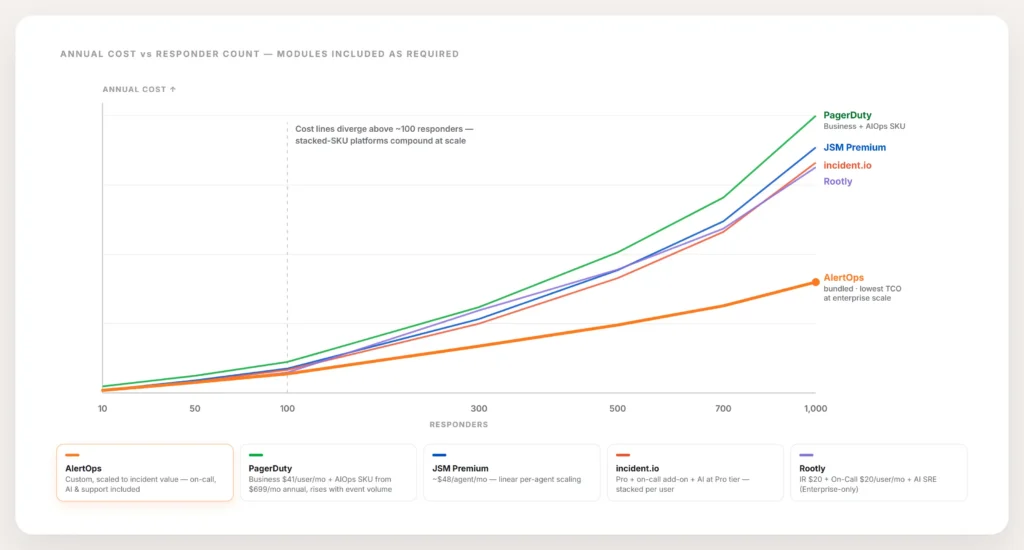
TCO curve comparing annual cost across responder count from 10 to 1000 responders for AlertOps (bundled), PagerDuty Business plus AIOps consumption SKU, Rootly IR plus On-Call plus AI SRE Enterprise, incident.io Pro plus on-call add-on plus AI Pro, and JSM Premium at $48 per agent per month. Cost lines diverge significantly above 100 responders, with AlertOps showing lowest TCO at enterprise scale due to bundled commercial structure where on-call, AI, and support are included rather than sold as stacked SKUs.
Verified May 2026 pricing across seven alternatives
| Platform | Base pricing (paid tiers) | On-call | AI / AIOps | Support |
|---|---|---|---|---|
| AlertOps | Custom, scaled to incident value | Included | Included (OpsIQ + Agent Chronicle) | Included in AlertOps Enterprise |
| PagerDuty | $21/user/mo Pro, $41/user/mo Business annual | Included in IM tiers | Separate $699+/mo consumption SKU | Tier-gated (email at Pro, 24×7 at Business+) |
| xMatters (Everbridge) | $9/user/mo Starter, $39/user/mo Base | Included from Starter | Built in (Nov 2025 AI Agent included) | Tier-gated (8×5 Starter, 24×7 Base+) |
| Rootly | $20/user/mo IR Essentials + $20/user/mo On-Call Essentials | Separate $20/user/mo product | Light AI in Essentials; AI SRE Enterprise-only | Tier-gated (Enterprise CSM) |
| incident.io | $15/user/mo Team, $25/user/mo Pro | +$10-20/user/mo add-on per tier, or $20/user/mo standalone | AI features Pro+ | Tier-gated (Slack channel at Pro, phone at Enterprise) |
| JSM Operations | ~$20/agent/mo Standard, ~$48/agent/mo Premium | Standard basics, Premium for advanced | Tier-gated (Rovo AI at Premium+) | Tier-gated (24×7 critical support Premium+) |
| Grafana Cloud IRM | $20/active IRM user/mo (after 3 free) + Grafana Cloud base | Included in unified IRM | Via broader Grafana Cloud | Tier-gated (community Free, 8×5 Pro, premium Enterprise) |
The headline sticker price is the entry point. The TCO calculation requires layering the modules each platform charges separately.
The TCO math at three enterprise responder counts
Profile 1: 100 responders, moderate alert volume (engineering-led team). PagerDuty Pro at $21/user/mo = $25,200/year base. AIOps SKU optional, depending on event volume. AlertOps custom, typically below PagerDuty + AIOps when AIOps is needed. Rootly IR + On-Call = $48,000/year ($40/user/mo combined). incident.io Pro + on-call add-on = $45,000/year ($25 + $20 = $37.50/user/mo). JSM Standard = $24,000/year ($20/agent/mo) without advanced ops.
Profile 2: 300 responders, high alert volume (mid-enterprise with multi-team NOC). PagerDuty Business + AIOps = $147,600 + $30,000-100,000/year depending on event volume. AlertOps custom, typically structured to be competitive at this scale because of bundled AI and support. Rootly IR + On-Call + AI SRE Enterprise = roughly $144,000-180,000+ depending on Enterprise SKU pricing. incident.io Pro + on-call + AI Pro = roughly $135,000+ at this scale. JSM Premium = $172,800/year ($48/agent/mo) which is required for the advanced operations capability needed at this scale.
Profile 3: 700 responders, enterprise alert volume (Footlocker-scale). PagerDuty Business + AIOps + Customer Service Ops + Automation modules = stacked SKUs reaching well into six figures. AlertOps custom, typically structured to scale to incident value rather than seat count, which at this responder count produces lower TCO than per-seat alternatives with AI modules added. JSM Premium = $403,200/year at agent pricing alone, before adding any custom advanced operations capability. Rootly and incident.io packaging produces similar six-figure outcomes when on-call and AI modules are layered.
These numbers are illustrative based on published pricing and the seven platforms’ standard module structures. Actual quotes vary by negotiation, discounting, and specific module configuration. The pattern that holds across all three profiles is that the cheapest sticker price is rarely the cheapest TCO once enterprise modules are added.
Why the JSM math frequently doesn’t work
For Opsgenie migrants evaluating JSM Operations as Atlassian’s recommended path, the per-agent pricing model is the first surprise. A mid-market fintech head of platform operations summarized it directly during his evaluation: “They’re basically replacing it with a new product, but they’re charging four times as much, so I can’t afford it.” Another team in the same evaluation cycle put the same math in different terms: “it’s essentially quadrupling the cost per seat.”
The Atlassian counter-move is an aggressive named discount. The 2026 sales motion bundles a 58% Year 1 / 40% Year 2 discount with the JSM Operations seats, often combined with ITSM seats at the same effective cost. A European mid-market hosting firm walking through the math out loud: “They have a special discount of 58% for the first year and 40% for the second year. It is in our budget also. Your solution is in our budget, but with the same cost, more or less. We also have the service management solution.” The numbers are real and prospects quote them by memory. The catch is Year 3, when the discount expires and per-agent pricing returns to list – at which point migration runway off JSM is no longer available because the team has already moved off Opsgenie. The “compelling Year 1” decision compounds into a five-year commitment at full list price.
The pattern recurs because Opsgenie’s per-responder pricing scaled across the full responder population (operators, vendor contacts, stakeholders who never opened a Jira ticket). JSM Operations seats are JSM agent seats. For organizations whose responder population extends beyond the Jira-using engineering team, the per-agent math at the JSM Premium tier required for advanced operations capability produces a TCO line that frequently exceeds purpose-built alternatives.
For Atlassian-standardized teams whose responder population genuinely overlaps with their Jira population, JSM Operations is a reasonable continuation of the commercial relationship. For everyone else, the JSM pricing math is the structural problem the recommendation skips.
Why the on-call-as-add-on math matters
For Opsgenie migrants whose primary use case is on-call rotation management, the platforms that charge for on-call as a separate paid module change the comparison significantly.
Rootly Incident Response Essentials is $20 per user per month. Rootly On-Call Essentials is a separately licensed product, also $20 per user per month. A team using both pays for two products. The flagship Rootly AI SRE agent is an additional Enterprise-only SKU on top.
incident.io Team tier is $15 per user per month. On-call is an explicit paid add-on: $10 per user per month on Team, $20 per user per month on Pro, or $20 per user per month as a standalone On-call only plan. Only the free Basic tier includes single-team on-call.
For a 300-responder team running both incident response and on-call as primary use cases, the Rootly contract reaches roughly $144,000/year before adding AI SRE. The incident.io contract reaches roughly $135,000/year before adding AI Pro. The AlertOps Enterprise contract bundles both on-call and AI at typically lower TCO at that responder count.
This is not a criticism of Rootly or incident.io as products. Both are excellent for the operating models they serve (mid-market DevOps and Slack-native engineering teams in particular). The pricing structure is the part Opsgenie migrants need to factor honestly into the TCO comparison.
Why the PagerDuty AIOps SKU matters (and the $800-per-feature pattern)
PagerDuty’s Incident Management pricing is straightforward: $21 per user per month Professional, $41 per user per month Business. On-call is included. The structural issue at enterprise scale is the AIOps SKU, and a related buyer-side complaint: the per-feature paywall pattern.
A mid-market US IT operations lead trialing PagerDuty against incident.io, Datadog On-Call, and AlertOps described the experience that ended his evaluation: “We bought a month of that and then started setting up. Although it seems to connect really well to our stuff – our Fortigate firewalls, Meraki switches and access points, even Windows servers, it’s got good connectivity – every advanced feature pretty much in the platform is paywalled behind an $800 upgrade. We’re not going to pay that much for alerting. So we’re looking at other alternatives now.” The pattern is not unique to him. Across enterprise evaluations, the buyer-side framing of PagerDuty is the “giant bucket” of routing rules (a 200-user dev tools team’s exact language) where every advanced capability is its own SKU.
PagerDuty AIOps is sold as a separate consumption-based subscription starting at $699 per month annual ($799 monthly), with pricing that rises with event volume. For enterprise environments running 200+ services and multiple observability sources, the event volume that flows into the platform produces an AIOps bill that frequently becomes the largest line in the contract.
For organizations whose value from incident management is heavily AI-correlated (and at enterprise scale, AI noise reduction is the operational lever that most directly addresses responder burnout and MTTR), the AIOps SKU is not optional in practice. Budgeting for it as a real line item rather than treating it as a tier upgrade is the right way to run the PagerDuty TCO comparison.
AlertOps includes OpsIQ correlation and Agent Chronicle (AlertOps Enterprise). The architectural placement of OpsIQ upstream of the responder queue produces operational outcomes (AlertOps platform data shows roughly 68% noise reduction in enterprise environments) without the separately priced AIOps SKU.
How to run the TCO comparison honestly
For Opsgenie migrants comparing the seven alternatives on pricing, three rules produce honest TCO numbers.
Calculate the actual responder count you need to license. Operators, vendor contacts, on-call rotations, stakeholders. Not the engineering headcount. The number of people who need to receive alerts, acknowledge them, or appear in escalation policies. For most enterprise environments, this number is meaningfully larger than the engineering team.
Add every module you’ll actually use: on-call if the platform sells it separately, AIOps if your alert volume needs it, advanced operations capability if the tier-gated features are required, compliance-grade audit if your industry requires it, and priority SLA support if your incident response operates at off-hours.
Project the TCO across five years, not one. Pricing changes, module additions, and contract escalations compound. A platform that’s $20/user/mo cheaper at year one but lacks the AI capability you’ll need at year three is rarely the better five-year choice.
When the TCO comparison runs honestly across all seven platforms, AlertOps frequently surfaces as the lower-TCO option for enterprise responder populations whose use cases require on-call, AI noise reduction, multi-channel response, bidirectional ITSM, and compliance-grade audit. The bundled-everything structure compounds in AlertOps’s favor at the responder counts where modules-as-add-ons make alternatives expensive.
The honest pricing principle
Pricing is real and pricing matters. The headline sticker price is rarely the right comparison number for enterprise environments. The right comparison number is the total cost of the modules your team will actually use, projected across the contract length, at the actual responder count you need to license.
For Opsgenie migrants whose responder population is bounded and whose use case is straightforward on-call, the cheapest sticker prices on the shortlist (JSM Standard at $20/agent/mo, incident.io Team at $15/user/mo without on-call, Rootly IR Essentials at $20/user/mo without on-call) are honest TCO comparisons. For enterprise environments, those entry-level prices rarely reflect what production actually costs.
AlertOps’s pricing is custom because enterprise environments need custom. The bundled-everything structure (on-call core, AI included, support included, multi-channel response, bidirectional ITSM, Agent Chronicle audit) holds together across enterprise responder populations in a way that per-seat alternatives with stacked modules do not.
Book a demo at alertops.com/demo to see how AlertOps prices for your specific environment and how the TCO compares to your current shortlist.
Frequently asked questions about Opsgenie alternative pricing
What is the cheapest Opsgenie alternative?
The cheapest sticker prices on the shortlist are JSM Standard (~$20/agent/mo), incident.io Team ($15/user/mo, without on-call), Rootly IR Essentials ($20/user/mo, without on-call), and xMatters Starter ($9/user/mo). The cheapest TCO depends on what modules your team actually uses; for enterprise environments with on-call, AI, and ITSM requirements, the platforms that charge for those modules separately frequently become the most expensive in production.
How much does Opsgenie cost compared to JSM Operations?
Opsgenie standalone pricing ran roughly $9-39 per responder per month depending on tier. JSM Operations charges per JSM agent seat: Standard ~$20/agent/mo annual, Premium ~$48/agent/mo annual. For organizations whose responder population extends beyond the Jira-using engineering team, the per-agent JSM pricing typically produces materially higher TCO than the per-responder Opsgenie pricing it replaced.
Why do Rootly and incident.io charge for on-call separately?
Both platforms position on-call as a discrete product or paid module rather than bundling it with incident response. Rootly On-Call Essentials is a separately licensed $20/user/mo product. incident.io on-call is a $10-20/user/mo paid add-on or standalone plan. The packaging reflects the vendors’ strategic positioning. The practical implication for buyers is that the total cost of running both incident response and on-call through these platforms is two products’ worth of licensing.
How much does PagerDuty AIOps cost?
PagerDuty AIOps starts at $699 per month annual ($799 monthly) as a separate consumption-based SKU layered on top of an Incident Management seat. Pricing rises with event volume.
What’s included in the AlertOps base plan?
AlertOps includes on-call, OpsIQ AI alert correlation, Agent Chronicle automated postmortem generation (with compliance-grade audit trail), multi-channel response orchestration (Slack, Teams, SMS, voice, email, mobile), bidirectional ServiceNow and Jira ITSM integration, the 200+ integration marketplace, and responsive support in AlertOps Enterprise. The free Opsgenie migration program (included with every plan, assisted not DIY) are also included.
Is xMatters cheaper than PagerDuty?
xMatters Starter at $9/user/mo is below PagerDuty Professional at $21/user/mo. xMatters Base at $39/user/mo is below PagerDuty Business at $41/user/mo. The TCO comparison depends on what AI and support modules each team needs. xMatters bundles AI capability in paid tiers; PagerDuty charges AIOps separately.
How does Grafana Cloud IRM pricing work?
Grafana Cloud Free includes three active IRM users with community support. Pro adds users at $20 per active IRM user per month beyond the three free seats, plus the Grafana Cloud base subscription (from $19/mo with usage). Enterprise commits start at $25,000/year.
Does AlertOps offer a free trial?
AlertOps offers demo access and trial structures depending on the deployment profile. Pricing and trial terms are available through the AlertOps team for a defined environment scope.