A Fortune 500 retail organization running roughly seven hundred users, one hundred fifty teams, and a couple hundred integrations through its Opsgenie tenant cannot move to a platform that ships on-call as a separate paid module. The math does not work at that responder count. It also cannot move to a platform that bills AI noise reduction as a consumption-based SKU on top of the seat price, because the alert volume one hundred fifty teams produce turns the AIOps line into the largest item in the contract. And it cannot move to a platform whose responsive support is gated behind an enterprise tier, because by definition every account at this scale is going to use it the first time a P1 lands at 2 AM.
That eliminates most of the alternatives on the standard Opsgenie-replacement shortlist. The platforms still standing have to ship the things enterprise teams actually use (on-call, AI, multi-channel response, bidirectional ITSM, compliance-grade audit, responsive support) inside the base plan, not as separately licensed modules or tier upgrades. They also have to be built at the orchestration layer rather than as incident response tools, because the alert volume, escalation topology, and audit requirements at this scale exceed what incident response tooling is architected to handle. AlertOps is the platform built around both: an orchestration-layer architecture and a commercial structure that holds together as the responder population grows.
What follows is the technical and architectural case. How OpsIQ produces measurable alert noise reduction at enterprise scale, what real multi-channel response orchestration looks like, why integration depth matters more than count, how Agent Chronicle produces the compliance-grade audit record regulated industries require, what enterprise on-call topology actually looks like in production, and the three commercial commitments (support included, AI included, always-evolving) that change the comparison once you read past the spec sheet.

AlertOps orchestration architecture diagram showing observability sources (Datadog, Splunk, Prometheus, AWS CloudWatch, Azure Monitor, New Relic) flowing into AlertOps, where OpsIQ Smart Correlation Engine and multi-dimensional routing engine sit upstream of the responder queue, then routing through six first-class response channels (Slack, Teams, SMS, voice, email, mobile) with bidirectional ServiceNow and Jira ITSM integration. Agent Chronicle generates automated postmortems with compliance-grade audit trail throughout.
What does an enterprise need from an Opsgenie alternative?
The Opsgenie installed base spans from twenty-engineer startups to seven-hundred-user enterprise deployments. Platforms that fit the small end of that range do not fit the large end, and platforms that fit the large end carry architectural capabilities that are overkill for the small end. Enterprise teams need a specific feature surface, and a specific commercial structure to match.
Two hundred or more integrations with first-class depth. The integration count is the entry threshold. Anything below it forces enterprise teams to build and maintain custom connectors for the long tail of their stack. The depth requirement is the differentiator. Integrations need to be bidirectional, status-aware, and capable of handling the volume enterprise observability produces without choking on the inbound webhook firehose.
AI-driven alert noise reduction at the ingestion layer. Enterprise environments generate alert volumes that overwhelm any platform whose routing logic operates on raw alerts. A 200-service environment with multiple observability sources can produce thousands of alerts during a single cascading incident. The platform has to correlate, suppress duplicates, and enrich at the ingestion layer (before a human responder sees the queue) or alert fatigue sets in within weeks.
On-call management that scales to enterprise topology. Single-team rotations are the easy case. Enterprise on-call covers follow-the-sun coverage across regions, vendor handoffs, multi-tier NOC structures with escalation between tiers, layered overrides, and time-zone-aware scheduling. The platform’s scheduling model has to express this topology natively, not through workarounds. And on-call needs to be a core capability, not a separately licensed module on top of the base plan.
Multi-channel response across Slack, Teams, email, SMS, voice, and mobile. Enterprise responder populations are not chat-only: the on-call SRE works in Slack, the vendor contact responds to SMS, the director takes a voice call, the NOC operator monitors Teams, and the compliance officer reads email. The platform has to coordinate response across all six surfaces through a single policy engine, not through fallback chains where one channel is primary and the others are afterthoughts.
ITSM integration as a first-class, bidirectional capability. ServiceNow, Jira, and the broader ITSM and CMDB ecosystem are the system of record for enterprise IT. The incident management platform is the system of response. The relationship between them has to be architectural, with bidirectional API integration, status synchronization, and ticket lifecycle alignment, rather than a one-way webhook bolted on.
Compliance-grade audit posture. For financial services, healthcare, telecom, and any regulated industry, an auto-generated postmortem document is not the same artifact class as a defensible audit timeline. The platform has to produce a structured, timestamped, immutable record of every alert, every escalation, and every responder action that can be handed to an auditor, regulator, or customer running vendor risk review.
A platform that delivers four of the six is a partial fit. A platform that delivers all six is the architectural answer. AlertOps Enterprise is built for all six.
How does AI alert noise reduction actually work at enterprise scale?
The category claim every incident management vendor makes in 2026 is AI-driven noise reduction. The architectural reality varies dramatically by where the AI sits in the response pipeline, and by whether the customer has to buy it as a separate SKU.
OpsIQ, the AI correlation engine inside AlertOps, operates upstream of the responder queue. Signals from observability platforms (Datadog, Splunk, Prometheus, AWS CloudWatch, Azure Monitor, New Relic, and the long tail of enterprise telemetry) arrive at the AlertOps ingestion layer. The engine applies similarity modeling, NLP, and configurable thresholds to group related alerts in real time, with field weights and grouping windows tuned to the customer environment. Related signals correlate into a single enriched incident. Duplicate signals suppress entirely. The output is an incident object, not an alert object, with a structured record carrying context, scope, and routing already determined.
The operational consequence is measurable. AlertOps platform data shows up to 68% alert noise reduction in enterprise environments through this correlation layer. For a 200-service environment generating a thousand raw alerts during a cascading incident, the responder receives approximately three hundred incidents, already correlated, already enriched, already prioritized. The remaining seven hundred signals suppress at the ingestion layer because they were duplicates or correlated dependencies of the three hundred.
The difference between this architecture and a platform that places AI downstream of the responder queue is significant. Downstream AI sees the noise the responder is already drowning in and tries to filter or rank it after the fact. Upstream AI prevents the noise from reaching the responder in the first place.
The commercial commitment matters as much as the architecture. The correlation engine ships in AlertOps Enterprise. Compare that to PagerDuty AIOps, sold as a separate consumption-based SKU starting at $699 per month annual on top of an Incident Management seat, or to Rootly’s AI SRE agent, which is Enterprise-only on top of separately licensed IR Essentials and On-Call Essentials products, or to incident.io’s AI Suggestions and AI Scribe, which require Pro or Enterprise. Enterprise teams running real event volume against any of those platforms end up paying for AI as a meaningful line item, not as part of the base.
Alert handling effort drops twenty to forty percent across enterprise deployments. The reduction translates directly into MTTR (twenty-five to thirty-five percent across enterprise environments, with documented colocation and data center deployments showing P1 MTTR going from 90 minutes to 52 minutes and MTTA reduced by 67 percent).
See how the correlation engine works in enterprise environments at alertops.com/demo.
What does real multi-channel response orchestration look like?
Enterprise response is not chat-only. Any platform that treats Slack as primary and the other channels as fallbacks misses the operational reality of how enterprise NOC teams actually respond.
Real multi-channel orchestration treats Slack, Microsoft Teams, email, SMS, voice, and mobile as architectural peers. A single incident can simultaneously page an SRE through Slack, alert a vendor contact via SMS, place a voice call to a director, post to a NOC operator’s Teams channel, send an email to the compliance officer, and push to a mobile app for the on-call engineer who left her laptop at home. All six paths fire through a single policy engine, all six are tracked through the same incident record, and all six produce acknowledgments that close the loop back to the orchestration layer.
This is the operating reality of enterprise incident response. A Fortune 500 retail organization running one hundred fifty teams across multiple regions does not have a single primary response channel. It has a dozen channels, each owned by a different role, each with its own acknowledgment expectations, each with its own escalation rules. The platform that pretends this complexity can collapse to “Slack-native” produces missed pages and double escalations within the first month of production use.
The architectural distinction is the policy engine. AlertOps’s routing engine evaluates service ownership, severity, time of day, vendor handoff conditions, channel preference, and compliance requirements in parallel. A single policy can express the topology that incident response tools express only through stacked rules. The result is policies that match the operational reality of enterprise response, not workarounds that approximate it.
Why ITSM integration depth matters more than integration count
Enterprise teams evaluating Opsgenie alternatives almost always check the integration count first. The number matters. Anything below two hundred forces custom connector work for the long tail of an enterprise stack. The dimension that distinguishes platforms at enterprise scale is integration depth, not count.
Bidirectional ITSM integration is the example. ServiceNow is the system of record for the majority of large enterprise IT operations. A one-way webhook that creates a ServiceNow ticket when an alert fires is the entry-level integration. A bidirectional integration that creates the ticket, synchronizes status updates as the incident progresses, reflects assignment changes in both directions, and closes the ticket cleanly when the incident resolves is the enterprise-grade integration. The first is a checkbox. The second is operationally consequential.
A Fortune 500 retail operations VP described her ServiceNow integration in plain terms: “that’s a quite important integration to us. We use that a lot.” Her environment runs roughly seven hundred users, one hundred fifty teams, and a couple hundred integrations. For that organization, the incident management platform that treats ServiceNow as a status synchronization peer is the platform that fits. The platform that treats ServiceNow as a notification target produces double-bookkeeping and reconciliation work for the operations team.
AlertOps’s ServiceNow integration is bidirectional and first-class. Status updates flow both directions, assignment changes synchronize, ticket lifecycle aligns with incident lifecycle. The Jira integration covers the same surface for engineering-led environments. The broader integration marketplace exceeds two hundred connectors, with the depth requirement applied across the integrations enterprise customers actually depend on rather than as a count-padding exercise.
What does compliance-grade audit look like?
For unregulated organizations, an auto-generated postmortem document satisfies internal learning requirements. For financial services, healthcare, telecom, and any organization subject to regulatory reporting, vendor risk review, or customer audit requirements, the compliance bar is different.
The compliance-grade artifact isn’t a learning document. It’s a structured, timestamped, immutable record of every alert that fired, every escalation step, every responder action, every acknowledgment, and every resolution decision throughout the incident lifecycle. The record needs to be defensible (auditable in the strict sense) and produced as a first-class output of the response platform, not as an after-the-fact reconstruction.
Agent Chronicle in AlertOps produces this record. Every alert ingested, every correlation OpsIQ performs, every escalation triggered, every responder action taken, and every status change is captured in the structured timeline. The timeline serves as the source artifact for the post-incident review and for any subsequent compliance use such as regulatory filings, vendor risk reviews, customer audit requests, internal SOX or HIPAA documentation. The artifact exists as a consequence of how the platform is architected, not as a manual deliverable the response team produces alongside the response itself.
For regulated industries, the compliance artifact is the basis on which the platform can be used at all, not a feature to negotiate at contract time. It ships in AlertOps Enterprise, not as a separately negotiated audit add-on.
How do enterprise on-call models actually scale?
The on-call scheduling primitive that small-team incident management platforms expose (a rotation, with overrides, that maps to a team) is necessary but not sufficient for enterprise on-call.
Enterprise on-call topology has five dimensions that small-team scheduling does not address.
Follow-the-sun coverage. A single service may be on-call to one team in Asia from 0000 to 0800 UTC, another team in Europe from 0800 to 1600, and a third in the Americas from 1600 to 0000. The scheduling model needs to express this natively, with time-zone-aware handoffs and consistent escalation behavior across the regional boundaries.
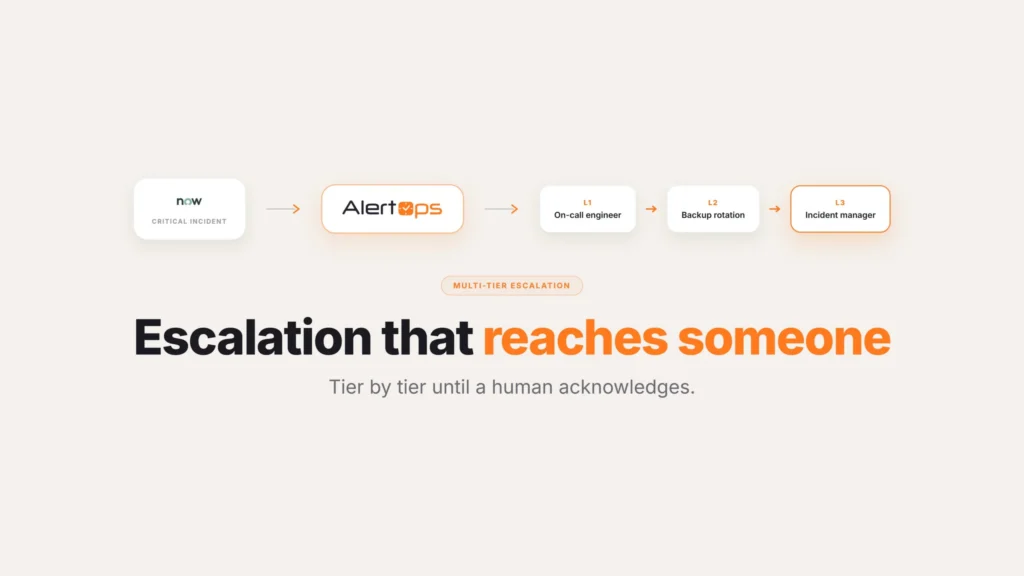
Multi-tier NOC structure. An incident may escalate from Tier 1 NOC operators to Tier 2 SREs to Tier 3 platform engineers to a vendor support contract to executive notification, in a defined sequence with defined timeouts at each tier. The escalation model needs to encode this topology rather than approximate it.
Vendor handoffs. Many enterprise incidents involve third-party vendors (managed cloud providers, network carriers, SaaS vendors, hardware support contracts). The escalation policy needs to know when to engage the vendor, through which contract, with what severity classification, and how to track the vendor’s response separately from the internal response.
Layered overrides. A senior engineer takes vacation, the backup picks up primary, the backup’s backup picks up secondary, the rotation continues. Three weeks later the senior engineer returns and the layered overrides need to unwind cleanly. The override model needs to handle this without producing the “I thought you were on-call” gaps that small-team scheduling produces.
Compliance-driven scheduling. Some industries require specific competency or certification for on-call response to specific incident classes. The scheduling model needs to enforce this (the right person, with the right qualification, for the right severity) not as a manual reminder but as a routing constraint.
AlertOps’s on-call scheduling model addresses all five. The Footlocker-scale environment (seven hundred users, one hundred fifty teams) that produces an on-call topology spanning multiple regions, multiple tiers, multiple vendors, and layered coverage requirements is the design center of the AlertOps scheduling engine, not an edge case it accommodates. And on-call is part of the platform, not a separately licensed product to add on top.
What economic outcomes does enterprise orchestration produce?
For the CFO, the VP of Engineering, and the buying committee that signs the contract, the architectural arguments translate into specific economic outcomes.
MTTR reduction. AlertOps platform data shows twenty-five to thirty-five percent MTTR reduction across enterprise deployments. In documented colocation and data center operations deployments, P1 MTTR went from 90 minutes to 52 minutes, a 42 percent improvement on the metric that translates most directly to revenue protection and SLA performance.
MTTA reduction. Time to acknowledgment compresses by similar magnitudes. The DC/Telecom deployments showed MTTA reduced by 67 percent through upstream correlation and policy-driven routing, meaning the right responder engages faster and the response window starts earlier in the incident lifecycle.
Alert volume reduction. AlertOps platform data shows up to 68% reduction in alert noise through upstream correlation. In the DC/Telecom deployments, alert volume reduced by 65 percent. This is the dimension that most directly addresses responder burnout and the SRE attrition cost enterprise engineering organizations absorb.
Alert handling effort reduction. Twenty to forty percent reduction in alert handling effort across enterprise deployments (AlertOps platform data). The reduction recovers responder capacity that can be redirected to proactive reliability work, the work that reduces the incident rate over time.
Breach economics. The IBM Cost of a Data Breach Report puts the average breach cost at $4.44 million globally and $10.22 million in the United States. Organizations with tested incident response plans and AI automation save an average of $2.66 million per breach. The incident management platform functions as a breach-cost-reduction lever, not a cost line, and the platforms that deliver real MTTR and noise reduction produce returns that dwarf the per-seat pricing comparison.
These are the outcomes orchestration architecture produces at enterprise scale, with the underlying capabilities bundled at the Enterprise tier rather than billed separately.
What commercial commitments distinguish AlertOps from the alternatives?
Architecture is half the case for AlertOps. The other half is the commercial structure that holds enterprise pricing flat as the responder population grows.
Responsive support is included. Most enterprise incident management vendors gate responsive support behind tier upgrades or sell it as priority SLA add-ons. PagerDuty starts email support at the Professional tier and reserves 24/7 phone for Business and Enterprise. incident.io reserves live phone and SLAs for Enterprise. JSM Operations reserves 24/7 critical support for Premium and above. The category practice comes from an assumption that does not hold for enterprise incident response: that customers will be fine waiting twenty-four hours during a P1.
AI is included. OpsIQ correlation, the agentic response capabilities, and Agent Chronicle ship with the Enterprise plan rather than living behind an AIOps SKU. The contrast is direct. PagerDuty AIOps is a separately priced consumption SKU starting at $699 per month annual. Rootly’s flagship AI SRE agent is Enterprise-only. incident.io’s AI Suggestions, AI Scribe, and AI chat agent require Pro or Enterprise. JSM’s Rovo AI agents and AI-powered ops require Premium. For enterprise teams whose value from incident management is heavily AI-correlated, that pricing pattern matters in the second year, when the consumption bill arrives.
The product ships continuously as an independent company. AlertOps stands on its own, with no parent-platform roadmap competing with portfolio priorities and no post-acquisition product cycle slowing integration work. The roadmap is shaped by enterprise customer requests, releases ship continuously, and there is no acquisition-paralysis risk on the horizon. For organizations choosing the platform they will run on through 2031, product velocity and independent direction matter for the same reason architecture matters: they determine whether the platform fits the future or fights it.
These commitments are the difference between a comparison that looks even on the spec sheet and a comparison that compounds in AlertOps’s favor across the contract length.
How does AlertOps replace Opsgenie at enterprise scale?
The replacement is structural, not feature-by-feature.
AlertOps preserves the Opsgenie feature surface enterprise teams depend on (on-call scheduling, escalation policies, multi-channel notification, integration marketplace, API and webhook support, mobile app, role-based access) and extends each into the orchestration layer with upstream correlation, multi-dimensional policy routing, bidirectional ITSM integration, and compliance-grade audit. The migration off Opsgenie is the moment to extend the operational footprint, not just replicate it.
The free Opsgenie migration program (included with every plan, assisted not DIY) handle the operational on-ramp. Escalation policies, on-call schedules, integrations, and user mappings are captured from the Opsgenie API and reproduced in AlertOps so cutover is incremental rather than rebuild-from-scratch. A Fortune 500-scale environment with hundreds of integrations and tuned escalation logic does not need to be rebuilt by hand. The migration tool preserves the operational investment.
For enterprise operations teams whose scale and operating model demand orchestration (financial services, healthcare, telecom, data center operations, MSP, government, critical infrastructure), AlertOps is the platform built for that layer, with the commercial structure that fits enterprise responder populations and the product velocity that holds up across a five-year contract.
Book a demo at alertops.com/demo to see how AlertOps handles your specific environment and what the free Opsgenie migration looks like for your scale.
The enterprise alternative is the architectural answer
The right enterprise Opsgenie alternative is the platform whose architecture matches the operating model the organization actually runs, with a commercial structure that does not penalize enterprise scale and a product roadmap that keeps shipping. Feature count is downstream of all three.
For enterprise operations teams whose evaluation surfaces orchestration as the architectural fit, measured against 200+ integration depth, AI-driven noise reduction at the ingestion layer, multi-channel response coordinated through a single policy engine, bidirectional ITSM integration, compliance-grade audit, and enterprise on-call topology, AlertOps is the platform built for that layer, with the commercial structure to match.
Pick the alternative whose architecture and commercial commitments you want to run on in 2031.
Frequently asked questions about the enterprise Opsgenie alternative
What is the best Opsgenie alternative for enterprise teams?
For enterprise operations teams running 200+ integrations, multi-channel response across Slack, Teams, voice, SMS, and mobile, bidirectional ServiceNow or Jira ITSM, and compliance-grade audit requirements, AlertOps is the platform built for that architectural layer. It’s an incident orchestration platform (distinct from incident response tools) with OpsIQ alert correlation, multi-dimensional policy routing, and Agent Chronicle audit timeline shipped in AlertOps Enterprise rather than gated behind tier upgrades or separate SKUs.
How does AlertOps compare to Opsgenie?
AlertOps preserves the Opsgenie feature surface (on-call scheduling, escalation policies, multi-channel notification, integration marketplace, API and webhook support) and extends each into the orchestration layer with upstream correlation, multi-dimensional routing, bidirectional ITSM, and compliance-grade audit. The migration captures Opsgenie configuration and reproduces it in AlertOps, with the architectural extensions available immediately. Support, AI, and on-call are all bundled in the Enterprise plan.
What is OpsIQ and how does it reduce alert noise?
OpsIQ is the AI correlation engine inside AlertOps that operates upstream of the responder queue. It correlates signals from observability platforms across similarity modeling, NLP, and configurable thresholds, then suppresses duplicates and groups related signals into enriched incidents before a human responder is notified. AlertOps platform data shows up to 68% alert noise reduction in enterprise environments through OpsIQ correlation. OpsIQ is included in AlertOps Enterprise rather than sold as a separate AIOps SKU.
What is Agent Chronicle?
Agent Chronicle is AlertOps’s compliance-grade incident timeline and audit trail capability. It captures a structured, timestamped, immutable record of every alert ingested, every correlation OpsIQ performs, every escalation triggered, every responder action taken, and every resolution decision throughout the incident lifecycle. The timeline serves as the audit-grade artifact for regulatory filings, vendor risk reviews, and customer audit requests. Agent Chronicle is part of AlertOps Enterprise.
Does AlertOps integrate with ServiceNow?
Yes. The AlertOps ServiceNow integration is bidirectional and first-class. Status updates flow both directions, assignment changes synchronize, ticket lifecycle aligns with incident lifecycle.
How many integrations does AlertOps have?
AlertOps’s integration marketplace exceeds 200 connectors across observability, monitoring, ITSM, CMDB, chat, communication, and ticketing categories. Integration depth (bidirectional API, status synchronization, lifecycle alignment) is applied across the integrations enterprise customers actually depend on rather than as a count-padding exercise.
Is support included in AlertOps plans?
Yes. Responsive support is included in AlertOps Enterprise rather than gated to enterprise tiers or sold as priority SLA add-ons. This contrasts with several competitors (PagerDuty, incident.io, JSM Operations) that gate live phone support and SLAs to higher tiers.
Is AI included in AlertOps plans?
Yes. OpsIQ alert correlation, agentic response, and Agent Chronicle audit timeline are part of AlertOps Enterprise. This contrasts with PagerDuty AIOps (separate $699+/mo consumption SKU), Rootly AI SRE agent (Enterprise-only), incident.io AI features (Pro+), and JSM Rovo AI (Premium+).
What MTTR improvement can I expect from AlertOps?
AlertOps platform data shows MTTR reduction of twenty-five to thirty-five percent across enterprise deployments. In documented colocation and data center operations deployments, P1 MTTR went from 90 minutes to 52 minutes (a 42% improvement), MTTA reduced by 67%, and alert volume reduced by 65%.