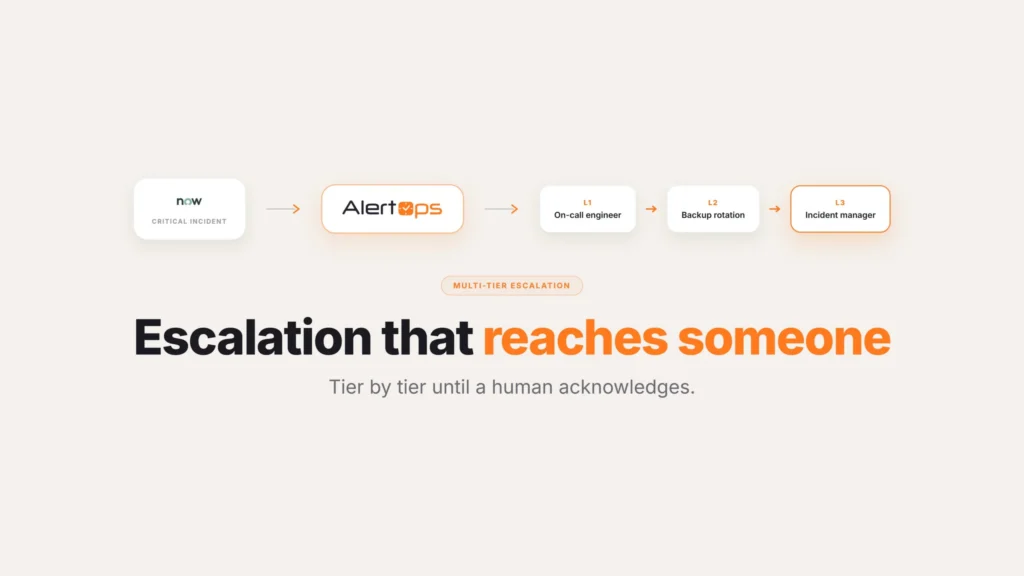
JSM Operations is Atlassian’s recommended migration path from Opsgenie. It is also a different product solving a different problem, sold to a different buyer, with a different data model and a different commercial structure. None of that shows up in the migration banner Atlassian displays when an Opsgenie admin logs in. It shows up around month two of the migration, when the team that used to pay for a hundred Opsgenie responders is staring at a JSM Operations quote that doesn’t math.
The Atlassian account team is not lying when they call JSM the successor. JSM Operations absorbed Opsgenie’s on-call and alerting capabilities into the JSM product after the June 4, 2025 end-of-sale date, the features exist, the migration path is documented, and the in-app migration guide is generally available. What the recommendation skips is whether the architectural and commercial assumptions that worked for Opsgenie as a standalone product still hold when the product is absorbed into JSM.
For most enterprise teams, they do not. This post is the honest assessment of what JSM Operations gives you, what it doesn’t, and which environments fit it well versus which environments will spend the next eighteen months wishing they had gone a different way.
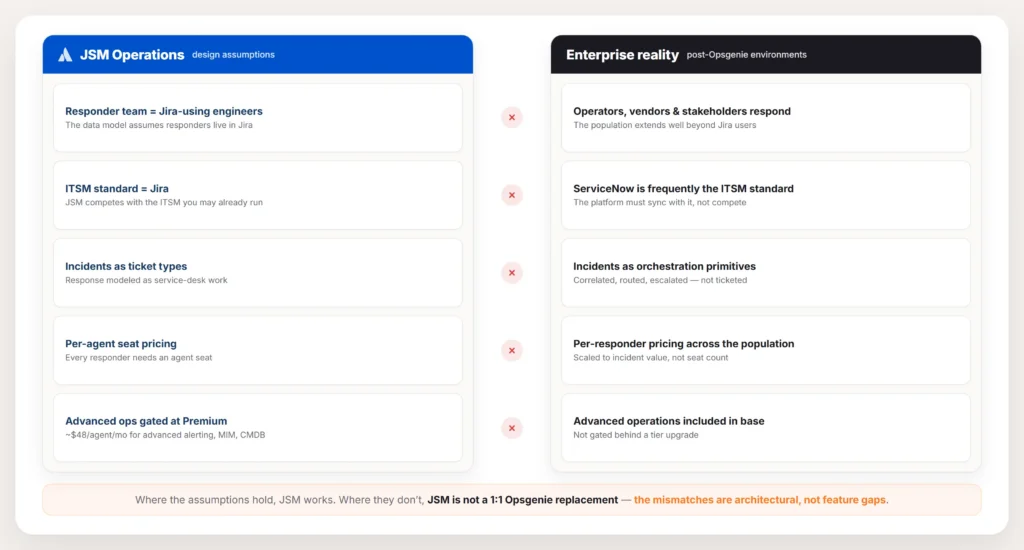
Diagram comparing JSM Operations design assumptions (responder team is Jira-using engineering team, Jira ITSM standard, incidents as ticket types, per-agent pricing, advanced operations at Premium tier ~$48/agent/mo) against enterprise reality (responder population extends beyond Jira users, ServiceNow as ITSM standard, incidents as orchestration primitives, per-responder pricing across full population, advanced operations included in base). The mismatches show why JSM is not a 1:1 Opsgenie replacement for most enterprise teams.
What does JSM Operations actually replace?
JSM Operations replaces Opsgenie’s product surface. On-call scheduling, escalation policies, alert routing, the integration marketplace, the API, the mobile app. All of it is reachable from JSM after the migration. Existing Opsgenie configuration imports through a tool Atlassian provides as part of the in-app migration guide.
What it doesn’t replace is the commercial relationship. Opsgenie was sold as a standalone product with per-responder pricing that scaled to responder count. JSM Operations is sold as JSM with Operations capability included at the Standard tier ($20/agent/mo annual) and full Operations capability at the Premium tier ($48/agent/mo annual). The seats are JSM agent seats, not standalone alerting seats. For organizations whose responder population is composed of operators, vendor contacts, and stakeholders who never opened a Jira ticket in their lives, the per-agent pricing produces a TCO line that looks nothing like the Opsgenie bill it replaced.
It also doesn’t replace the architectural assumption. Opsgenie was designed around a single question: who gets paged, when, through what channel. JSM is designed around a different question: how does a service request flow through an ITSM workflow to resolution. Both are valid questions. Both have entirely different design centers. When Opsgenie’s capabilities fold into JSM, they fold into the second design center, which means the data model treats every incident as a JSM ticket type with the lifecycle and workflow conventions JSM expects.
For environments that already think about incidents as tickets and run their incident management workflow through Jira, this is consistent. For environments that don’t, it produces friction the migration banner doesn’t warn about.
What enterprise teams actually discover during the migration
Three patterns recur across enterprise post-migration retrospectives.
The responder population doesn’t fit the agent model
A platform operations lead at a Fortune 500 retail organization summarized the mismatch directly during her evaluation: “our ServiceNow team tells us that, oh, well, ServiceNow does all that on-call stuff. It’s just like PagerDuty.” Her on-call population at Footlocker scale is roughly seven hundred users across one hundred fifty teams. Putting that responder count on JSM agent seats produces a contract math that scales linearly with team count, when the actual need scales with whether the responder ever opens Jira (most don’t).
The ITSM standard is ServiceNow, not Jira
This is the most common mismatch in enterprise post-Opsgenie environments. Organizations that built their ITSM practice on ServiceNow over the past decade have a system of record in place that JSM is not going to displace. When JSM Operations becomes the incident management layer, the team ends up running two ITSM-adjacent systems in parallel, with reconciliation work between them and no clear winner. The team trying to “exit out of the Atlassian ecosystem” entirely is a real pattern in enterprise post-Opsgenie evaluations.
Advanced operations capability gates at Premium
The on-call basics live in the JSM Standard tier. The features that enterprise operations teams actually need (advanced alert integrations, incident investigation, major incident management, CMDB integration) live in JSM Premium at roughly $48 per agent per month annual. For organizations whose Opsgenie deployment was paying for advanced alerting capability as part of the standalone product, the JSM Premium tier upgrade is the moment when the per-seat economics of “the recommended path” become the most expensive option on the shortlist.
Atlassian is using an aggressive named discount to lock in Opsgenie refugees
The Atlassian sales motion in 2026 is built around a 58% Year 1 / 40% Year 2 discount specifically for Opsgenie customers migrating to JSM, sometimes bundled with ITSM seats at the same effective cost. A European mid-market hosting firm summarized the offer during evaluation: “Now to incentivize the people to migrate from OpsGenie to JSM, we have a special discount of 58%… and for the first year and 40% for the second year, so we can. It is in our budget also. Your solution is in our budget, but with the same cost, more or less. We also have the service management solution.” The math looks compelling for one or two budget cycles. The decision becomes harder when the discount expires in Year 3 and the per-agent pricing returns to list, by which point migration runway is no longer available.
None of these patterns are theoretical. They are recurring observations across enterprise teams that started the migration assuming JSM was the natural successor and ended up running a second evaluation halfway through.
What’s missing from JSM Operations versus a purpose-built incident orchestration platform
The feature surface is real, but the architectural and commercial gaps are what enterprise teams discover. Five specific gaps recur.
Bidirectional ServiceNow integration as a first-class capability
For organizations whose ITSM is ServiceNow, this is a non-negotiable. JSM’s relationship to ServiceNow is competitive rather than collaborative – it doesn’t treat ServiceNow as a peer system of record, whereas purpose-built incident orchestration platforms do. AlertOps integrates bidirectionally with ServiceNow, with status synchronization, assignment alignment, and ticket lifecycle that matches incident lifecycle. The platform that treats your existing ITSM as the system of record (rather than trying to replace it) is the platform that fits ServiceNow-standardized enterprise environments.
Multi-channel response orchestration as architectural peers
Enterprise response runs across Slack, Microsoft Teams, email, SMS, voice, and mobile. A single incident can simultaneously page an SRE on Slack, a vendor contact via SMS, a director on voice, a NOC operator in Teams, and the on-call engineer through the mobile app, all coordinated through one policy engine. JSM Operations handles multi-channel notification but the orchestration depth required for enterprise NOC topology, with vendor handoffs and channel preferences per stakeholder, is not the JSM design center.
AI-driven upstream alert correlation
Enterprise environments generate alert volumes that require correlation at the ingestion layer, before a human responder sees the queue. AlertOps OpsIQ correlates signals across similarity modeling, NLP, and configurable thresholds, with platform data showing up to 68% alert noise reduction in enterprise environments. JSM Operations has AI capabilities (Rovo AI agents at the Premium tier) but the AI sits downstream of the responder workflow rather than upstream of the alert queue. The architectural placement produces different operational outcomes.
Compliance-grade audit as a first-class output
Regulated industries (financial services, healthcare, telecom) need a structured, timestamped, immutable record of every alert, every escalation, every responder action throughout the incident lifecycle. Agent Chronicle in AlertOps produces this artifact in AlertOps Enterprise. JSM’s audit story relies on Jira’s ticketing audit trail, which is appropriate for service request management but is not the artifact class regulators expect for incident response evidence.
Product velocity from an independent vendor. JSM Operations is one capability inside a broader Atlassian platform strategy. The roadmap competes with the rest of the Atlassian portfolio for engineering investment. Enterprise teams choosing the platform they will run on through 2031 weigh whether the roadmap is being driven by Operations customer needs or by Atlassian’s broader strategy. Independent vendors with a single product focus tend to ship faster against operations-specific requirements.
See how AlertOps handles the architectural gaps JSM Operations doesn’t close at alertops.com/demo.
When JSM Operations does fit
JSM is the right path for a specific organizational profile. Three conditions need to hold.
The organization is deeply standardized on the Atlassian stack. Jira for engineering work, Confluence for documentation, Bitbucket for source, Compass for service catalog. The Atlassian commercial relationship is already significant and the procurement story for adding Operations on top is simpler than evaluating a third-party alternative.
The responder population overlaps cleanly with the Jira-using engineering team. Operators, vendor contacts, and stakeholders outside Jira are minimal. Per-agent pricing scales with the team that already uses Jira, not with a separate response population.
The on-call requirements are within JSM’s design envelope. Standard-tier on-call basics or Premium-tier advanced operations are sufficient. There is no requirement for bidirectional ServiceNow as a peer system, no multi-tier NOC with vendor handoffs, no AI noise reduction at the ingestion layer, no compliance-grade audit artifacts as a first-class output.
When all three conditions hold, JSM Operations is a reasonable continuation of the Atlassian relationship. When one or more does not hold, the architectural and commercial gaps surface inside the first year of production use, and the team that migrated to “the obvious path” is doing a second evaluation while the rest of the alternatives market reshuffles around them.
What enterprise teams choose when JSM doesn’t fit
The post-Opsgenie alternatives market in 2026 has narrowed to a handful of credible options for enterprise environments. PagerDuty for organizations standardized on its mature event routing. xMatters for teams with existing Everbridge CEM relationships. incident.io and Rootly for Slack-native engineering teams that fit the mid-market band. Grafana Cloud IRM for observability-led teams already in the Grafana stack.
AlertOps occupies the orchestration layer that JSM doesn’t reach: bidirectional ITSM integration as first-class, multi-channel response across six surfaces, OpsIQ alert correlation at the ingestion layer, Agent Chronicle compliance-grade audit, with AlertOps Enterprise bundling support, AI, and on-call. For enterprise teams whose evaluation surfaces orchestration as the architectural fit, AlertOps is the platform built for that layer.
The free Opsgenie migration program (included with every plan, assisted not DIY) handle the operational on-ramp. Escalation policies, on-call schedules, integrations, and user mappings are captured from the Opsgenie API and reproduced in AlertOps so cutover is incremental rather than rebuild-from-scratch.
The honest framing for the evaluation
JSM Operations is Atlassian’s recommended path, and it works for a specific organizational profile. The mistake is treating “recommended by the vendor” as equivalent to “right for the organization.” The vendor’s recommendation aligns with the vendor’s commercial interests. The right path for the organization aligns with the operating model, the responder population, and the compliance posture the organization needs to support for the next five years.
For Atlassian-standardized teams whose three conditions hold, JSM is a coherent continuation. For everyone else, JSM is one option among several, and the evaluation should compare it against the alternatives on the same dimensions: bundled vs unbundled pricing, architectural layer, multi-channel orchestration depth, ITSM integration depth, compliance posture, and product velocity. When that comparison runs honestly, JSM is rarely the answer for enterprise environments. AlertOps frequently is.
Book a demo at alertops.com/demo to see how AlertOps handles the architectural and commercial gaps JSM Operations doesn’t close.
Frequently asked questions about Opsgenie versus JSM
Is Atlassian JSM a real replacement for Opsgenie?
JSM Operations absorbs Opsgenie’s product surface (on-call scheduling, escalation policies, alert routing, integration marketplace, API, mobile app) into the JSM product. The features exist. What changes is the data model (incidents as JSM ticket types), the commercial structure (per-agent JSM seats rather than per-responder Opsgenie seats), and the architectural assumption (incident response folded into a service management platform). For Atlassian-standardized teams whose responder population overlaps with the Jira-using engineering team, JSM is a reasonable path. For enterprise teams whose architecture requires orchestration, ServiceNow-as-system-of-record, or compliance-grade audit, JSM is not the right fit.
What does JSM Operations cost compared to Opsgenie?
JSM Operations seats are priced as JSM agent seats. Standard tier is approximately $20 per agent per month annual. Premium tier (required for advanced alert integrations, incident investigation, major incident management, and CMDB) is approximately $48 per agent per month annual. Compared to Opsgenie’s standalone per-responder pricing, the JSM agent-based pricing typically increases TCO for organizations whose responder population extends beyond the Jira-using engineering team.
Why do enterprise teams choose alternatives instead of JSM?
Three patterns recur. The responder population doesn’t fit the JSM agent pricing model. The ITSM standard is ServiceNow rather than Jira, producing a system-of-record conflict. The advanced operations capabilities required at enterprise scale gate behind the JSM Premium tier, where the per-agent economics frequently exceed purpose-built alternatives. Enterprise teams whose evaluation surfaces these patterns typically select an incident orchestration platform like AlertOps or a peer incident response tool like PagerDuty instead.
Does JSM Operations integrate with ServiceNow?
JSM Operations has integrations with ServiceNow but the relationship is competitive rather than collaborative. JSM is itself an ITSM platform and is not architected to treat ServiceNow as a peer system of record. For ServiceNow-standardized enterprise environments, the bidirectional ITSM integration depth required for production incident management is not the JSM design center. Purpose-built incident orchestration platforms like AlertOps handle bidirectional ServiceNow integration as a first-class architectural capability.
What features does JSM Operations have that Opsgenie didn’t?
JSM Operations adds tight integration with the rest of the Atlassian stack (Jira, Confluence, Compass, Bitbucket), Rovo AI agents at the Premium tier, and the JSM ITSM workflow surface for service request management adjacent to incident response. For teams who want incident management folded into a broader ITSM and engineering toolchain, these additions are real value.
When should I choose JSM Operations as my Opsgenie replacement?
JSM fits when three conditions hold simultaneously: your organization is deeply standardized on the Atlassian stack, your responder population overlaps cleanly with your Jira-using engineering team, and your on-call requirements fit within JSM’s design envelope without needing bidirectional ServiceNow, multi-tier NOC with vendor handoffs, or compliance-grade audit as a first-class output. When all three hold, JSM is a coherent continuation. When one or more doesn’t hold, the architectural and commercial gaps surface inside the first year of production use.
How does AlertOps differ from JSM Operations as an Opsgenie replacement?
AlertOps operates at the incident orchestration layer with OpsIQ alert correlation upstream of the responder queue, multi-dimensional policy routing across six response channels as architectural peers, bidirectional ServiceNow and Jira ITSM integration as first-class capability, and Agent Chronicle compliance-grade audit. AlertOps Enterprise bundles support, AI, and on-call. JSM Operations folds incident response into a service management workflow with per-agent JSM pricing, gates advanced operations capability behind the Premium tier, and is built around the assumption that the responder team is the Jira-using engineering team.