The most-repeated PagerDuty phrase in 2026 enterprise evaluations is “giant bucket.” A 200-user development tools platform that had already migrated from PagerDuty to Opsgenie once described the pattern verbatim during their second evaluation: “We were originally a PagerDuty using company. At the time PagerDuty was kind of this thing where it was just this giant bucket of a bunch of routing rules and alerts and all that, and we hated that because from a management perspective it was just impossible to keep everybody straight. The principal reason we moved over from PagerDuty to OpsGenie was the fact that we can centrally manage the teams.” They are now choosing AlertOps for the second migration, and the giant-bucket framing came back into the conversation unprompted.
The Opsgenie shutdown forced enterprise teams back into the alternatives market. PagerDuty was the obvious next stop because it is the longest-running dedicated incident response platform with the most mature event routing engine in the category. A meaningful share of enterprise teams looked at PagerDuty and chose AlertOps instead. This post is the honest account of why: what the buying committees actually said, where the architectural fit converged on orchestration over response, and what the post-Opsgenie enterprise commit looks like in practice.

Enterprise non-negotiables matrix comparing AlertOps and PagerDuty across five enterprise requirements. Bidirectional ITSM, multi-channel response, AI alert correlation included, responsive support included, on-call as core capability. AlertOps green across all five through bundled commercial structure. PagerDuty separately licenses AIOps at $699 per month annual and gates 24/7 support to Business tier and above.
What’s actually driving the PagerDuty walkaways
Three patterns recur across enterprise post-Opsgenie evaluations that ended at AlertOps rather than PagerDuty.
The PagerDuty paywall pattern. A mid-market US IT operations lead evaluating PagerDuty Pro against incident.io, Datadog On-Call, and AlertOps described the experience that ended his trial: “We bought a month of that and then started setting up. Although it seems to connect really well to our stuff – our Fortigate firewalls, Meraki switches and access points, even Windows servers – it’s got good connectivity. But every advanced feature pretty much in the platform is paywalled behind an $800 upgrade. We’re not going to pay that much for alerting. So we’re looking at other alternatives now.” The pattern is not isolated. Across enterprise evaluations, the buyer-side framing is that PagerDuty’s headline pricing is the entry price, not the production price. Every advanced capability (AIOps, automations, premium integrations, advanced routing) surfaces as a separate paid upgrade. The TCO at enterprise scale frequently doubles or triples the headline number.
The “giant bucket” management problem at scale. The same dev tools platform that left PagerDuty for Opsgenie summarized why centralized management mattered: at 200 users with multiple teams, the bucket-of-rules approach made administration impossible. Their second migration off Opsgenie surfaced the same concern in reverse. The platforms that organize escalation around teams and integration around team boundaries produce the same management problem at enterprise scale, regardless of vendor. AlertOps’s decoupled architecture (groups and schedules, escalation policies, and integrations as separate modules rather than team-coupled) addresses the structural problem PagerDuty’s response model does not.
Sentiment from prior PagerDuty incumbents. An aerospace and defense incident response lead summarized the prior-customer sentiment directly in January 2026: “We’ve got to get rid of PagerDuty. I don’t really care what I need to do or who I need to bribe, but.” The strength of the emotion is notable. Long-running PagerDuty customers who are actively shopping rarely describe the platform in neutral terms. The walk-aways tend to be decisive once the alternatives evaluation begins.
What enterprise teams actually need from the post-Opsgenie platform
The Opsgenie installed base ran a specific commercial structure: per-responder pricing scaled across the full responder population, including operators, vendor contacts, and stakeholders who never touched an engineering ticket. The replacement decision has to handle the same responder topology. Footlocker-scale environments running roughly seven hundred users across one hundred fifty teams and roughly two hundred integrations are not edge cases in the post-Opsgenie market. They are the design center.
Five capabilities recur as enterprise non-negotiables in the evaluation conversations.
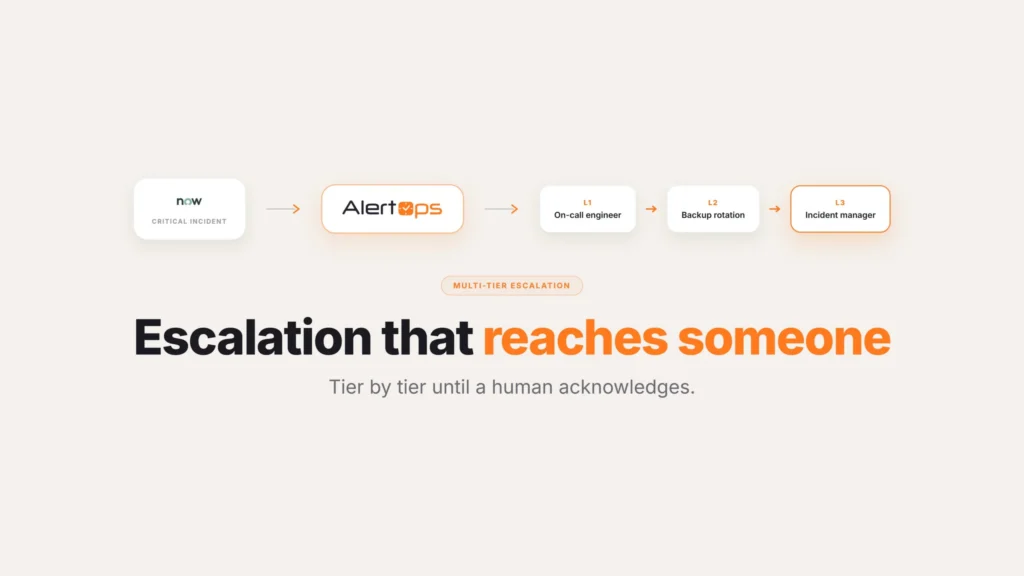
Bidirectional ITSM as a first-class capability. ServiceNow is the system of record for enterprise IT at most Footlocker-scale customers. The incident management platform has to integrate as a peer system, not as a webhook target. An AlertOps SE described the ServiceNow positioning during a Fortune 500 retail evaluation: “ServiceNow moved to JSM and they ended up sticking with ServiceNow and using AlertOps. As we are seamlessly integrated with ServiceNow, we’re on their marketplace and we’re a purposely built add-on to them. So more complimentary than anything rather than trying to get in there and take away everything.” For customers whose ITSM standard is ServiceNow, the bidirectional integration is the structural argument.
Multi-channel response orchestration as architectural peers. An enterprise dev tools customer described their war-room workflow: “They’re 24 by 7. They have runbooks that they run through that will then either we then if they’re not able to resolve it, escalate to our different SRE teams… and then if nothing is resolved from that point, we will bring in our development teams. Now we have an entire war room process… we’re really looking to expand using this tool to both harness automation, harness AI, some augmented workflows.” The workflow runs across Slack, Teams, voice, SMS, and mobile simultaneously, coordinated by one policy engine. The platforms that treat one channel as primary and the others as fallbacks produce missed pages.
Orchestration architecture rather than response tooling. An AlertOps SE described the architectural positioning during an enterprise insurance migration: “From point A to point B, we’re effectively an orchestration engine. So get the alarms from your system, aggregate them, notify. Additionally, we can write back to your ticketing systems, any status systems. Or more recently, a common use case we’ve been running into is triggering automations via any RPA tools you have as well.” The orchestration layer sits above incident response tooling, with OpsIQ correlation upstream of the responder queue and bidirectional integration with downstream automation. The architectural distinction shows up at enterprise scale where alert volume and integration breadth exceed what response tooling was built to handle.
AI capability built into the plan, not gated behind an AIOps SKU. PagerDuty AIOps is a separate consumption-based SKU starting at $699 per month annual on top of the IM seat. For enterprise environments running 200+ services and heavy alert volume, AIOps is not optional in practice, and the consumption pricing scales with event volume, frequently becoming the largest line in the contract. AlertOps Enterprise carries OpsIQ correlation, Agent Chronicle audit, and agentic response without a separate SKU. The architectural placement of correlation upstream of the responder queue produces measurable outcomes (up to 68% alert noise reduction in enterprise environments per AlertOps platform data).
Responsive support in the base plan, not behind a tier upgrade. PagerDuty starts email support at the Professional tier and reserves 24/7 phone for Business and Enterprise. AlertOps treats responsive support as part of the platform. For organizations whose incident response runs hot, that assumption is one of the structural differences that compounds across contract length.
The xMatters comparison that enterprise teams also run
PagerDuty is not the only competitor in serious enterprise evaluations. The same Fortune 500 retail organization described their top alternative explicitly: “We’re looking at a bunch of your competitors obviously. One of them I think is probably top of the list, at least for me is xMatters. And the reason it’s top of the list is, you know, having a workflow designer where you can execute triggered actions on when the alert comes through.” xMatters (now Everbridge) is a credible enterprise competitor, particularly for organizations with existing Everbridge Critical Event Management relationships pairing IT incident response with mass notification.
The trade-off conversation with xMatters tends to center on product velocity post-Everbridge acquisition and the architectural depth of orchestration features compared to AlertOps’s incident-orchestration focus. For organizations evaluating from a clean slate without an existing Everbridge relationship, AlertOps’s independent product status and faster release cadence factor into the five-year decision.
What the migration scale looks like
The Opsgenie migration capability matters at enterprise scale. AlertOps’s free migration team has handled hundreds of enterprise Opsgenie migrations, including large multi-tenant environments. An AlertOps SE described one recent engagement: “I actually have just wrapped up 200 users and we only required three working sessions.” Another summarized the demand: “Nearly like half our customers at this point are trying to come from OpsGenie.”
For Footlocker-scale environments with 700 users, 150 teams, and 200 integrations, the migration typically runs six to twelve weeks end-to-end. The automated tool handles users, groups, schedules, and escalation policies. The Solution Engineering team handles integration migration, cutover planning, and clean deprovisioning. The migration is included in the AlertOps plan rather than sold as a separate professional services engagement.
See how AlertOps handles enterprise-scale Opsgenie migrations at alertops.com/demo.
The honest enterprise framing
PagerDuty is the most credible incumbent in dedicated incident response and the right choice for specific organizational profiles. Engineering organizations already standardized on PagerDuty with years of operational tuning in the escalation engine, organizations whose primary AI value is downstream event correlation and whose budget can absorb the AIOps SKU on top of the IM seats, and mid-market to enterprise environments whose responder population is bounded find PagerDuty’s strengths decisive.
For enterprise environments running Footlocker-scale responder populations with bidirectional ServiceNow as a non-negotiable, multi-channel response coordinated through one policy engine, compliance-grade audit as a first-class output, and AI alert correlation upstream of the responder queue included in the plan, AlertOps is the architectural fit. The five capabilities above, together with the bundled commercial structure and the independent product velocity, compound across contract length in ways that change the TCO comparison.
The enterprise teams choosing AlertOps over PagerDuty after Opsgenie EOL are not making the choice on a feature checklist. They are making it on architectural layer, commercial structure, and operating model fit. For the profiles where those three factors point at orchestration over response tooling, AlertOps is the platform built for that layer.
Book a demo at alertops.com/demo to see how AlertOps handles your specific enterprise environment and what the comparison against PagerDuty looks like for your responder population.
Frequently asked questions
Why are enterprise teams choosing AlertOps over PagerDuty after Opsgenie EOL?
Three patterns recur: the PagerDuty per-feature paywall pattern that doubles or triples headline pricing at enterprise scale, the “giant bucket” management problem that makes centralized administration difficult at scale, and the AlertOps architectural fit for enterprise non-negotiables (bidirectional ServiceNow, multi-channel orchestration, AI included, support included, on-call as core capability).
What is the PagerDuty paywall pattern?
PagerDuty’s headline pricing is Incident Management seats ($21/user/mo Pro, $41/user/mo Business). Advanced capabilities (AIOps, automations, premium integrations, advanced routing) require separate paid upgrades starting at $699/mo for AIOps and additional per-feature charges. The TCO at enterprise scale frequently doubles or triples the headline number.
What does AlertOps include that PagerDuty charges separately for?
OpsIQ alert correlation (PagerDuty AIOps is a separate consumption SKU starting at $699/mo annual). Responsive support in AlertOps Enterprise (PagerDuty gates 24/7 phone to Business+). Agent Chronicle compliance-grade audit (PagerDuty audit features are mature but priced differently across tiers). Multi-channel response across Slack, Teams, SMS, voice, email, and mobile as architectural peers through one policy.
How does AlertOps’s ServiceNow integration compare to PagerDuty’s?
AlertOps’s ServiceNow integration is bidirectional and first-class. Status updates flow both directions, assignment changes synchronize, ticket lifecycle aligns with incident lifecycle. AlertOps’s positioning is complementary to ServiceNow as the ITSM system of record. PagerDuty’s ServiceNow integration is mature but operates as one of many integrations rather than as a peer-system-of-record relationship.
What enterprise companies have migrated from PagerDuty to AlertOps?
AlertOps has handled hundreds of enterprise Opsgenie migrations and a significant number of PagerDuty replacements. Specific customer references are available through the AlertOps team for a defined evaluation scope. Customer profiles span financial services, healthcare, telecom, data center operations, MSP, and large enterprise dev tools platforms.
How much money do enterprise teams save switching from PagerDuty to AlertOps?
Specific savings depend on responder count and what AIOps and support tier the team was paying for. One documented example from a 2026 AlertOps engagement: a customer switching from PagerDuty saved just under $10,000 annually on the invoice. Larger environments with more modules layered onto the PagerDuty contract typically see larger absolute savings, with the bundled-everything AlertOps structure compounding the advantage at enterprise responder counts.
Is AlertOps better than PagerDuty for enterprise incident management?
For specific enterprise profiles, yes. For organizations needing bidirectional ServiceNow integration as a first-class capability, multi-channel response across six surfaces, AI alert correlation included in the plan, and responsive support without tier gating, AlertOps is the architectural fit. For organizations already deeply standardized on PagerDuty with mature operational tuning and budget for the AIOps SKU, PagerDuty’s strengths are decisive.