A ServiceNow incident that notifies one person and stops isn’t escalation. It’s a coin flip on whether that one phone is on do not disturb. The record is correct, the SLA timer is running, and the whole response rests on one human feeling a buzz at three in the morning.
This guide covers why one notification isn’t escalation, how to build the tiered chain with timeouts and repeat attempts, how acknowledgement keeps the chain from waking people it doesn’t need to, when to use an Escalation Policy versus a Response Play, and how the whole path fires from the ServiceNow trigger by priority. For the full integration, start with the AlertOps and ServiceNow two-way integration guide.
Table of Contents
- Why One Notification Isn’t an Escalation Path
- The Escalation Path: Primary, Secondary, Manager, Director
- Calling Again to Make Sure They Wake Up
- Acknowledgement Is What Stops the Climb
- A Fallback So a P1 Never Dies Silently
- Escalation Policy or Response Play
- The Whole Path Fires From the ServiceNow Trigger
- Conclusion
- FAQ
Why One Notification Isn’t an Escalation Path
Plenty of setups call themselves escalation when what they actually do is send one notification and hope. An incident opens, a single responder gets a message, and the system considers its job done. If that person is asleep, driving, in a dead zone, or has their phone face-down on silent, the incident sits. Nothing climbs. The only thing moving is the SLA clock.
The gap is the assumption that notification equals response. A notification leaves the building. A response means a human received it, understood it, and started working. Between those two is every reason a page goes unanswered, and a single notification has no way to recover from any of them.
Escalation closes that gap. It treats the first page as an attempt, not a conclusion, and has a plan for what happens when the attempt fails: a defined sequence of people and timing that keeps reaching outward until the incident is in someone’s hands.
The Escalation Path: Primary, Secondary, Manager, Director
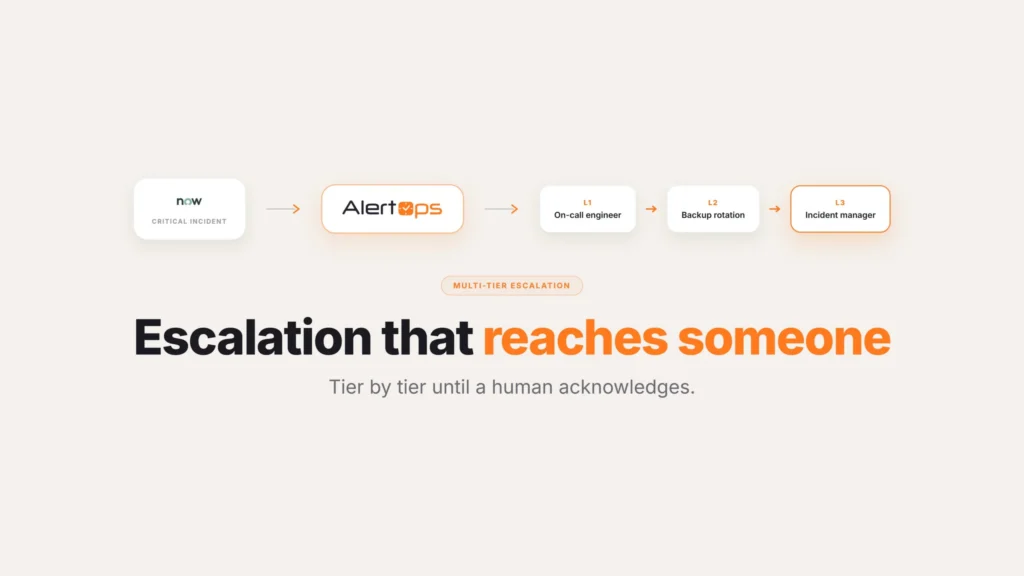
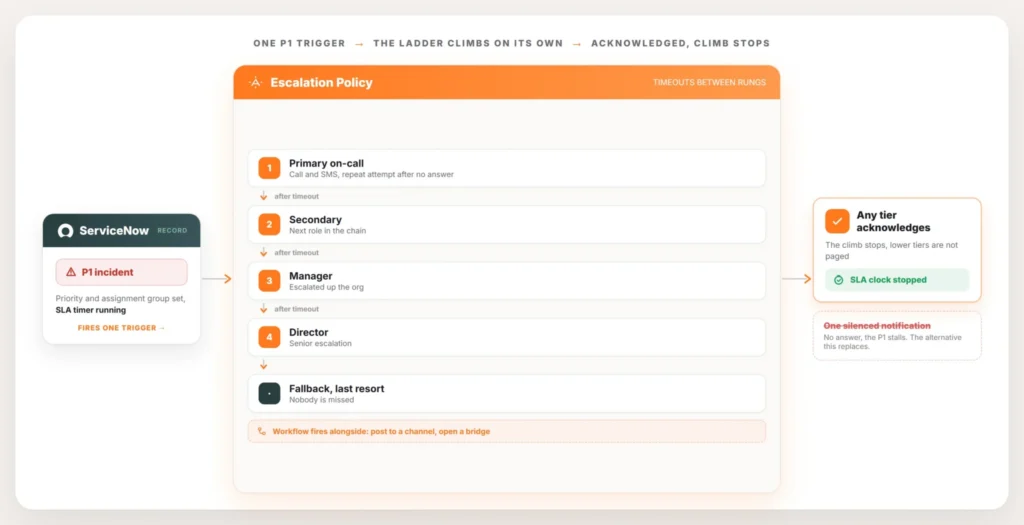
An enterprise escalation path is a ladder, and most P1 ladders run deeper than people expect. Six or seven levels is a normal design, not an extreme one. The primary on-call gets the first page, and if a defined timeout passes with no acknowledgement, the incident moves to the secondary. Still nothing, and it goes to the manager, then the director. The chain keeps climbing because at that severity, silence isn’t an acceptable resting state.
In AlertOps this is an Escalation Policy: the plotted pathway between user roles that guides alert deliveries. You define the roles in sequence, the wait time between each, and the contact methods used at each step. Because the policy is shift-wise, “the primary” isn’t a fixed name. It resolves to whoever is on the active shift in that role right now, so the path follows the rotation instead of paging an engineer who went off-call six hours ago.
The timeout between tiers is the load-bearing part. Too short and the manager’s phone rings before the primary has had a fair chance to wake up and grab a laptop. Too long and a P1 burns fifteen quiet minutes per rung while the outage spreads. The right interval is a deliberate choice per tier and per priority, encoded so nobody’s making that judgment by hand at three in the morning.
Calling Again to Make Sure They Wake Up
Climbing to the next person is only half of what a real path does. The other half is trying the current person harder before giving up on them. A single buzz is easy to sleep through. Two calls a minute apart, followed by an SMS, is much harder to miss, and the responder you actually want is usually the primary, not the director three rungs up.
Repeat attempts live inside the tier. Before the path escalates away from the primary, it can call again, switch channels, and call once more, because the goal is to wake the right person, not rush past them to someone less close to the problem. AlertOps delivers across phone, SMS, email, and push using each responder’s own contact preferences, so the retries follow how that person is actually reachable rather than spraying every channel at once.
Volume alone doesn’t solve a silenced phone. A sequence does: attempt, wait, attempt again on another channel, then climb if the person genuinely isn’t reachable.
Acknowledgement Is What Stops the Climb
A path that only climbs creates its own problem: by tier four it has woken half the org for an incident one person is already fixing. The fix is to make escalation acknowledgement-aware, so the chain reacts to what responders do instead of marching through every tier on a timer.
The moment a responder accepts the incident, the climb stops. The manager and director below the line never get paged, because the path has what it was reaching for: a human who owns the problem. AlertOps writes that acknowledgement back to the ServiceNow incident, and assigning from a phone or SMS is enough to mark the incident owned and stop the SLA clock.
The same awareness keeps the path from paging someone twice. If a responder is already engaged, the escalation doesn’t loop back and re-page them as if they were unreached. The chain tracks who has answered and routes around them, so the only people it disturbs are the ones it still needs.
A Fallback So a P1 Never Dies Silently
Every honest escalation design has to answer one question: what happens when the whole chain comes up empty. Primary, secondary, manager, director, every tier paged, every repeat attempt spent, and still no acknowledgement. Without a plan for that case, the incident simply stops, and a P1 quietly dies in a set of silenced phones while the SLA clock keeps running.
A fallback is the last resort that refuses to let that happen. At the bottom of the path, you place a tier that always reaches someone: a wider group, an incident-commander rotation, a duty manager, a channel the whole team watches. AlertOps supports this through the policy itself and through Override Shifts when a known gap needs short-term coverage.
The fallback rarely fires. That’s the point of building it. It exists so the rare night when four tiers in a row miss the page doesn’t turn into the outage nobody knew about until morning.
Escalation Policy or Response Play
Not every team wants a strict tier-by-tier chain, and AlertOps doesn’t force one. There are two ways to build the path, and the right choice depends on whether roles matter for that team.
An Escalation Policy is the role-based option, built around sequenced roles with wait times between them. It’s the right tool when escalation genuinely needs that hierarchy, a P1 path where the manager and director are real, distinct rungs that come into play only after the people closest to the problem have had their chance.
A Response Play is the simpler, role-agnostic alternative for teams that want one flow instead of a chain, notifying everyone on the active shift together rather than working through roles in sequence.
| Escalation Policy | Response Play | |
| Structure | Sequenced roles with wait times between each | One flow, tiers defined by minutes from the start |
| Best for | P1 paths where the hierarchy itself matters | Teams that just need the on-call group reached |
| Who gets notified | One role at a time, in order | Every member of the active shift together |
| When to choose it | Manager and director are real, distinct rungs | “Alert this group on this schedule” is the whole requirement |
Many enterprises run both: Escalation Policies for the deep P1 ladders where roles matter, Response Plays for the teams that just need the on-call group reached without a hierarchy. Workflows handle the auxiliary work that runs alongside the path rather than as a tier in it, posting to a channel or opening a bridge when a defined condition is met. The path reaches the people. The Workflow handles the room they walk into.
The Whole Path Fires From the ServiceNow Trigger
None of this requires anyone to touch the chain by hand during an incident. The path is wired to the ServiceNow trigger, so when an incident reaches a defined priority, the matching escalation starts on its own. A P1 can launch the deep, multi-tier ladder. A P3 can run a single calmer tier.
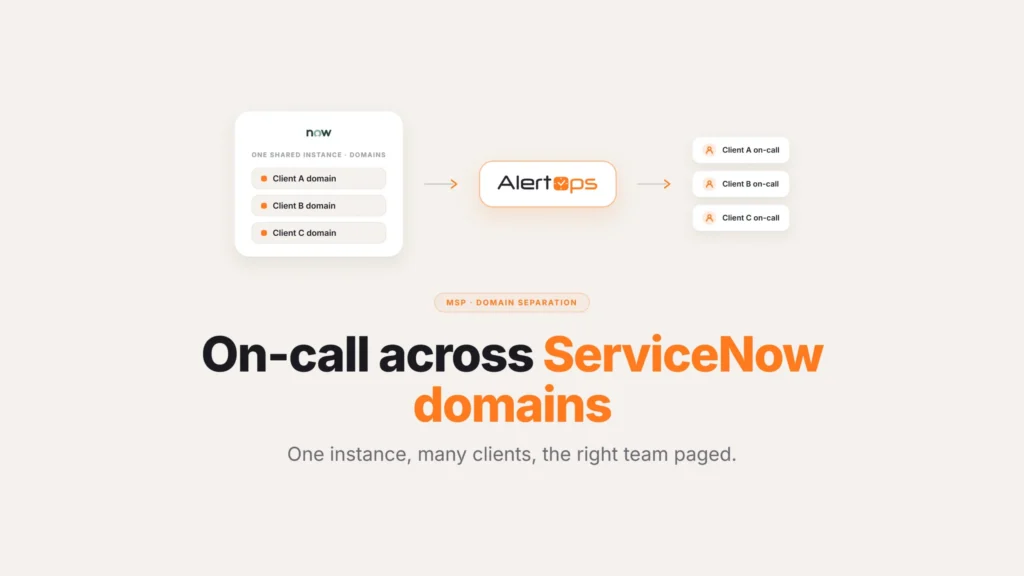
ServiceNow stays the system of record throughout. It owns the incident, the priority, the assignment group, and the SLA. AlertOps reads the trigger, runs the escalation across the tiers, and writes the acknowledgement, the responder, and the timeline back to the incident, so the record reflects who was reached and when without anyone narrating it. This sits next to two related pieces: mobilizing the response and opening the bridge once a major incident fires is covered in automating major incident response in ServiceNow, and reaching the correct team in the first place is covered in ServiceNow assignment groups and on-call routing.
Book a demo at alertops.com/demo to see a multi-tier escalation path run against your own ServiceNow priorities and on-call schedules.
Conclusion
An escalation path is really just an admission that people miss pages sometimes, for ordinary reasons that have nothing to do with how good the on-call program is. Phones die, calls get missed, someone sleeps through a buzz they’d normally catch. A path that climbs, retries, listens for acknowledgement, and falls back to a last resort is built around that reality instead of pretending it away. The incident still finds someone. It just takes the design seriously enough to plan for the night the first person doesn’t answer.
Frequently asked questions
How do I build a multi-tier escalation path from a ServiceNow incident?
You build it as an AlertOps Escalation Policy triggered by the ServiceNow incident. The policy defines a sequence of roles, a timeout between each tier, and the contact methods used at each step. When an incident reaches a defined priority, AlertOps pages the on-call primary, and if no acknowledgement arrives before the timeout, it escalates to the next tier, continuing up the chain until someone accepts.
What is the difference between an Escalation Policy and a Response Play?
An Escalation Policy follows a sequence of roles such as primary, secondary, and manager, with wait times between them, and fits when escalation needs that hierarchy. A Response Play notifies the recipients you list on a timeline of minutes from the start, with every member of the active shift notified together regardless of role. Reach for the policy when roles genuinely matter, and the play when the whole requirement is alerting one group on a schedule.
Will escalation stop once someone acknowledges the incident?
Yes. Accepting the incident is what tells the chain to stand down. Nobody further down the line gets paged once that happens, the acknowledgement writes back to the ServiceNow incident, and assigning from a phone or SMS marks it owned and stops the SLA clock. Someone already engaged on the incident won’t get re-paged as the escalation proceeds.
What happens if no one in the escalation chain answers?
The path ends in a fallback: a last-resort tier such as a wider group or a duty-manager rotation that always reaches someone. Override Shifts cover known short-term gaps in the rotation as well. The fallback exists so a critical incident never stalls silently once every tier and repeat attempt has been exhausted.
How many escalation levels do enterprises usually need?
A full P1 chain often runs through primary, secondary, the group manager, the director, and sometimes further rungs above that. Lower-priority incidents tend to get by on a single tier. Because the path fires from the ServiceNow priority, each priority level can map to its own depth.