The Opsgenie alternatives market that was crowded in 2024 has narrowed in 2026. Atlassian’s 58% Year 1 / 40% Year 2 discount aggressively recruits Opsgenie refugees into JSM Operations. PagerDuty’s $800-per-advanced-feature pattern walks customers away before the trial finishes. Grafana OnCall OSS was archived in March 2026, forcing the open-source band into Grafana Cloud IRM. Rootly and incident.io grow fast on Slack-native incident response but sell on-call as a separately priced module. The result is a market where the “credible alternative” set is smaller than the long tail of vendors suggests, and the ranked decision turns on packaging math as much as feature lists.
This is the verified May 2026 ranking of the eight platforms enterprise teams are actually evaluating after Opsgenie EOL. Scored on the dimensions that matter at enterprise scale (architectural layer, packaging structure, AI inclusion, support model, ITSM integration depth, compliance posture, product velocity, free Opsgenie migration tooling). With the buyer-side complaints prospects actually voice, the discount and paywall facts that shift the math, and the operating-model profiles each platform genuinely fits.

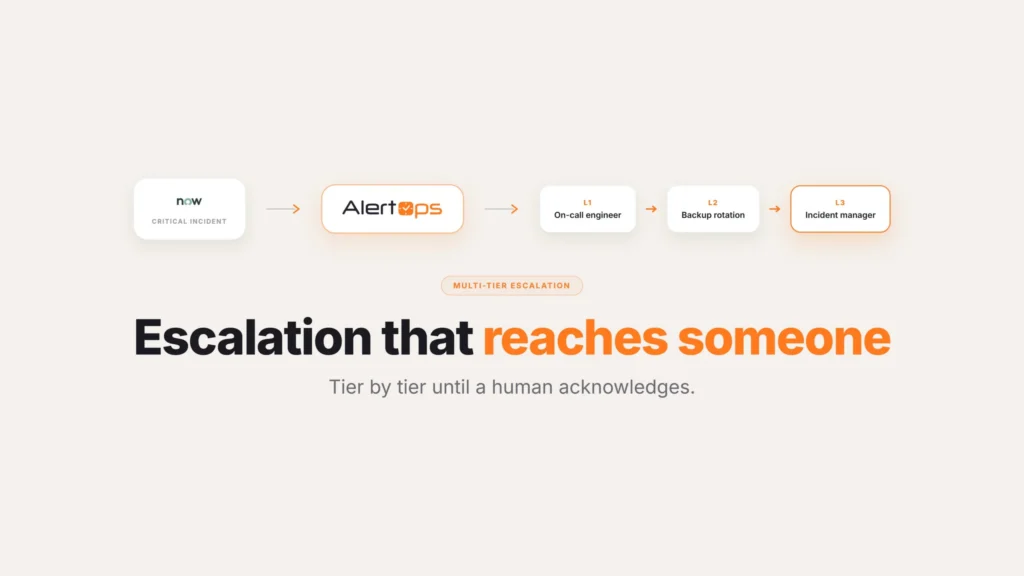
Verified May 2026 ranking matrix of 8 Opsgenie alternatives scored across architectural layer, on-call inclusion, AI/AIOps inclusion, support inclusion, ITSM integration depth, and compliance posture. AlertOps shows green across all dimensions through bundled commercial structure. PagerDuty has on-call included but AIOps separately licensed. Rootly and incident.io sell on-call as separate products or add-ons. JSM Operations gates advanced operations capability behind Premium tier.
The 8 platforms
| Rank | Platform | Architectural layer | Base pricing | Best fit |
|---|---|---|---|---|
| 1 | AlertOps | Incident orchestration | Custom, scaled to incident value | Enterprise NOC, regulated industries, multi-channel response, bidirectional ITSM |
| 2 | PagerDuty | Incident response + AIOps add-on | $21/user/mo Pro, $41/user/mo Business | Engineering orgs standardized on PagerDuty with mature event routing |
| 3 | xMatters (Everbridge) | Incident response + CEM overlap | $9/user/mo Starter, $39/user/mo Base | Enterprises with existing Everbridge CEM relationship |
| 4 | Rootly | Slack-native incident response | $20/user/mo IR + $20/user/mo On-Call (separate) | Mid-market DevOps with Terraform-managed config |
| 5 | incident.io | Slack-native IR with AI agents | $15/user/mo Team, +$10-20/user/mo on-call add-on | Series B-D DevOps wanting AI-forward Slack incident workflow |
| 6 | Atlassian JSM Operations | Service management with on-call | ~$20/agent/mo Standard, ~$48/agent/mo Premium | Atlassian-standardized teams whose responders are Jira users |
| 7 | Grafana Cloud IRM | Observability-bundled IRM | $20/active IRM user/mo + Grafana Cloud base | Observability-led teams already in Grafana stack |
| 8 | Splunk On-Call (VictorOps) | On-call within Splunk Observability | Bundled with Splunk Observability licensing | Splunk-standardized environments with observability tied to incident response |
The ranking reflects architectural fit and commercial structure at enterprise scale, not absolute capability. PagerDuty is more mature than rank 2 suggests. xMatters is more capable than rank 3 suggests. The ranking is “fit for the post-Opsgenie enterprise migration in 2026 specifically,” not “best product in absolute terms.”
#1 – AlertOps
The orchestration-layer fit for enterprise post-Opsgenie environments. AlertOps preserves the Opsgenie feature surface (on-call scheduling, escalation policies, integration marketplace, multi-channel notification, mobile app, API) and extends each into the orchestration layer with OpsIQ alert correlation upstream of the responder queue, multi-dimensional policy routing, bidirectional ServiceNow and Jira ITSM integration, and Agent Chronicle automated postmortem generation (with compliance-grade audit trail).
The commercial structure compounds in AlertOps’s favor at enterprise responder counts. AlertOps Enterprise includes responsive support, not gated to enterprise tiers. AI capability (OpsIQ + Agent Chronicle + agentic response) is part of AlertOps Enterprise, not sold as a separate AIOps SKU. On-call is a core capability, not a separately licensed module. The free Opsgenie migration program (included with every plan, assisted not DIY) are included with every plan, with documented engagements completing 200-user migrations in three working sessions.
What enterprise prospects actually say during evaluation. A Fortune 500 retail operations VP describing the ServiceNow integration: “That’s a quite important integration to us. We use that a lot.” AlertOps’s ServiceNow integration is bidirectional and first-class, positioning AlertOps as complementary to ServiceNow as the ITSM system of record rather than competitive with it. An AlertOps SE summarized the architecture during an enterprise insurance demo: “From point A to point B, we’re effectively an orchestration engine. So get the alarms from your system, aggregate them, notify. Additionally, we can write back to your ticketing systems, any status systems. Or more recently, triggering automations via any RPA tools.”
Best fit. Enterprise environments (financial services, healthcare, telecom, data center operations, MSP, government, critical infrastructure) running 200+ services with multi-channel response across Slack, Teams, voice, SMS, email, and mobile; bidirectional ServiceNow or Jira ITSM as non-negotiable; compliance-grade audit; AI alert correlation at the ingestion layer.
#2 – PagerDuty
The longest-running dedicated incident response platform with the most mature event routing engine in the category. The Spring 2026 Release expanded the AI partner ecosystem to thirty-plus vendors, shipped MCP plugins for Claude Code and Cursor, and continues evolving the SRE Agent into a virtual responder that joins escalation policies. For organizations standardized on PagerDuty with years of operational tuning, the platform delivers.
The buyer-side pattern that shapes the comparison. A 200-user dev tools platform that migrated from PagerDuty to Opsgenie summarized the structural concern: “PagerDuty was kind of this thing where it was just this giant bucket of a bunch of routing rules and alerts and all that, and we hated that because from a management perspective it was just impossible to keep everybody straight.” The “giant bucket” framing recurs across enterprise evaluations. The other pattern is the per-feature paywall. A US IT operations lead at a mid-market firm: “Every advanced feature pretty much in the platform is paywalled behind an $800 upgrade. We’re not going to pay that much for alerting. So we’re looking at other alternatives now.”
The packaging math. PagerDuty Incident Management at $21/user/mo Professional or $41/user/mo Business is the base. AIOps is a separate consumption-based SKU starting at $699/mo annual that rises with event volume. Customer Service Operations and Automation are additional modules. For enterprise environments running heavy event volume, the AIOps SKU frequently becomes the largest line in the contract.
Best fit. Engineering organizations already standardized on PagerDuty with years of operational tuning, organizations whose primary AI value is downstream event correlation and whose budget absorbs the AIOps SKU, and mid-market teams whose responder population is bounded.
#3 – xMatters (Everbridge)
Mature enterprise IT alerting with flow-based communication workflows and tight overlap with Everbridge Critical Event Management for mass notification. The November 2025 xMatters AI Agent launch added contextual summaries, runbook suggestions, and resolver recommendations directly inside the Incident Console without a separate AI subscription. Pricing starts at $9/user/mo Starter and $39/user/mo Base.
The strongest fit profile. Enterprises that already use Everbridge CEM for physical and people-resilience use cases. Pairing IT incident response with CEM under a single vendor produces a coherent compliance and procurement story.
The trade-offs. Post-acquisition product velocity is slower than independent peers. UI feels dated relative to modern Slack-native tools. For organizations evaluating from a clean slate without an existing Everbridge relationship, the velocity difference factors into the five-year decision.
Best fit. Enterprises with existing Everbridge CEM relationships and a use case that pairs IT incident response with mass notification.
#4 – Rootly
Slack-native incident response with the catalog model, Terraform-managed configuration, and the Rootly AI SRE agent as the flagship Enterprise-only capability. The Rootly AI Labs program launched at GitHub HQ and continued investment in AI agents show real product velocity for the mid-market DevOps band.
The packaging caveat that matters. Rootly Incident Response Essentials is $20/user/mo, and Rootly On-Call Essentials is a separately licensed product, also $20/user/mo, so a team that wants both pays for two products. The flagship AI SRE agent is an additional Enterprise-only SKU on top. For environments where on-call is a primary use case (which is most post-Opsgenie environments), the two-product packaging meaningfully changes the TCO comparison.
The honest strengths. The Slack-native incident workflow is best-in-class for mid-market DevOps teams that live in chat. The Terraform-managed configuration resonates with platform engineering teams. The post-incident learning loop is excellent.
Best fit. Mid-market DevOps teams that live in Slack and want a polished, opinionated incident workflow with strong Terraform/GitOps configurability. Not a primary fit for enterprise NOC environments with multi-channel response requirements or for organizations whose on-call is the main use case.
#5 – incident.io
One of the most polished Slack-first incident response products in the category. The catalog model, AI Suggestions, AI Scribe, and AI investigation agent are genuinely differentiated. The June 2025 $62M Index Ventures round funded the push into AI agents that “resolve incidents with you.” The PagerDuty Rescue Program (contract buyouts up to a year free, AI-assisted migration) shows the company competing aggressively for displaced Opsgenie and PagerDuty customers.
The packaging caveat that mirrors Rootly’s. Basic free tier includes single-team on-call. Above that, on-call is a paid add-on: $10/user/mo on Team tier, $20/user/mo on Pro tier, or $20/user/mo as a standalone On-call only plan. AI features (Suggestions, Scribe, chat agent) require Pro or Enterprise. Responsive support is tier-gated: Basic and Team get email and community, Pro gets a dedicated Slack channel and shared SE, live phone and SLAs are Enterprise-only.
Best fit. Series B-D DevOps and SRE teams that want a Slack-first, AI-forward incident workflow with strong post-incident learning. The catalog model handles medium-complexity environments well. The stacked add-on pricing (Response + On-call + AI) compounds for larger responder populations.
#6 – Atlassian JSM Operations
The path Atlassian recommends for current Opsgenie customers. Atlassian stopped Opsgenie new sales on June 4, 2025; full support ends April 5, 2027. The in-app migration guide and personalized task list are generally available. For organizations standardized on the Atlassian stack, JSM Operations offers tight ecosystem integration and a familiar commercial relationship.
The discount fact that’s shifting evaluations. Atlassian is offering a 58% Year 1 / 40% Year 2 discount on JSM Operations specifically for Opsgenie migrants, sometimes bundled with ITSM seats at the same effective cost. A European mid-market hosting firm walking through the math: “They have a special discount of 58% for the first year and 40% for the second year. It is in our budget also.” The numbers are real and prospects quote them by memory. The Year 3 list-price return makes the long-term math more complicated than the Year 1 quote suggests.
The structural trade-offs. Basic on-call lives in JSM Standard ($20/agent/mo). Advanced operations capability (advanced alert integrations, incident investigation, major incident management, CMDB) requires JSM Premium ($48/agent/mo). The data model treats incidents as JSM ticket types. The architectural assumption is that the responder team is the Jira-using engineering team. For environments where these assumptions hold, JSM works. For environments where ServiceNow is the ITSM standard or where responders extend beyond Jira users, the fit breaks.
The customer-side framing. A Fortune 500 retail platform operations lead: “Honestly, I don’t think we have a lot of use for it outside of the on-call stuff because we use ServiceNow for our ITSM stuff and that’s really what JSM’s trying to compete with, so.” Another customer summarized the JSM evaluation directly: “It’s not very powerful, so we would also like to evaluate the other solutions.”
Best fit. Atlassian-standardized teams whose responder population overlaps cleanly with the Jira-using engineering team and whose on-call requirements fit within JSM’s design envelope.
#7 – Grafana Cloud IRM
The merged successor to Grafana OnCall and Grafana Incident, unified into a single application inside Grafana Cloud. Tight integration with Grafana metrics, logs, and traces is the central value proposition. For observability-led teams already standardized on Grafana, the marginal cost of adding on-call and incident response is low.
The recent platform changes that matter. Grafana OnCall OSS entered maintenance mode in March 2025 and was archived on March 24, 2026. All forward development is in Grafana Cloud IRM with no self-hosted option. This blocks air-gapped and regulated buyers that require on-premise deployment.
The pricing. Grafana Cloud Free includes 3 active IRM users with community support. Pro adds users at $20 per active IRM user per month beyond the 3 free seats, plus Grafana Cloud base from $19/mo with usage. Enterprise commits start at $25,000/year.
Best fit. Observability-led teams already deep in the Grafana stack who want lightweight on-call and incident response at low marginal cost. Not a primary fit for enterprise environments with bidirectional ITSM, MSP multi-tenancy, or compliance-grade audit requirements.
#8 – Splunk On-Call (VictorOps)
Splunk On-Call (formerly VictorOps) is the on-call and incident response platform inside the Splunk Observability portfolio. For Splunk-standardized environments where observability is tied tightly to incident response, the platform fits as part of the broader Splunk Observability licensing rather than as a separately purchased product.
The strategic uncertainty. Splunk’s acquisition by Cisco closed in 2024 and the integration into Cisco’s broader observability and security strategy is ongoing. For organizations evaluating multi-year platform commitments, the post-Cisco product direction is a factor.
Best fit. Splunk-standardized environments where observability and incident response are tightly coupled and where the existing Splunk licensing already covers the on-call use case.
How to actually run the ranked evaluation
The ranking above reflects architectural fit and commercial structure at enterprise scale. The right evaluation for any specific organization runs through three questions whose answers determine which platforms make the shortlist.
What does your responder population look like? Bounded engineering team in the low hundreds: PagerDuty, incident.io, Rootly, Splunk On-Call all fit. Extended population including operators, vendor contacts, and stakeholders well beyond engineering: AlertOps’s bundled-everything pricing produces lower TCO at enterprise responder counts; xMatters fits for Everbridge-standardized teams.
What does your ITSM standard look like? Jira or Atlassian-centric: JSM Operations is the default path; AlertOps’s bidirectional Jira integration is the orchestration alternative. ServiceNow as system of record: AlertOps’s bidirectional ServiceNow integration is the architectural fit. Both Jira and ServiceNow in different teams: AlertOps handles the multi-ITSM case as architectural peers; most alternatives handle one well and the other as a webhook.
What does your AI value look like? Downstream event correlation and AIOps depth: PagerDuty AIOps (with the separate SKU). Upstream alert noise reduction at the ingestion layer: AlertOps OpsIQ (included). AI-powered post-incident learning and Slack-native investigation: incident.io. Embedded AI in flow-based workflows: xMatters AI Agent.
For enterprise post-Opsgenie migrations whose answers point toward orchestration-layer architecture with bundled commercial structure, AlertOps is the platform built for that profile. For other profiles, the ranking above narrows the choice cleanly to the platforms whose strengths match the operating model.
The most surprising findings from the 2026 alternatives market
Five facts from the 2026 evaluation cycle that shift the standard ranking.
Atlassian’s 58%/40% JSM discount is recruiting Opsgenie refugees by name. Mid-market prospects quote the number from memory during evaluation calls. The discount is real; the Year 3 list-price return makes the long-term math more complicated. Counter explicitly in any JSM comparison.
Rootly and incident.io both sell on-call as a separately priced module. The headline seat price is the incident response product. On-call adds another $10-20/user/mo. For Opsgenie migrants whose primary use case is on-call, the two-product packaging meaningfully changes the TCO comparison versus single-product alternatives.
PagerDuty’s per-feature paywall walks customers away. The $800-per-advanced-feature pattern is sharper than the headline seat price as an attack vector. Customer evaluations cite the paywall pattern more than the AIOps SKU price.
Grafana OnCall OSS is archived. The open-source path narrowed in March 2026. Cloud-only Grafana Cloud IRM is the only forward path, which blocks air-gapped and regulated deployments.
Slack-as-pager is universal buyer anxiety. The pattern of using Slack to wake up the on-call engineer at 2 AM is consistently flagged as the wrong architectural choice. A US IT operations lead summarized it: “I don’t want to rely on slack to wake up an on-call person at 2:00 AM. For example, if a critical service goes down.” The Slack-native incident response tools that conflate chat and paging surface this concern early in evaluations.
The honest framing
The 2026 Opsgenie alternatives market has clearer winners than the long tail suggests. AlertOps is the architectural fit for enterprise environments whose evaluation points at orchestration-layer capabilities with bundled commercial structure. PagerDuty fits engineering organizations standardized on its mature event routing. xMatters fits Everbridge-relationship enterprises. Rootly and incident.io fit Slack-native mid-market DevOps teams (with the on-call-as-add-on caveat). JSM fits Atlassian-standardized teams whose responders are Jira users. Grafana Cloud IRM fits observability-led teams in the Grafana stack. Splunk On-Call fits Splunk-licensed environments.
For everyone else, the ranking is less about absolute capability and more about which architectural and commercial structure compounds across the next five years of contract length and operational scale. The post-Opsgenie decision is the largest platform commitment most enterprise operations teams will make this decade. Picking the right architecture for the next five years matters more than picking the cheapest seat price for the first year.
Book a demo at alertops.com/demo to see how AlertOps ranks against your specific shortlist and what the migration looks like for your environment.
Frequently asked questions
What are the top Opsgenie alternatives in 2026?
The verified May 2026 ranking: AlertOps (orchestration-layer fit for enterprise), PagerDuty (mature event routing with AIOps add-on), xMatters/Everbridge (CEM-paired enterprise alerting), Rootly (Slack-native mid-market DevOps with on-call as separate product), incident.io (Slack-first AI-forward with on-call add-on), Atlassian JSM Operations (Atlassian-standardized teams), Grafana Cloud IRM (observability-led teams), Splunk On-Call (Splunk-licensed environments).
Which is the best Opsgenie alternative for enterprise teams?
For enterprise environments running 200+ services with multi-channel response, bidirectional ServiceNow or Jira ITSM, compliance-grade audit, and AI alert correlation at the ingestion layer included in the plan, AlertOps is the architectural fit. For Atlassian-standardized teams whose responders are Jira users, JSM Operations is the natural continuation. For engineering organizations already on PagerDuty with mature tuning, PagerDuty is the default.
Which Opsgenie alternative is cheapest?
The cheapest sticker prices are xMatters Starter ($9/user/mo) and JSM Standard ($20/agent/mo) and incident.io Team ($15/user/mo without on-call). The cheapest TCO depends on what modules are actually used; for enterprise environments, the platforms that charge for on-call/AI/audit separately frequently become the most expensive in production.
Why is Squadcast missing from the ranking?
Squadcast was removed from the AlertOps competitive set in 2026 per positioning direction. The ranking focuses on the eight platforms enterprise teams are actively evaluating in 2026 post-Opsgenie EOL.
How does the JSM discount work for Opsgenie migrants?
Atlassian offers a 58% Year 1 / 40% Year 2 discount on JSM Operations specifically for Opsgenie migrants. The discount is sometimes bundled with ITSM seats at the same effective cost. Year 3 returns to list pricing, which makes the long-term TCO more complicated than the Year 1 quote suggests.
Do Rootly and incident.io charge for on-call separately?
Yes. Rootly On-Call Essentials is a separately licensed product at $20/user/mo on top of Rootly Incident Response Essentials at $20/user/mo. incident.io on-call is a $10-20/user/mo paid add-on per tier or sold as a $20/user/mo standalone plan. Only incident.io’s free Basic tier includes single-team on-call.
What did PagerDuty do that walked customers away?
The most-cited buyer-side complaint about PagerDuty in 2026 evaluations is the per-feature paywall pattern: every advanced capability requires a separate paid upgrade starting at $800. The “giant bucket” framing for the centralized routing administration problem at scale is the second pattern.
What is the most surprising finding from the 2026 evaluation cycle?
Atlassian’s 58%/40% JSM discount is actively recruiting Opsgenie refugees, with prospects quoting the discount numbers from memory during evaluation calls. The discount is real; the Year 3 list-price return makes the long-term math more complicated than the Year 1 quote suggests.