The postmortem is the document everyone agrees matters and almost no one finds time to write. The incident closes, the team is exhausted, the next page is already coming, and the review gets pushed to next week. By the time someone opens a blank template, the timeline lives in three chat threads and four people’s memory, half of it gone.
This guide walks through why manual postmortems fail, what the response captures on its own, how the AI summary and timeline get built, how the write-back lands in ServiceNow, and the audit trail that falls out as a byproduct. For the full integration, start with the AlertOps and ServiceNow two-way integration guide.
Table of Contents
- Why the Postmortem Almost Never Gets Written
- The Response Is Already the Record
- What Agent Chronicle Generates
- Writing the Postmortem Back Into ServiceNow
- Manual vs. Generated Postmortems
- The Audit Trail You Didn’t Have to Build
- Conclusion
- FAQ
Why the Postmortem Almost Never Gets Written
Nobody skips the postmortem on purpose. It loses to everything else. The incident is resolved, the people who fixed it have been awake too long, and the queue didn’t stop while they worked. Writing up what happened competes with the next thing on fire, and the next thing usually wins.
So the review slips. A day, then three, then to the retro that may or may not happen. When someone finally sits down to write it, the raw material has decayed. The exact order of events is fuzzy. The reason the team tried the rollback before the failover, often the most useful detail in the whole document, is gone because it lived in someone’s head and that someone is now on call again. The postmortem that gets produced is a reconstruction, and reconstructions are smooth in the places that should be rough.
The deeper problem is where the information lives. The facts of an incident are scattered the moment it ends: pages in one system, chat in another, the ticket in ServiceNow, and the actual decisions nowhere durable at all. Asking a person to gather all of that after the fact, from memory, under time pressure, is asking for the exact document that fails an audit and teaches the team nothing.
The Response Is Already the Record
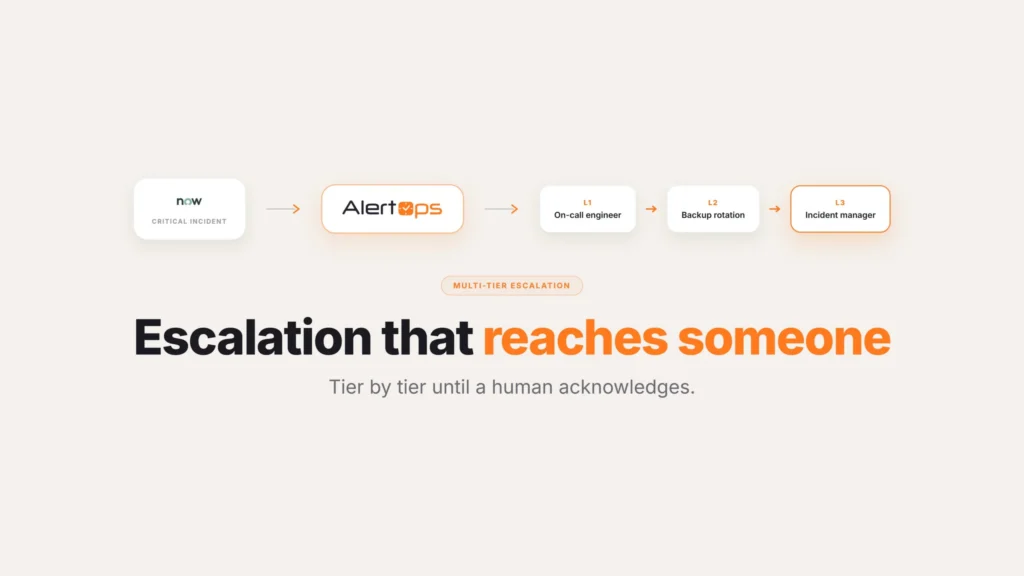
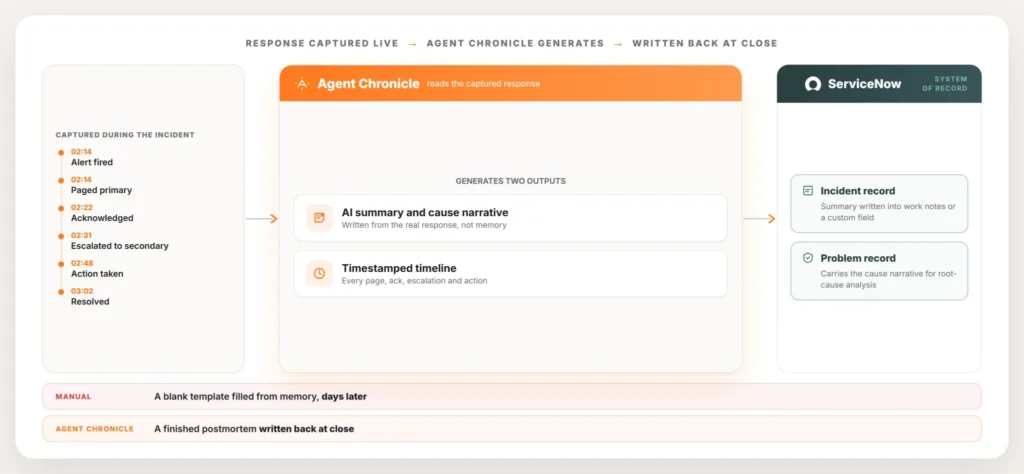
Here’s the part that changes the math. While the incident is happening, the response is being recorded in full. AlertOps captures every event as it occurs: the alert that fired, who got paged, when they acknowledged, where it escalated when the first responder didn’t pick up, the actions taken, and when it resolved. None of that is reconstructed later. It’s logged in real time, with timestamps, because that’s how the orchestration works in the first place.
That captured response is the postmortem in raw form. The timeline question that takes an hour to answer from memory, what happened and in what order, is already answered. The escalation path everyone argues about in the retro is on the record. The gap between the page and the acknowledgement, the thing that tells you whether the alert woke the right person, is a number, not a guess.
What’s missing from raw event data is shape. A list of timestamped events is accurate but unreadable, and no one is going to paste forty log lines into a Problem record and call it root cause analysis. The work that remains is turning the record into a narrative a human can read and a system can store.
What Agent Chronicle Generates
Agent Chronicle is the part of OpsIQ that turns the captured response into a postmortem. Its primary function is automated postmortem generation: it reads the full event history of an incident and produces the summary, the cause narrative, and the timeline, written in prose rather than left as raw logs. It captures what happened, how it was resolved, and what comes next, and that’s the shape of what it writes.
Two outputs matter most for ServiceNow. The first is the timestamped timeline, the ordered account of the incident from first alert to resolution, with the pages, acknowledgements, and escalations in place. The second is the summary and cause narrative, a readable account of what broke, how the team responded, and what resolved it, drawn from the actions actually recorded during the response rather than from someone’s recollection a week later.
Because the narrative is generated from the captured response, it carries the detail that memory drops. The order is right because it came from timestamps. The escalation is there because it was logged. The resolving action is named because it was the action the responder took, not the one they think they took.
Writing the Postmortem Back Into ServiceNow
The artifact only earns its keep if it lands where the record lives, and for most enterprises that’s ServiceNow. AlertOps writes the generated summary and cause narrative back into the ServiceNow incident through the two-way integration, as work notes or into a custom field the team defines. The finished postmortem attaches to the same incident that carried the response, so anyone who opens the ticket later reads what happened without leaving ServiceNow or hunting through a separate tool.
Teams that run a formal problem management process get the cause narrative where it belongs there too. When an incident graduates to a Problem record, the root cause analysis can be populated from the same generated narrative, so the Problem record carries the explanation instead of a pointer to a document that may not exist yet. The mechanics of pushing structured detail into the incident, Problem, and change tables are covered in writing back to ServiceNow Problem and Change records.
ServiceNow stays the system of record through all of this. AlertOps doesn’t move the postmortem out of ServiceNow or stand up a parallel home for it. The narrative is generated from the response AlertOps already captured and then written into the record ServiceNow already owns.
Manual vs. Generated Postmortems
| Written manually after the fact | Generated by Agent Chronicle | |
| When it gets written | Days later, once someone finds time | At close, from the response already captured |
| Source of the timeline | Memory and scattered chat logs | Timestamped events logged as they happened |
| Accuracy of the sequence | Reconstructed, prone to gaps | Exact, since it’s built from real timestamps |
| Where it lives | Often a separate doc or wiki page | Written directly into the ServiceNow incident and Problem record |
| Effort required from the team | A write-up someone has to sit down and produce | None. It’s a byproduct of the response that already happened |
The Audit Trail You Didn’t Have to Build
There’s a second document that comes out of this without anyone writing it. The timestamped timeline that feeds the postmortem is also an audit record, the defensible account of who was notified, when they acknowledged, how the incident escalated, and what was done. For regulated industries, that account isn’t a nice-to-have. It’s what an auditor asks for, and reconstructing it from memory after the fact is exactly the situation compliance teams dread.
Because the timeline is captured live and written back to ServiceNow, the audit trail and the postmortem are the same source of truth rather than two documents that disagree. The review the team reads and the record the auditor pulls come from the same timestamped events. How that trail is built and what it covers is its own subject, handled in the ServiceNow incident audit trail.
Conclusion
The postmortem problem was never really about writing skill or discipline. It was about asking people to reconstruct, from memory, something a system had already recorded in full. Once the response itself is the raw material, generating the write-up is a formatting problem, not a research project, and the document that used to get skipped becomes something that shows up automatically, already accurate, already in the place your team looks for it.
Book a demo at alertops.com/demo to see a generated postmortem written back into your own ServiceNow instance.
Frequently asked questions
Can AI auto-generate an incident postmortem and write it to ServiceNow?
Yes. AlertOps Agent Chronicle generates the postmortem from the response it already captured, the summary, cause narrative, and timestamped timeline, then writes the summary and cause narrative back into the ServiceNow incident through the two-way integration, as work notes or a custom field. ServiceNow stays the system of record and receives the finished artifact.
What does Agent Chronicle actually produce?
A timestamped timeline of every alert, page, acknowledgement, escalation, and action, plus a readable summary and cause narrative covering what happened, how it was resolved, and what comes next. It’s built from the recorded response rather than from memory after the fact.
Can the root cause analysis populate a ServiceNow Problem record?
Yes. When an incident graduates to a Problem record, the cause narrative Agent Chronicle generates can populate the root cause analysis there, so the Problem record carries the explanation instead of a placeholder. The same two-way integration that updates the incident handles the write-back to the Problem record.
Where does the postmortem content live, in AlertOps or ServiceNow?
In ServiceNow. AlertOps generates the postmortem from the captured response and writes the summary and cause narrative back into the ServiceNow incident and Problem record, so the finished artifact lives with the ticket the team already manages.
Does this help with audit and compliance?
Yes. The timestamped timeline that feeds the postmortem doubles as an audit record of who was notified, when they acknowledged, how the incident escalated, and what was done. Since it’s captured live and written back to ServiceNow, the postmortem and the audit trail come from the same source instead of two documents that could disagree.