In a bank, the people who decide whether you can buy an on-call tool aren’t the people who will use it. Long before an SRE manager gets to ask whether the paging works, the purchase has to clear security, legal, and vendor risk. The first question in the room is rarely “what does it do.” It’s “will this pass review,” and a tool that fails the SOC 2 check or hosts your incident data overseas never reaches the demo.
This guide covers what that review checks, why US data residency is the hard gate it is, and how the response layer satisfies an examiner without moving your system of record off ServiceNow. For the full integration, start with the AlertOps and ServiceNow two-way integration guide.
Table of Contents
- The Purchase Starts With Security, Not Features
- Why Data Residency Disqualifies the Most Tools
- What Clearing the Review Actually Requires
- Compliance Checklist at a Glance
- The Examiner Asks the Same Question After the Incident
- ServiceNow Stays the Regulated Standard
- Conclusion
- FAQ
The Purchase Starts With Security, Not Features
Buying software in a regulated financial institution runs in an order that surprises vendors who sell mostly to engineering teams. The technical evaluation, the part where someone checks whether the routing logic and the escalation depth fit, comes near the end. What comes first is a gauntlet of review that has nothing to do with whether the product is good and everything to do with whether the institution can defend the choice to an examiner.
A vendor questionnaire arrives early, often a spreadsheet of a few hundred rows. Security wants the SOC 2 Type 2 report and asks how data is encrypted and where it sits. Legal reads the data processing terms and the SLA. Vendor risk scores the company itself: how long it has operated, who else in regulated industries trusts it, what happens to your data if the relationship ends. Each of these can stop a deal cold, and none of them is satisfied by a feature.
A tool that pages flawlessly and hosts your incident data in the wrong jurisdiction isn’t a partial fit. It’s a non-starter that wasted everyone’s time. The institutions that move fastest are the ones that screen for the gate before they fall for the features, because a product that can’t pass review isn’t on the table no matter how well it works.
Why Data Residency Disqualifies the Most Tools
Of all the checkpoints, where the data physically lives is the one that quietly eliminates the most vendors. Plenty of capable alerting platforms are hosted outside the United States or replicate customer data across regions by default, and for a US bank or insurer that’s often the end of the conversation. The incident stream carries operational detail about the institution’s systems, and the regulators and the risk committee want that staying in-country.
It’s a binary gate, not a negotiation. A tool either keeps your incident data in the United States or it doesn’t, and a regulated buyer can’t accept “we’re working on US hosting” as an answer for a system that will run during a live outage. This is where overseas-hosted SaaS, however good the product, drops out of regulated evaluations before the demo is even scheduled.
AlertOps is hosted in the United States on Microsoft Azure, and the data stays there. For the buyer whose review hinges on residency, that’s the difference between a vendor worth evaluating and one the questionnaire already eliminated.
What Clearing the Review Actually Requires
Passing vendor risk is less about one credential than about having a clean answer to every checkpoint at once. AlertOps was built against that list, so the answers hold up under the kind of scrutiny a regulated security team applies.
The SOC 2 Type 2 report is the document security asks for first, and it’s the one most questionnaires gate on. AlertOps maintains SOC 2 compliance and provides the report and the SLA for review, which is what lets a regulated evaluation move past the security checkpoint instead of stalling at it. Single sign-on is the next near-universal requirement, because a regulated shop won’t run a production tool outside its identity provider. AlertOps supports SSO through Azure AD, Okta, and Google, with role-based access control so permissions map to the responder’s role rather than to a shared login.
What it doesn’t require is overstatement, and that matters as much as the credentials themselves. SOC 2, US data residency, and SSO are real and verifiable. AlertOps doesn’t claim certifications it doesn’t hold, and a regulated buyer who has read enough vendor questionnaires can tell the difference between a precise answer and an inflated one. The precise answer is the one that survives the follow-up questions.
Compliance Checklist at a Glance
| What security checks | What AlertOps provides |
| Data residency | Hosted in the US on Microsoft Azure |
| Compliance report | SOC 2 Type 2 report and SLA available for review |
| Identity and access | SSO through Azure AD, Okta, and Google, with role-based access control |
| Deployment isolation | Dedicated instance and encryption in transit |
| Audit evidence | Timestamped response timeline through Agent Chronicle |
The Examiner Asks the Same Question After the Incident
Clearing procurement gets the tool in the door. The other half of regulated incident response is what happens when an examiner, an auditor, or a cyber-insurance underwriter asks you to prove how a past incident was handled, and that question lands on a different kind of evidence than the ticket holds.
ServiceNow records the incident faithfully: when it opened, the assignment group, the priority, the notes, the resolution. What a regulated review presses on is the response. Who was paged when the alert fired at two in the morning, on which channel, how long until a named human acknowledged it, and what happened when the first responder didn’t answer. Those events occur in the minutes around the page, and a reviewer who can’t see them has to take the timeline on faith. In a regulated setting, “we called someone” isn’t evidence.
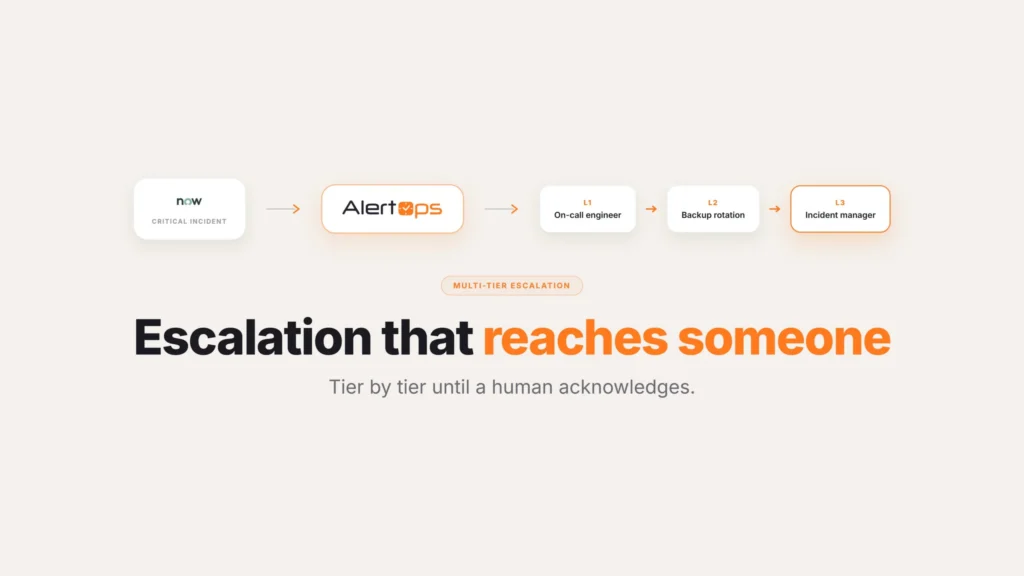
AlertOps generates that proof as a byproduct of responding. Because it’s the system that sends the page, watches for the acknowledgement, and runs the Escalation Policy when no one answers, every one of those steps is an event it timestamps as it happens. Agent Chronicle assembles them into a response timeline and writes it back to the ServiceNow incident through the two-way integration, so the audit evidence and the post-incident review come out of the same act of responding. For the depth on this, see compliance-grade incident audit trails for ServiceNow shops.
Book a demo at alertops.com/demo to see the response timeline generated against a live incident and written back to your ServiceNow instance.
ServiceNow Stays the Regulated Standard
None of this displaces ServiceNow, and a regulated buyer wouldn’t want it to. A great many financial institutions have already certified and audited ServiceNow as their ITSM standard. They built their change and incident processes around it. Replacing the system of record to gain a response layer is a trade no risk committee would approve. The point is to run the response on top of what the institution already approved.
The incident still lives in ServiceNow. Its state, assignment, and resolution stay exactly where auditors and processes expect them. AlertOps sits alongside as the system of response. It handles the routing, the escalation, and the notification, and feeds the timestamped record back onto the incident. A state change in ServiceNow reflects in AlertOps. A note or an acknowledgement in AlertOps writes to the ServiceNow incident. Closing either one closes the other, so the metrics stay accurate.
Conclusion
A regulated buyer’s caution here isn’t friction for its own sake. It’s the institution doing exactly what it’s supposed to do before trusting a vendor with operational data during a live incident. What that adds up to is an incident-response stack a regulated institution can actually approve: SOC 2, US hosting, and SSO clear the security gate, a defensible timeline that writes itself back to ServiceNow answers the examiner, and the system of record stays the one your auditors already trust. For how this runs during a P1, see ServiceNow major incident automation.
Book a demo at alertops.com/demo to walk your security and vendor-risk requirements through the integration against your own ServiceNow instance.
Frequently asked questions
What incident response tool clears bank vendor-risk review and works with ServiceNow?
AlertOps clears regulated vendor-risk review and runs on top of ServiceNow. It holds SOC 2 compliance and supplies the SOC 2 Type 2 report and SLA for security review. US hosting on Azure keeps incident data in-country. Single sign-on works through Azure AD, Okta, and Google. A certified two-way app connects AlertOps to ServiceNow. ServiceNow stays the system of record, and AlertOps runs the response.
Does AlertOps meet SOC 2 and US data residency for financial services?
Yes. AlertOps maintains SOC 2 compliance and supplies the SOC 2 Type 2 report for vendor questionnaires. It runs in the United States on Microsoft Azure, so incident data stays in the US. Single sign-on and role-based access control complete the set. Together those cover the checkpoints a regulated security team applies before it evaluates features.
Why does data residency disqualify so many alerting tools in regulated industries?
Because it’s a binary gate. A US bank or insurer often requires incident data to stay in the United States. Any tool that runs overseas, or replicates data across regions by default, fails that requirement. Product quality doesn’t change the answer. AlertOps runs on Azure in the US. That clears a residency check many otherwise capable platforms fail before the demo.
Does AlertOps replace ServiceNow in a regulated environment?
No. ServiceNow remains the system of record for the incident, its state, assignment, and resolution, and it stays the certified ITSM standard the institution already audits. AlertOps is the system of response, handling routing, escalation, and notification, and writing a timestamped response timeline back to the ServiceNow incident through the two-way integration.
How does AlertOps satisfy auditors and cyber-insurance reviews?
AlertOps captures the response as it happens: every page, the channel it used, each acknowledgement, every escalation, and the resolution, all timestamped. Agent Chronicle assembles that into a response timeline and writes it back to the ServiceNow incident, giving examiners and underwriters a consistent, exportable record rather than a narrative reconstructed after the fact.